Fine Dining, Timeless Canals, and an Afternoon Aboard the Historic Henry Schmitz
Story and Photography by Terry Check
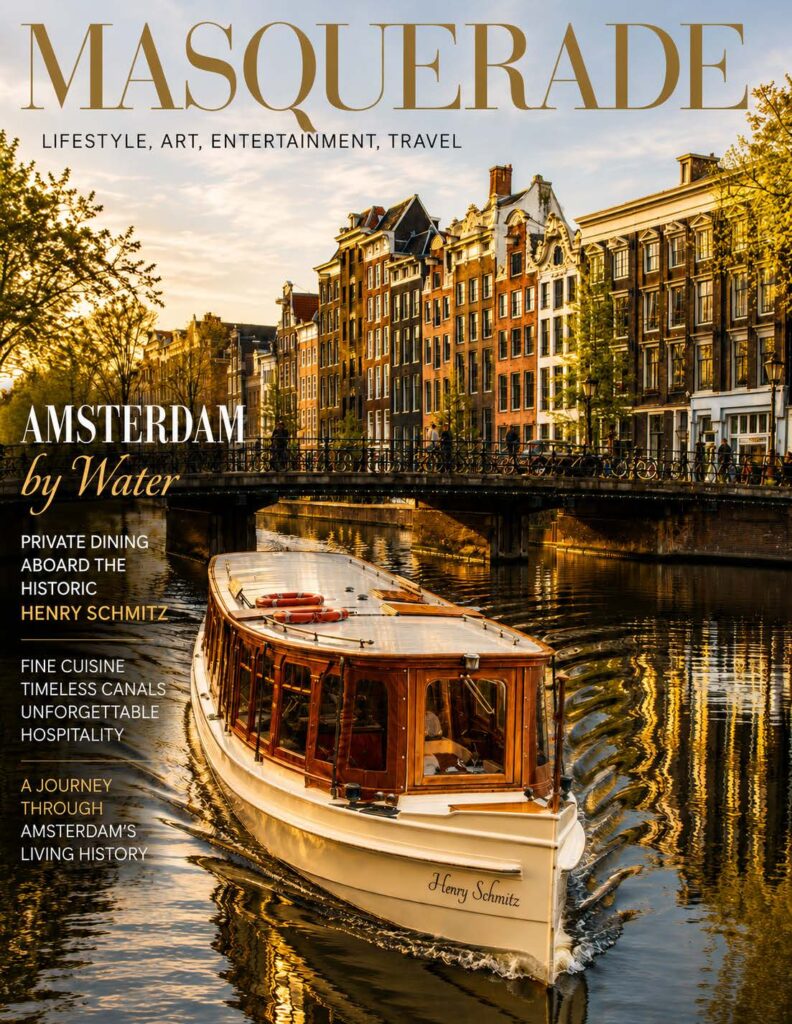
The Henry Schmitz slipped away from the quay with barely a disturbance, her polished mahogany salon glowing in the afternoon light. Beyond the windows, Amsterdam began to move—not with the hurried rhythm of bicycles, trams, and crowded sidewalks, but at the unhurried pace of the water.
A low stone bridge approached. Our captain eased the historic salon boat toward its narrow arch as naturally as though following a path he had traveled all his life. Reflections from the canal shimmered across the wood-paneled interior, moving like liquid gold above the dining tables.
Conversation softened. Cameras lowered.
For a few moments, everyone simply watched the city drift past.
Amsterdam is often introduced through its celebrated museums, merchant houses, flower markets, and café-lined streets. Yet from the water, the city reveals another personality—more intimate, more graceful, and wonderfully removed from the crowds.
Perhaps this was how Amsterdam had always intended to be experienced: slowly, comfortably, and one canal at a time.
A Salon Boat with a Story
The Henry Schmitz does not resemble an ordinary sightseeing vessel. Her long white hull, beautifully restored wooden superstructure, brass fittings, and generous windows recall an era when canal travel was as elegant as it was practical.
Seen from across the water, she appears almost inseparable from Amsterdam itself. Her mahogany panels reflect the narrow façades rising behind her, while the canal doubles the entire scene in wavering shades of brown, cream, and gold.
Stepping aboard feels less like joining an excursion and more like entering a private floating salon.
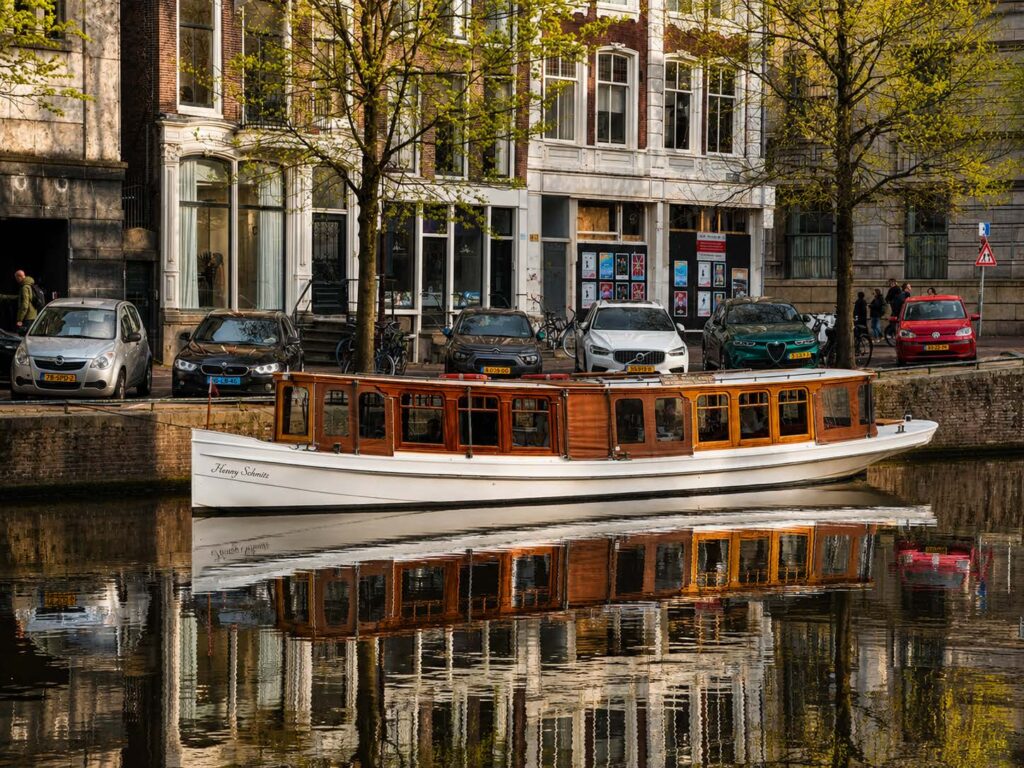
The Henry Schmitz rests along an Amsterdam canal, mirrored in the still water.
Inside, polished timber surrounds a traditional bar lined with bottles and glassware. Wine glasses hang overhead in orderly rows. Red curtains frame passing views of arched bridges, bicycles, waterside terraces, and leaning canal houses. The atmosphere is refined but never formal—a comfortable setting designed for conversation, dining, and quiet observation.
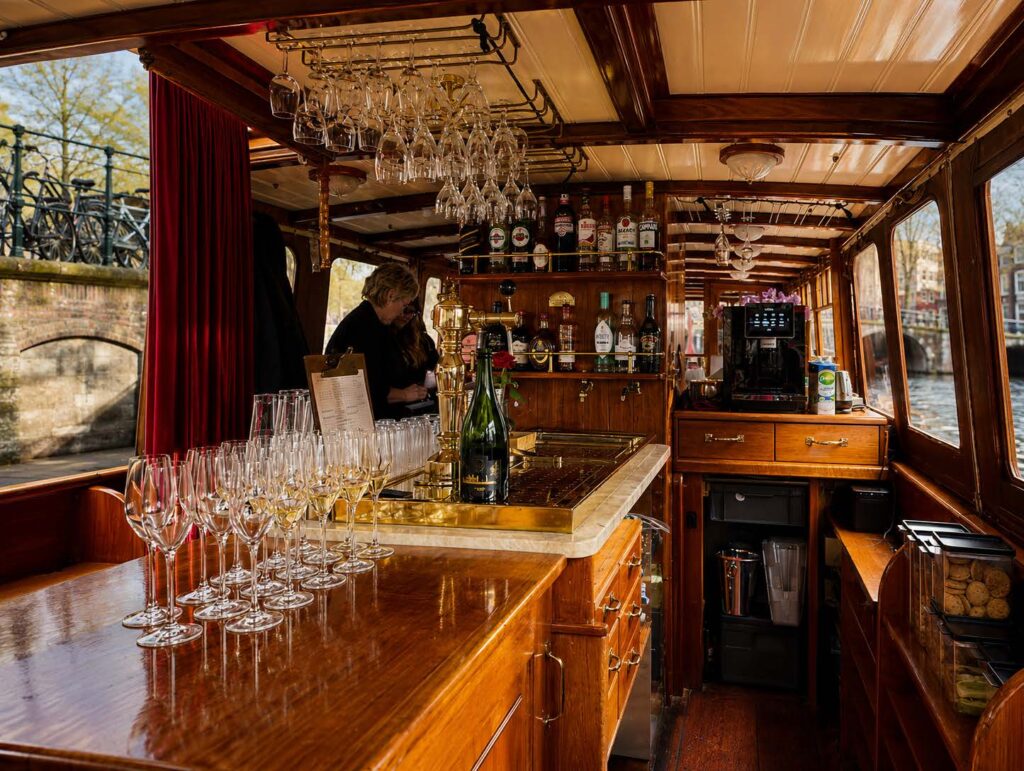
Polished mahogany, brass fittings, and waiting wine glasses create the atmosphere of a private floating salon.
At the helm, the captain seemed entirely at home among the brass instruments, curved windows, and varnished woodwork. His navy jacket, striped cuffs, and gold buttons belonged naturally to the setting.
He was not merely steering the boat. He was introducing us to his Amsterdam.
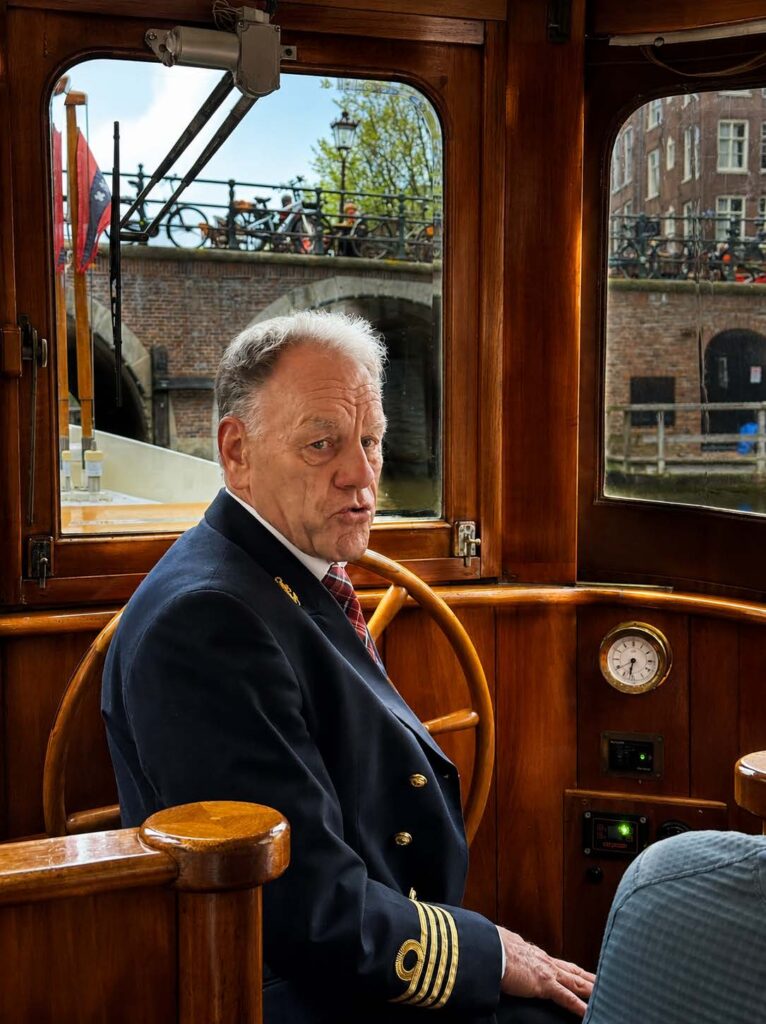
The captain at the helm of the historic salon boat.
The City Unfolds
Amsterdam does not reveal itself in grand, theatrical gestures. It unfolds gradually.
One turn brought us alongside a lively canal café, its red umbrellas reflected in the rippling water. Diners leaned toward one another in animated conversation while bicycles waited along the railings and narrow brick houses rose behind them.
A few minutes later, the scene changed completely.
We entered a quieter canal where the façades stood almost motionless above their reflections. Windows offered glimpses of everyday life. Trees softened the stone embankments. Small boats rested against the walls as naturally as automobiles parked along a neighborhood street.
That constant change is one of Amsterdam’s pleasures. Every bend offers another composition.
A church tower appears above a row of rooftops.
A cyclist pauses on an iron bridge.
A family gathers beside a houseboat.
A waterside terrace fills with friends enjoying the last hours of afternoon.
The canals are not simply historic features preserved for visitors. They remain living streets—routes through which residents travel, socialize, dine, and experience their city.
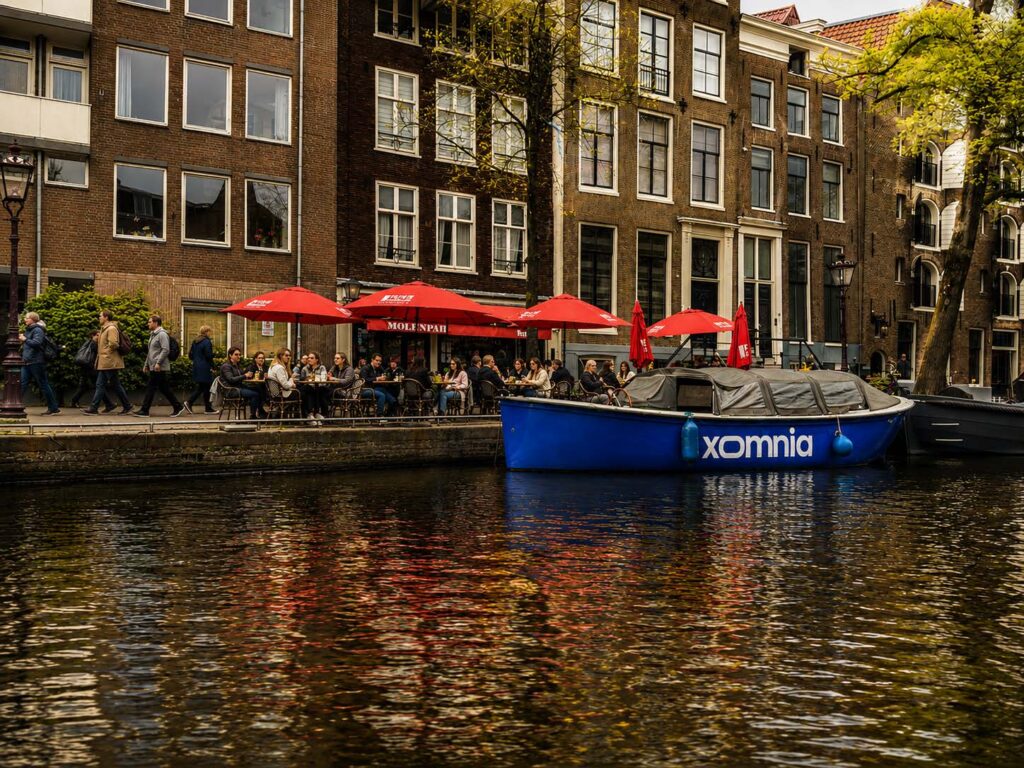
Canal-side cafés, bicycles, and waterfront reflections reveal Amsterdam as a living city.
At one point, we passed the Montelbaanstoren, its distinctive tower rising above the canal beneath a brilliant blue sky. From the water, the landmark seemed to belong not to a distant historical period, but to the active city surrounding it—boats below, homes beside it, and daily life continuing in its shadow.
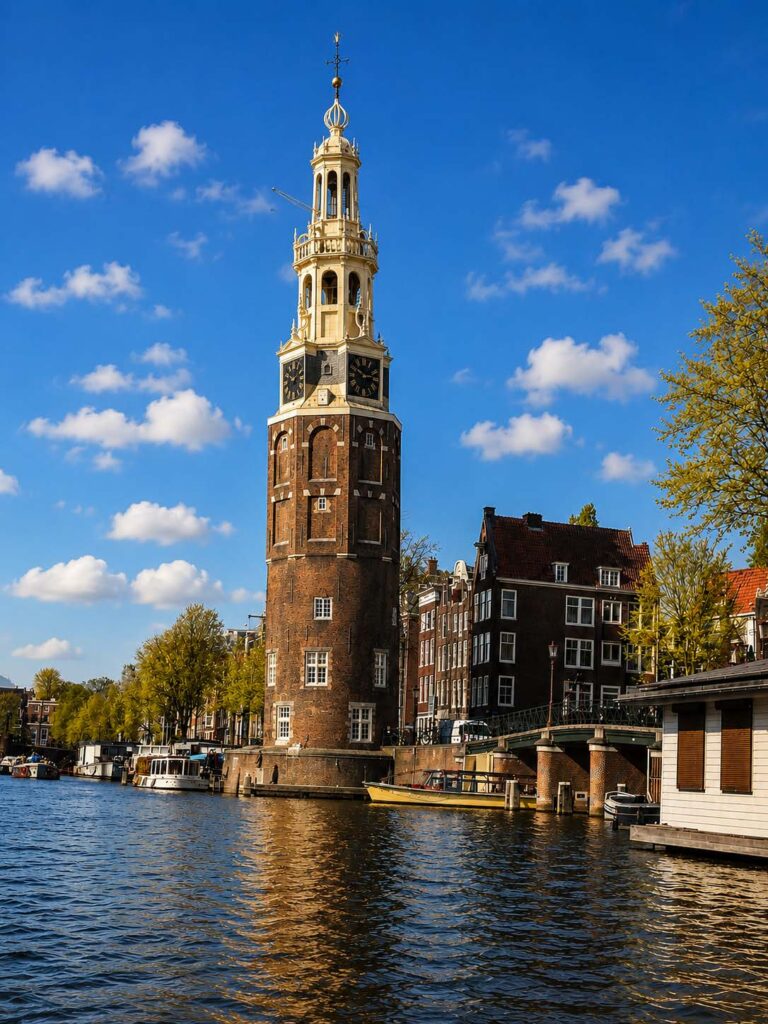
The Montelbaanstoren rises above the water and surrounding canal houses.
Dinner Comes Aboard
The dining experience aboard the Henry Schmitz was unlike anything we had encountered on a conventional cruise.
Rather than preparing every course in a galley hidden below deck, the boat coordinated with a canal-side restaurant. At the appointed moment, the captain brought the vessel alongside the quay. A member of the crew stepped ashore, and shortly afterward our maître d’ appeared from a street-level kitchen carrying the freshly plated dinners.
Dressed in a dark suit and red tartan tie, he emerged smiling, balancing the meals with the practiced confidence of someone who had completed this unusual ritual many times before.
The scene captured the essence of the afternoon: a beautifully orchestrated collaboration between boat, restaurant, captain, and crew.
There were no rushed deliveries or impersonal catering containers. Dinner traveled only a few steps—from the restaurant kitchen, across the quay, and into the waiting salon.
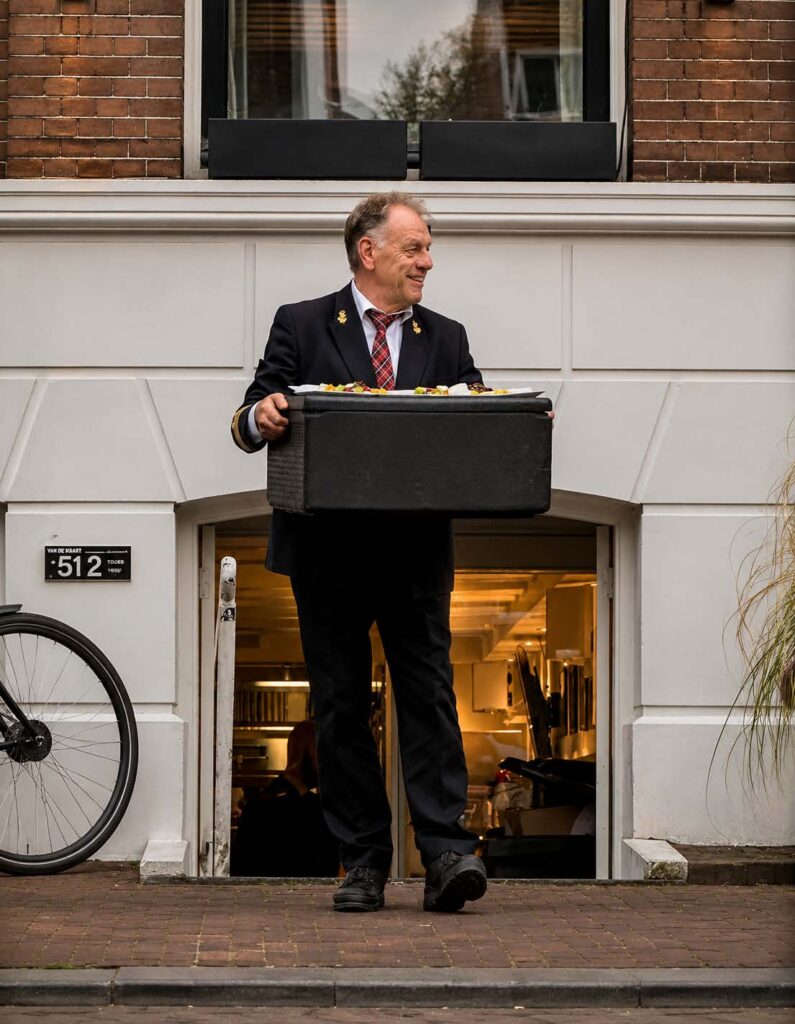
The Captain d’ carries freshly plated dinners from the canal-side kitchen to the waiting Henry Schmitz.
Before service, several dishes rested beside the gleaming brass bar. Bowls of chicken, vegetables, noodles, mushrooms, herbs, and carefully composed accompaniments created a tempting preview of the meal to come.
The cuisine appeared generous and approachable, yet every plate showed thoughtful attention to color, texture, and presentation.
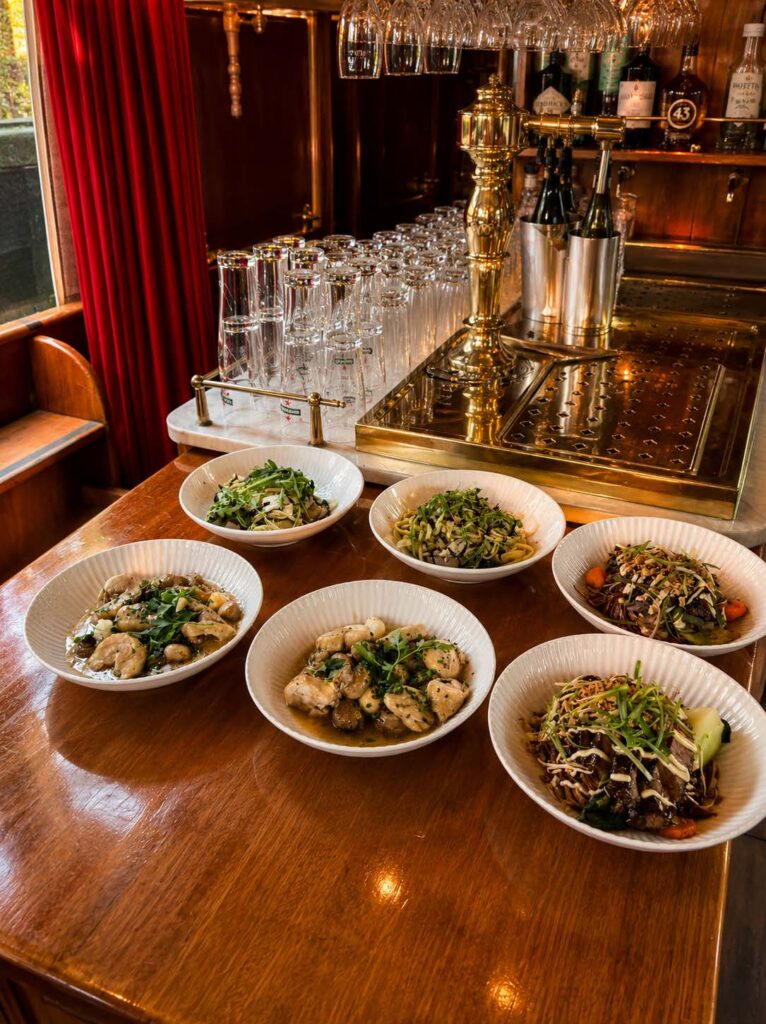
Freshly prepared courses await service beside the gleaming onboard bar.
Soon, white linen covered the dining tables. Wine was poured. The warm wooden interior framed each place setting, while Amsterdam continued passing beyond the windows.
Our entrée arrived in a broad white bowl: tender chicken and mushrooms in a delicate savory sauce, finished with fresh herbs and seasonal vegetables. Across the table, another beautifully presented course combined seafood, greens, tomatoes, and carefully layered accompaniments.
Red and white wines caught the window light.
The simplicity of the setting made the meal feel even more refined. There was no need for elaborate decoration. The canal, the historic boat, the linen, the wine, and the city provided all the theater required.
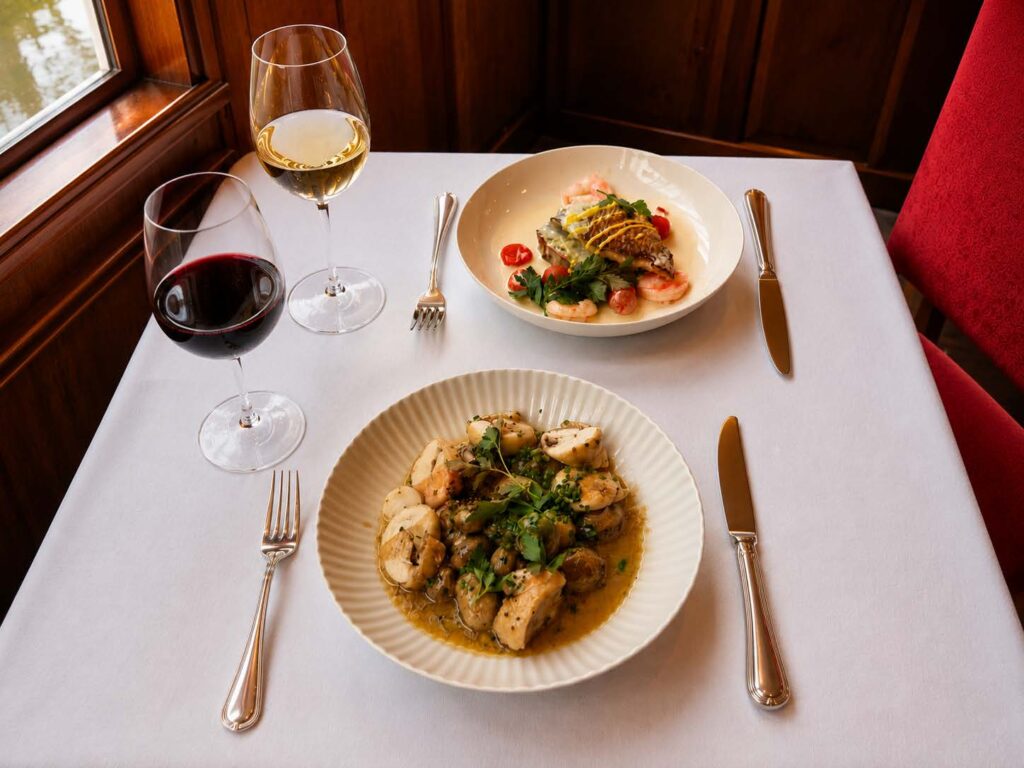
Dinner served on white linen as Amsterdam passes beyond the salon windows.
Each course became part of the journey rather than an interruption to it. We could look down at a beautifully prepared plate, then glance through the window to find another bridge, another canal house, or another fragment of Amsterdam waiting outside.
Fine dining rarely depends on food alone. It is created by the convergence of cuisine, service, atmosphere, timing, and place.
Aboard the Henry Schmitz, all five moved together.
Hospitality Without Hurry
Luxury is often measured through marble lobbies, spacious suites, or formal service rituals. Yet the most memorable luxury is frequently quieter.
It is the captain remembering a guest’s name.
It is a glass refilled before anyone needs to ask.
It is the absence of hurry.
No one aboard appeared to be working from a rigid script. The hospitality felt natural because it reflected genuine pride—in the boat, in the cuisine, and most of all in Amsterdam.
Our captain occasionally slowed to point out a view that might otherwise have passed unnoticed. He seemed less interested in reciting a memorized list of landmarks than in sharing the details he personally loved.
“There,” he would say, directing our attention toward a small waterway disappearing between historic homes.
It was often those less-famous views that remained with us.
The grand landmarks gave the journey structure. The quiet moments gave it meaning.
Amsterdam in Motion
We continued through neighborhoods where canal life unfolded around us.
A brightly decorated sightseeing boat rested beside a busy quay as passengers waited beneath an expansive spring sky. Nearby, residents sat along the embankment, bicycles clustered behind them, and trees cast their early leaves across the façades.
The image was energetic and unmistakably Amsterdam: tourism and daily life occupying the same narrow strip of water without either overwhelming the other.
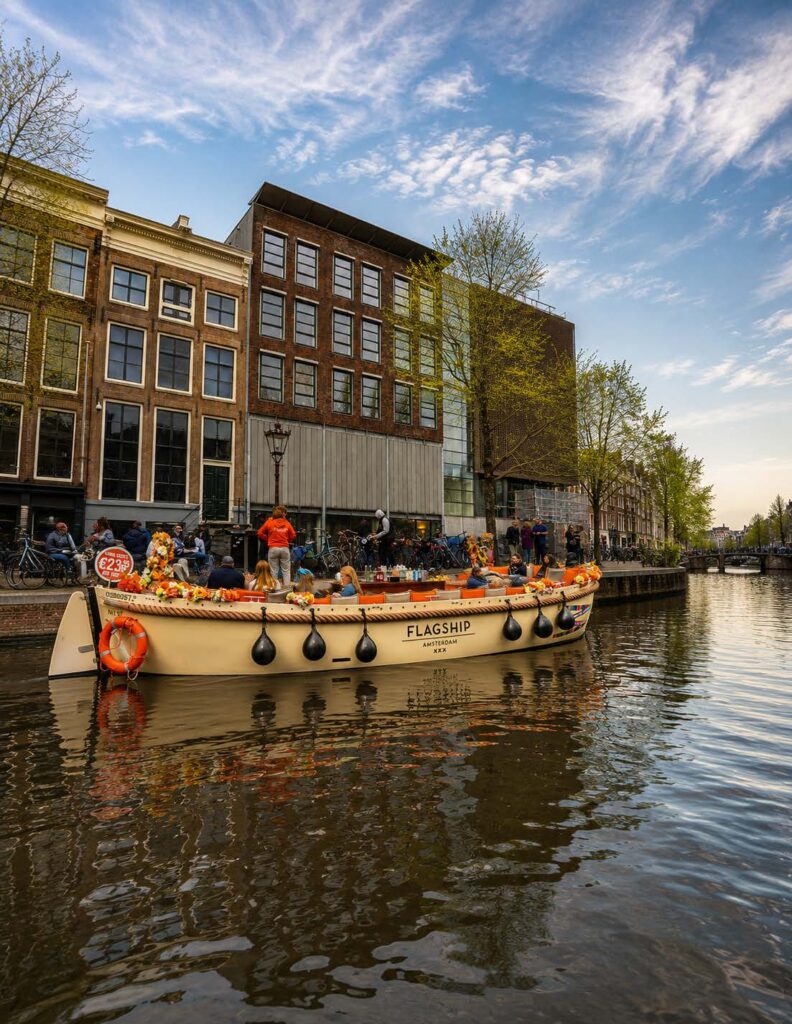
Tour boats, residents, bicycles, and spring light share the same narrow canal-side world.
Elsewhere, small boats moved between historic buildings. Café terraces filled as the day softened. Reflections of awnings, lamps, and windows stretched across the water and dissolved with every passing wake.
From street level, Amsterdam can feel busy. From the salon of the Henry Schmitz, its energy became a moving panorama—lively, layered, and never quite repeated.
Toward Evening
As afternoon gave way to evening, the light began to change.
The blue sky softened. Long shadows reached across the façades. Windows turned amber. The canals, which had reflected brick and spring foliage earlier in the day, began to gather the colors of illuminated bridges and streetlamps.
Ahead, a drawbridge stood open against the dusk, its raised sections outlined with warm lights. Boats waited beneath it while the surrounding water reflected gold, red, and blue.
The engineering of the bridge was practical, but in the evening light it became almost ceremonial—a gateway between daytime Amsterdam and the city after dark.
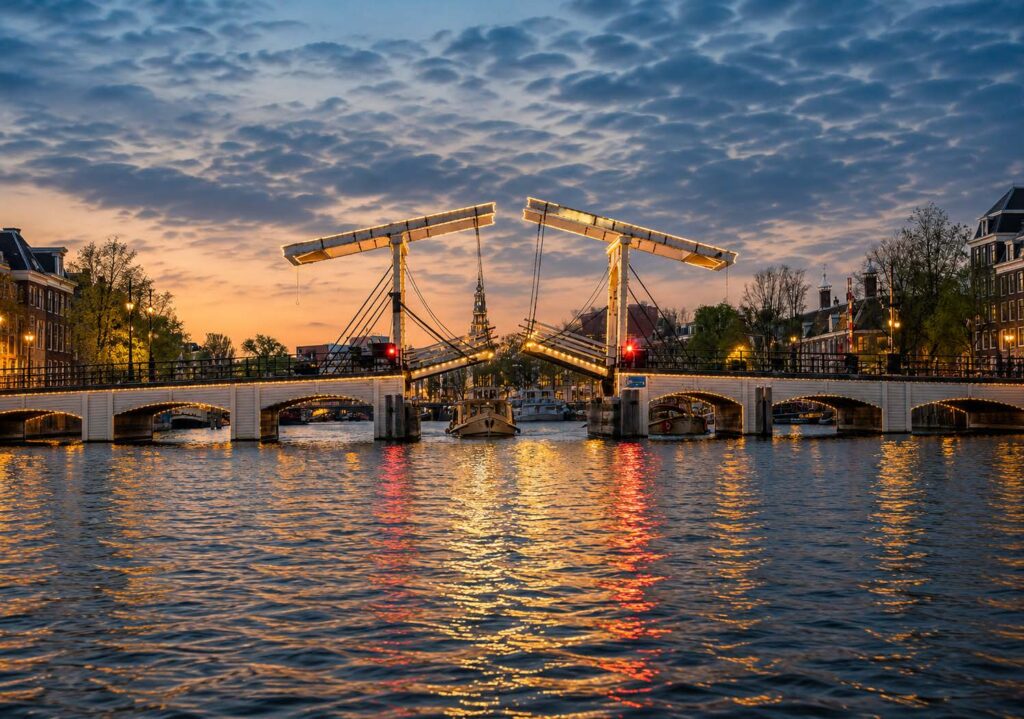
An illuminated drawbridge opens against the blue hour.
Photographers often speak of the golden hour, but Amsterdam offers something beyond it. There is a brief period when the daylight has nearly disappeared, the lamps have begun to glow, and the water holds both at once.
The city seems suspended between two worlds.
We passed through that transition slowly, the salon growing warmer as the exterior light deepened.
Conversation became easier. Guests who had boarded as strangers exchanged stories, recommendations, and plans for future journeys. Business cards appeared. Email addresses were shared. Laughter moved freely around the table.
Travel has always had the power to create temporary communities. A shared meal and a beautiful setting can accomplish in several hours what ordinary life might take weeks to achieve.
The City at Sunset
Near the end of our journey, Amsterdam offered one final spectacle.
Across the water, the skyline appeared in silhouette beneath a sky burning with orange, scarlet, and crimson. The dome and towers of the Basilica of Saint Nicholas rose above the darkened rooftops. To the right, the illuminated tiers of the floating Sea Palace restaurant glowed against the deepening evening.
The sunset spread across the canal until the entire surface seemed aflame.
It was not a quiet, pastel ending. It was dramatic—one last burst of color before night descended.
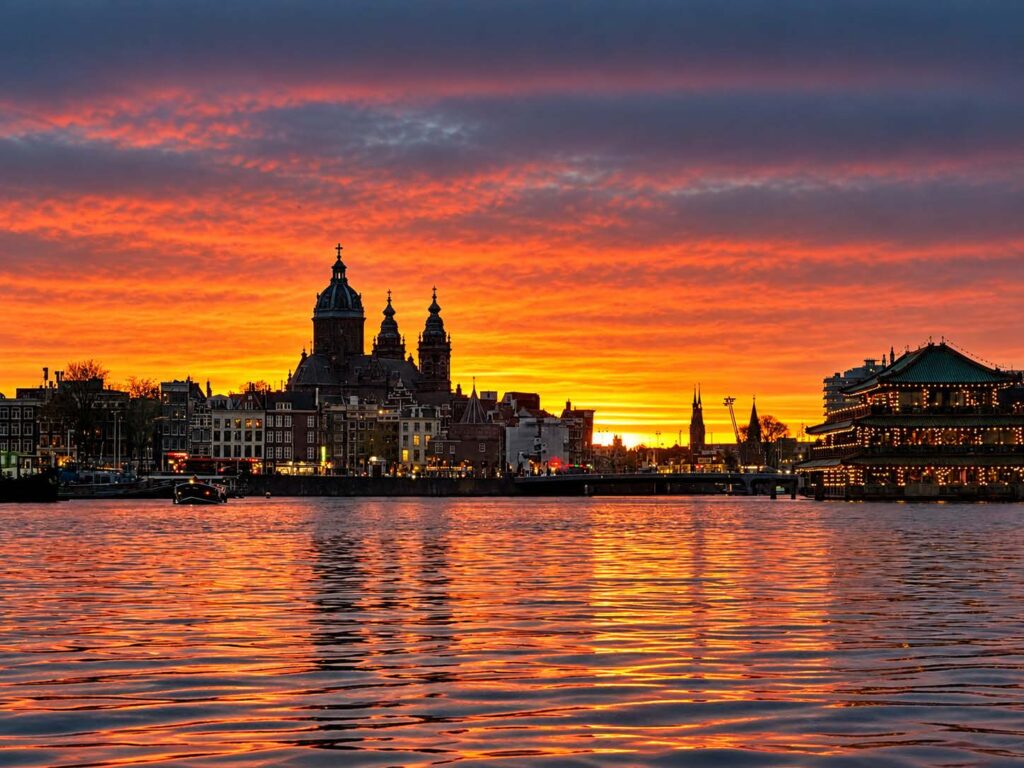
Amsterdam’s skyline burns beneath a dramatic sunset across the water.
For several minutes, no one spoke.
Some scenes seem to ask for silence.
Returning to the Quay
Eventually, familiar landmarks signaled our return. The captain guided the Henry Schmitz toward her berth with the same unhurried confidence that had marked our departure.
Lines were secured.
The engine fell silent.
Yet no one seemed eager to leave.
Guests gathered their belongings slowly, lingering for another glance at the mahogany interior, the brass bar, and the evening canal beyond the windows. We thanked the captain and crew for transforming what might have been an ordinary canal cruise into something deeply personal.
As Jacque and I stepped back onto the quay, we turned for one final look.
The Henry Schmitz rested quietly against the canal wall, her windows glowing softly. She appeared as elegant as she had when we first arrived, but the boat now seemed to carry something more than guests and dinner service.
She carried our memories.
More Than a Canal Cruise
People often ask what makes a destination unforgettable.
It is rarely a single monument.
Amsterdam’s museums are extraordinary. Its architecture is remarkable. Its history can fill a lifetime of study. Yet our strongest memory of the city may always be an afternoon aboard a restored salon boat, moving quietly through canals built centuries ago while dinner arrived one course at a time from neighborhood kitchens.
The experience brought together everything we value in travel:
A welcoming captain.
Thoughtful service.
Beautifully prepared cuisine.
Unexpected views.
Conversations shared around a table.
Golden light reflected on water.
These are the details that remain long after tickets have been discarded and luggage returned to the closet.
Time Well Spent
At Masquerade Magazine, we have been fortunate to explore remarkable places around the world. Each destination offers a different lesson.
Amsterdam reminded us that the finest travel experiences rarely demand attention. They reveal themselves gradually to those willing to slow down.
The Henry Schmitz carried us through the city’s historic canals, but she also carried us beyond the familiar image of Amsterdam. Through her windows, we discovered a living city—one shaped by water, illuminated by history, and sustained by the people who continue to call its canals home.
The afternoon was not measured by the number of bridges crossed or landmarks photographed.
It was measured in moments:
A captain pointing toward a hidden canal.
A captain d’ emerging from a kitchen with dinner in his hands.
Wine poured beside polished mahogany.
New friendships forming around a table.
A drawbridge opening at twilight.
A sunset turning the city to fire.
Sometimes the finest way to discover a place is simply to let the water carry you through it.
For Jacque and me, the journey aboard the Henry Schmitz was more than an elegant afternoon in Amsterdam.
It was a reminder that the world’s greatest journeys are not always measured in miles.
They are measured in moments.
And this was, without question, time well spent.
