What one secondhand bookshelf revealed about photography, reinvention, and the books that remained
Story by Terry Check
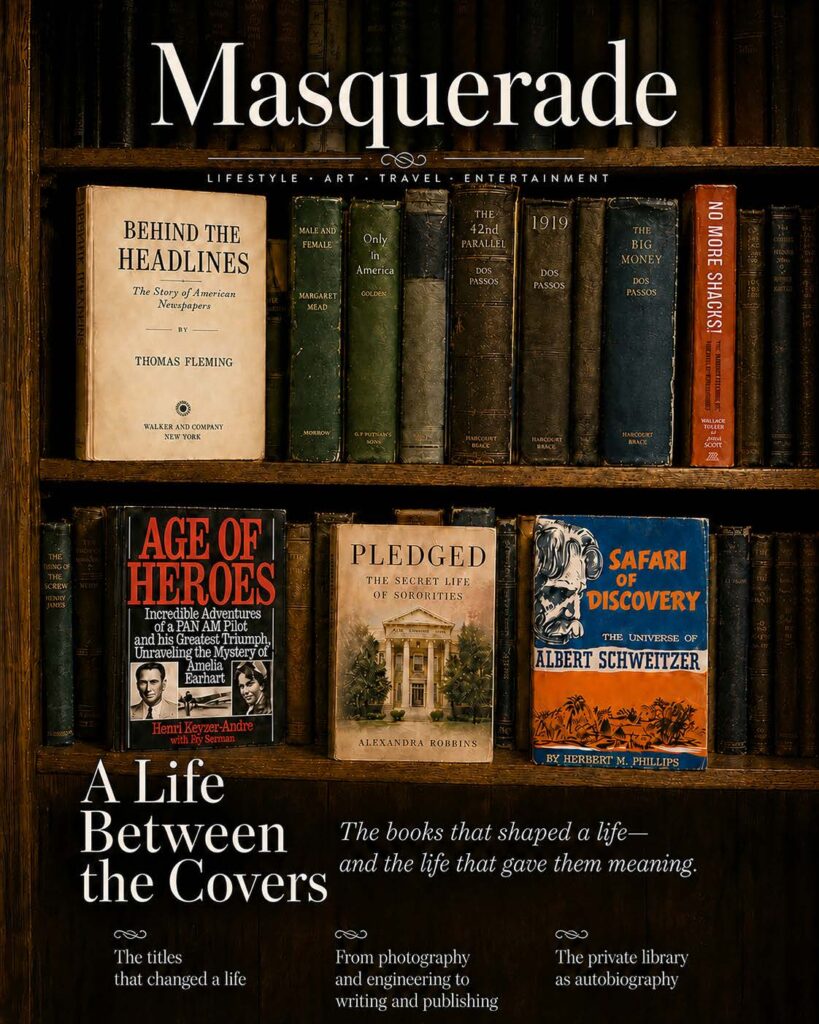
Since high school, I have been fascinated by photography. I bought my first camera—a 35mm film camera—and began teaching myself how to see through a lens. Years later, in college, I casually photographed almost anything that seemed unusual or out of place. I was drawn to overlooked details, unexpected arrangements, and moments at the edge of a scene that others might pass without noticing.
One day, in a secondhand bookstore, I photographed a crowded wooden bookshelf. At first, I was interested in its visual composition: faded jackets, worn bindings, uneven rows, and titles pressed together without any obvious order. Then I began wondering which of those books might hold my attention.
I looked more closely.
Several titles drew me in. They opened doors into journalism, aviation, social behavior, anthropology, American history, humanitarian service, and the lives of people who acted on their convictions. I read some of them, and years later, they remain interesting and enriching—not simply because of what they contain, but because of what they reveal about the person who chose them.
The photograph captured more than a shelf of used books. It recorded a moment of recognition. What first appeared to be an ordinary bookstore display became an invitation to explore.
A bookshelf is never merely a place where books are stored. Over time, it becomes a form of autobiography—written not in chapters, but in cracked bindings, penciled notes, faded covers, and titles that survive every move and every reinvention. Some promised adventure. Others offered history, culture, journalism, psychology, or a glimpse into lives far removed from my own. Together, they created an education that extended beyond classrooms, degrees, and professional credentials.
Looking across the shelf, four books stand forward like markers along a long journey: Behind the Headlines, Age of Heroes, Pledged, and Safari of Discovery. They are very different books, yet together they reveal the subjects that have repeatedly drawn me in: storytelling, adventure, hidden social worlds, human character, and the moral force of people who transformed conviction into action.
They also help explain how someone trained as an environmental engineer, who spent decades building a business, could later reinvent himself as a writer, photographer, and publisher.
The shelf may appear miscellaneous.
The life behind it is not.
Behind the Headlines: Learning to See the Story
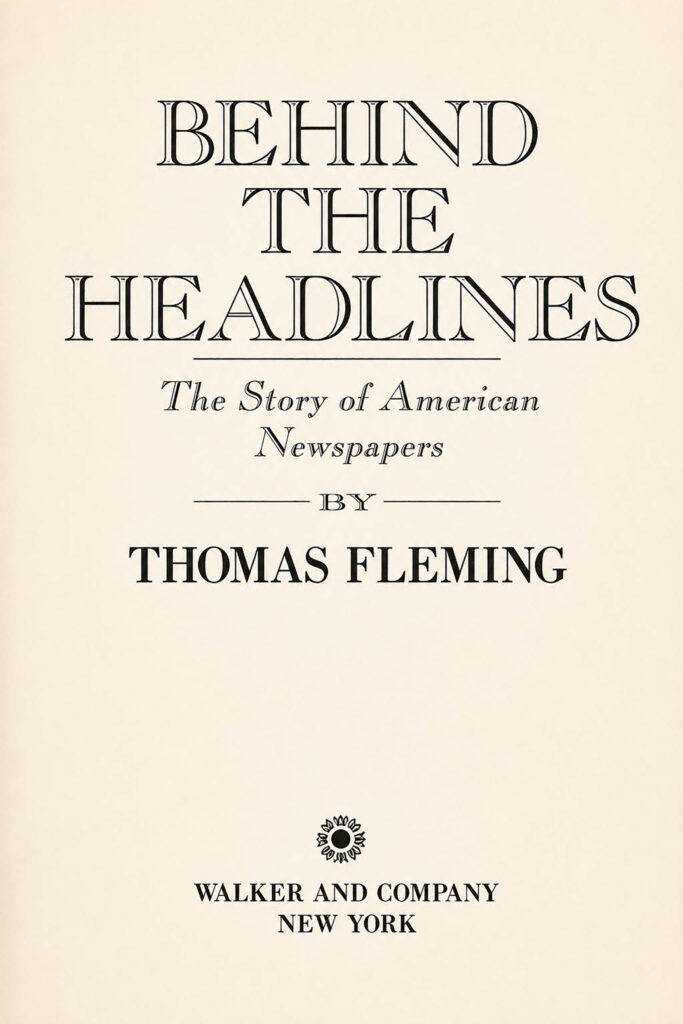
Behind the Headlines: The Story of American Newspapers by Thomas Fleming
Thomas J. Fleming’s Behind the Headlines: The Story of American Newspapers occupies a natural place at the beginning because newspapers helped shape how generations understood the world.
Before information arrived continuously on screens, the newspaper carried the weight of public memory. It recorded elections, wars, scandals, crimes, discoveries, triumphs, and the daily rituals of ordinary life. The front page announced what a community was expected to care about. The editorial page attempted to explain why it mattered.
Behind every headline, however, stood a series of decisions: what to report, what to omit, where to place a story, whom to quote, and how to frame events for the reader. Newspapers were never simply containers of information. They were living institutions shaped by publishers, editors, reporters, deadlines, competition, judgment, and the temper of their time.
That world holds special meaning for me now.
Masquerade Magazine did not grow out of a conventional publishing career. It came later in life, after engineering, business, family, travel, and more than one reinvention. It began with photography, persistence, and the belief that an interesting story was worth pursuing even when no one had officially invited me to tell it.
The subjects of Masquerade—fashion, art, entertainment, travel, motoring, and lifestyle—may differ from the city desks and political columns of traditional newspapers, but the central responsibility remains similar: recognize the story, find its human meaning, and present it in a way that makes the reader care.
Looking at Behind the Headlines now, I see more than a history of newspapers. I see the machinery of storytelling itself—the transformation of events into narrative and experience into record.
I also see a connection to that first 35mm camera.
Photography taught me to notice what others might overlook: an expression behind a prepared answer, a gesture that reveals character, an object at the edge of the frame, or an unguarded moment that says more than the official version of events. Long before I thought of myself as a writer or publisher, the camera was teaching me one of journalism’s most important lessons.
The story is often not where everyone is looking.
You look closely. You ask questions. You decide what is worth remembering.
Age of Heroes: The Courage to Depart

Age of Heroes by Henri Keyzer-Andre with Hy Steirman
If journalism helps explain the world, adventure enlarges it.
Age of Heroes: The Incredible Adventures of a Pan Am Pilot and His Greatest Triumph—Earhart, by Henri Keyzer-Andre with Hy Steirman, belongs to an era when aviation existed partly in science and partly in legend.
Early pilots crossed oceans without the sophisticated navigation systems, satellite communications, and weather forecasting that modern travelers take for granted. The airplane was not simply transportation. It represented discovery, international ambition, personal courage, and, at times, extraordinary risk.
Pan American World Airways came to symbolize a glamorous vision of travel. Its aircraft connected cities, islands, cultures, and continents that had once seemed impossibly distant. The Pan Am pilot became a figure of romance and authority—part technician, part navigator, part adventurer.
The name Amelia Earhart deepens that mythology. Her story endures not only because of her disappearance, but because she represented the possibility of moving beyond the limits assigned to her. She entered a world dominated by men and claimed the sky as her own.
Her courage was not theatrical bravery. It was the disciplined courage required to attempt what had not yet been proven safe, practical, or even possible.
That idea speaks to me far beyond aviation.
Every meaningful journey contains a moment when the familiar must be left behind. Sometimes it is a literal departure: boarding an airplane, stepping onto a ship, entering a foreign city, or following a road whose destination is uncertain. At other times, it is a professional decision, a creative risk, or the willingness to begin again when others expect life to become smaller and more predictable.
My own life has included several such departures. Engineering led to entrepreneurship. Business eventually gave way to writing and photography. Travel became more than movement from one destination to another; it became a source of stories, images, friendships, and renewed purpose.
The transition was not part of a carefully designed plan. Like choosing a book from a secondhand shelf, it began with interest and the willingness to see where that interest might lead.
That is why stories of pilots and explorers remain compelling even when nearly every destination can be previewed online. Their real subject is not simply where they went.
It is what allowed them to go.
Age of Heroes represents the courage to depart before every detail is known. The pilot and the writer share something fundamental: both must leave the safety of the familiar to discover what lies beyond it.
Pledged: Behind the Polished Surface

Pledged: The Secret Life of Sororities by Alexandra Robbins
At first glance, Alexandra Robbins’s Pledged: The Secret Life of Sororities may appear far removed from newspaper history or aviation adventure. Yet its place on the shelf reveals another interest that has influenced my work: the private worlds operating beneath familiar appearances.
A sorority house can seem from the outside to be a recognizable institution—friendship, tradition, ritual, status, belonging. Beneath the polished image, however, exist pressures, loyalties, ambitions, insecurities, hierarchies, and private struggles.
That contrast is the essence of investigative storytelling.
Institutions that appear easy to understand often contain the most revealing stories. A fashion show is not simply clothing moving down a runway. A cruise ship is not merely a vessel. A hotel, theater, restaurant, or private club contains its own codes, expectations, rivalries, rituals, and performances.
Pledged examines the desire to belong and the price that belonging can demand. It explores how people adapt themselves to the expectations of a group—sometimes willingly, sometimes uneasily, and sometimes at the cost of a more authentic identity.
These themes extend far beyond college life.
Fashion is a language of both belonging and distinction. Before a word is spoken, clothing can signal confidence, aspiration, rebellion, status, or conformity. Entertainment presents glamour, yet behind the performance lie discipline, competition, vulnerability, and labor. Travel offers beauty, but it also reveals the deeper structures of a place—custom, class, privilege, identity, and cultural boundaries.
A lifestyle magazine may begin with beauty and glamour, but its most meaningful stories look beyond appearances to the people, work, and culture beneath them. The greater responsibility is to look beyond it—to discover the human story beneath the image.
That is why Pledged deserves to stand among the four principal books. Journalism asks what happened. Adventure asks where we might go. Pledged asks who we become when we enter a social world and begin performing the version of ourselves that world expects.
As a publisher and photographer, I have learned that the most revealing moments are often not the official ones. They occur before the curtain rises, after the interview ends, behind the runway, inside the kitchen, or in the conversation that begins when formalities have relaxed.
The polished surface may attract the eye.
The human story is usually behind it.
Safari of Discovery: When Curiosity Becomes Responsibility

Safari of Discovery: The Universe of Albert Schweitzer by Herbert M. Phillips
Herbert M. Phillips’s Safari of Discovery: The Universe of Albert Schweitzer moves the shelf toward larger questions: service, philosophy, responsibility, and the meaning of a life devoted to more than personal success.
Albert Schweitzer was a physician, theologian, musician, philosopher, and humanitarian whose life became associated with reverence for life. His story belongs to a tradition of people who refused to separate intellectual conviction from practical action.
It is easy to admire compassion as an abstract ideal. It is far more difficult to organize one’s life around it.
The title Safari of Discovery suggests that the true journey is not merely geographic. Discovery may also be moral. It may begin with travel to another place, but its deeper purpose is to confront another way of living and ask what responsibilities arise from what we have seen.
That question follows every thoughtful traveler.
We visit temples, villages, museums, theaters, restaurants, ships, and ancient monuments. We photograph beauty, ceremony, architecture, celebration, and history. But travel also reveals struggle, resilience, faith, inequality, and the consequences of decisions made long before our arrival.
The best travel stories should do more than say, “Look where we went.”
They should ask, “What did this place reveal?”
Schweitzer’s example also challenges conventional ideas about achievement. A life may be considered successful because it accumulates recognition, access, wealth, or influence. But it becomes meaningful through what it preserves, teaches, heals, creates, or gives to others.
That idea connects unexpectedly with my earlier career in environmental engineering. Engineering is practical by nature. Problems must be identified, systems designed, and solutions made to work in the real world. Idealism alone is not enough. Good intentions must become plans, structures, and actions.
Among the books on this shelf, Safari of Discovery serves as a moral counterweight. It reminds me that curiosity should lead not only to knowledge or experience, but also to responsibility.
To see more of the world is also to become more accountable to it.
The Supporting Shelf: America, Identity, and Action
The remaining books do not need to carry the story individually. Together, however, they deepen the portrait.
Margaret Mead’s Male and Female: A Study of the Sexes in a Changing World reflects an interest in anthropology, culture, and the expectations placed upon men and women. Mead examined how strongly human behavior is shaped by society and challenged assumptions often presented as universal truths.
Her work belongs naturally beside Pledged. Both books explore the influence of social structure on personal identity. They ask how much of who we become is freely chosen and how much is shaped by family, custom, gender, class, and institution.
Harry Golden’s Only in America adds another voice—observant, witty, humane, and alert to the contradictions of American life. Humor can expose realities that formal argument cannot. It allows a writer to examine prejudice, ambition, foolishness, hypocrisy, and hope without losing sight of human complexity.
John Dos Passos’s The 42nd Parallel, 1919, and The Big Money form the U.S.A. trilogy, a sweeping portrait of a nation transformed by industry, war, labor, politics, wealth, advertising, and ambition. America emerges not as a finished idea, but as movement, collision, opportunity, disappointment, invention, and consequence.
No More Shacks!: The Daring Vision of Habitat for Humanity, by Millard Fuller and Diane Scott, brings the shelf back to action. Like the story of Schweitzer, it is rooted in the belief that ideals matter most when they become practical.
Housing is more than shelter. It represents dignity, stability, family, community, and the possibility of a future. The book’s presence among works of journalism, anthropology, literature, and history suggests that reading was never only an escape from the world.
It was also a way of studying how people live—and how their lives might be improved.
What the Books Remember
A private library is rarely a complete record of what someone has read. Books are loaned and never returned. Others are donated, misplaced, packed away, or left behind during a move. Some remain unopened for years, waiting for the moment when their subject suddenly becomes urgent.
The books that survive are therefore not necessarily the greatest books or even the ones we remember most clearly. They are the books that, for reasons both obvious and mysterious, continued to belong.
Together, these volumes trace a path through journalism, aviation, social behavior, anthropology, literature, humanitarian service, and the complicated story of America. They reflect the stages of one life: photography, education, engineering, entrepreneurship, travel, reinvention, writing, and publishing.
The shelf is not a monument to certainty.
It is evidence of curiosity.
Some books teach us about the world. Others quietly prepare us to enter it. And a few remain beside us for a lifetime because somewhere between their covers, we encountered part of ourselves.
