On Richardson Bay, a flotilla of salvaged houseboats became a refuge for artists, rebels, dreamers, and anyone determined to build a life outside the lines.
Story and Photography by Terry Check
A Legend on Richardson Bay
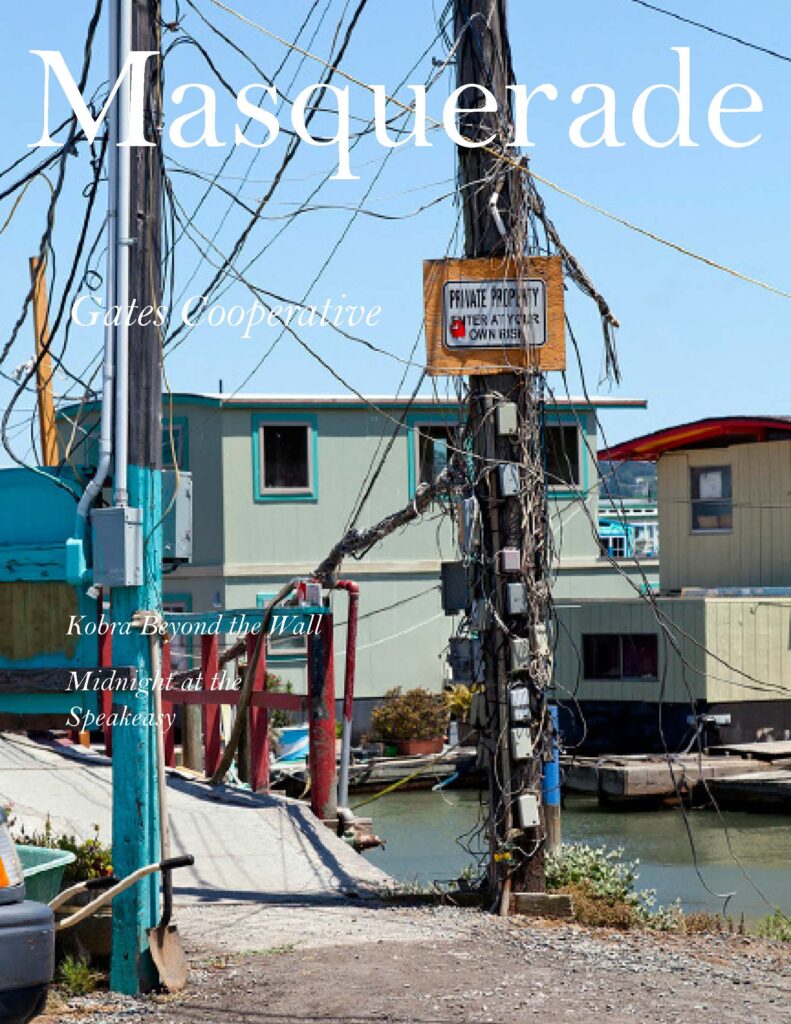
At dawn on Richardson Bay, the houses seemed to wake before the people did. Ropes creaked against pilings. Painted walls caught the first pale light. Windows patched from forgotten buildings reflected the moving water. Decks leaned slightly into the wind. Flowers grew from unlikely containers. Boats, barges, platforms, shacks, studios, and floating cottages gathered together in a world that looked improvised, impossible, and strangely beautiful.
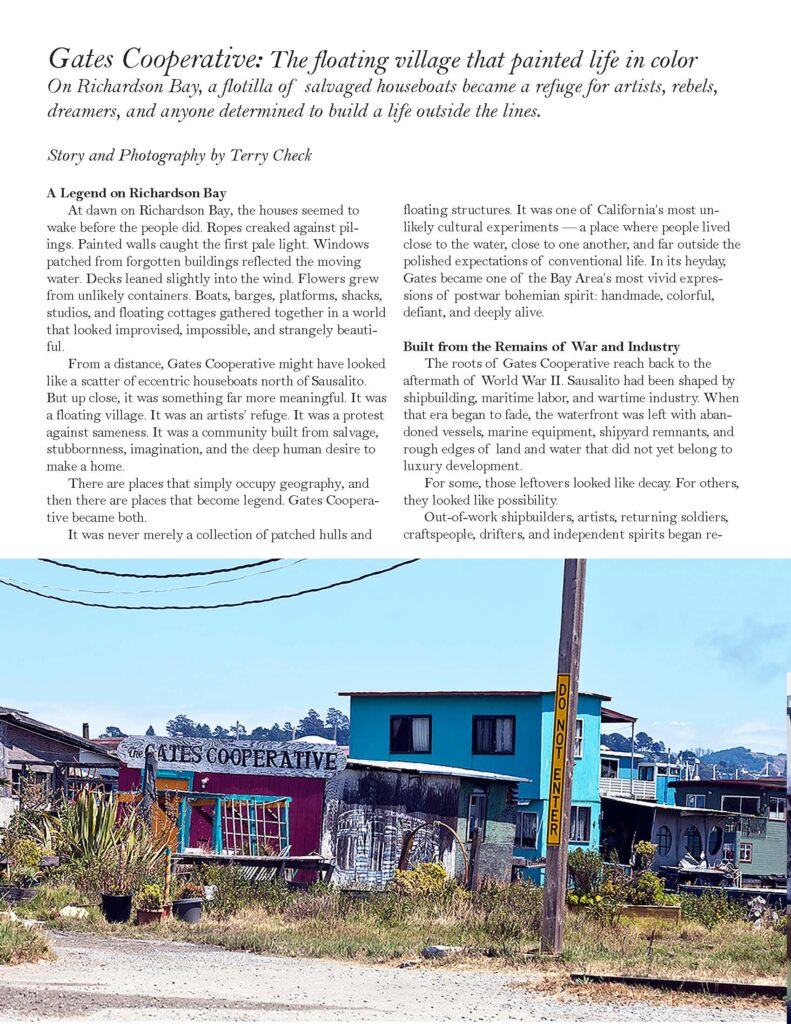
From a distance, Gates Cooperative might have looked like a scatter of eccentric houseboats north of Sausalito. But up close, it was something far more meaningful. It was a floating village. It was an artists’ refuge. It was a protest against sameness. It was a community built from salvage, stubbornness, imagination, and the deep human desire to make a home.
There are places that simply occupy geography, and then there are places that become legend. Gates Cooperative became both.
It was never merely a collection of patched hulls and floating structures. It was one of California’s most unlikely cultural experiments — a place where people lived close to the water, close to one another, and far outside the polished expectations of conventional life. In its heyday, Gates became one of the Bay Area’s most vivid expressions of postwar bohemian spirit: handmade, colorful, defiant, and deeply alive.
Built from the Remains of War and Industry
The roots of Gates Cooperative reach back to the aftermath of World War II. Sausalito had been shaped by shipbuilding, maritime labor, and wartime industry. When that era began to fade, the waterfront was left with abandoned vessels, marine equipment, shipyard remnants, and rough edges of land and water that did not yet belong to luxury development.
For some, those leftovers looked like decay. For others, they looked like possibility.
Out-of-work shipbuilders, artists, returning soldiers, craftspeople, drifters, and independent spirits began reclaiming boats and barges as shelter. They brought tools, paint, rope, lumber, and instinct. They repaired what could be repaired. They invented what could not. Slowly, a loose floating settlement began to take shape.
Donlon Arques is often remembered as a central figure in the evolution of the Sausalito waterfront. He rented low-cost berths and welcomed unconventional residents into a floating world that gradually became known as Gates Cooperative, named for the old launching gates nearby.
The timing of Gates Cooperative is best understood as a gradual evolution rather than a single founding moment. Its cultural roots reach back to the postwar Sausalito waterfront of the late 1940s and 1950s, when salvaged materials, surplus vessels, and leftover shipyard structures gave people a way to improvise homes on the water. But as an organized cooperative, Gates appears to have emerged during the houseboat conflicts of the late 1970s and early 1980s. By then, the people living in and around the abandoned cove had become more than scattered anchor-outs. They had become a community with a name, a shared identity, and a reason to defend their place on Richardson Bay.
It was not planned by architects. It was not designed by committees. It was not born from real estate speculation. Gates emerged the way certain rare communities do: by accident, necessity, imagination, and word of mouth.
Where Salvage Became Style
What emerged was not polished, but alive.
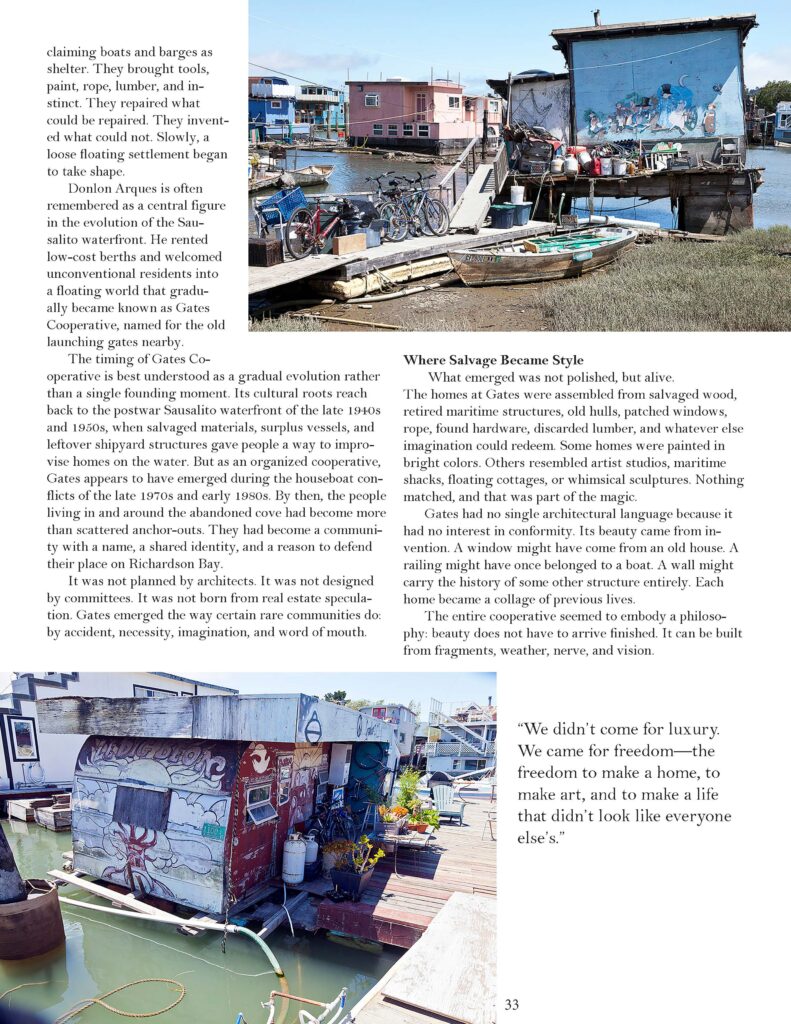
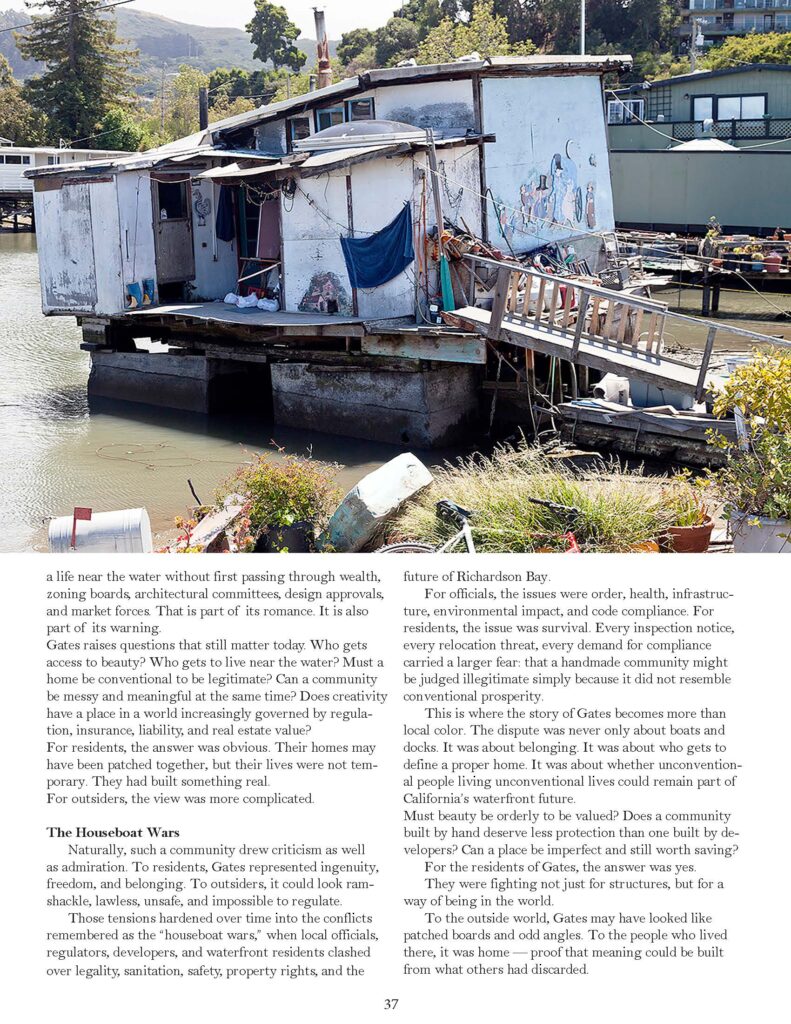
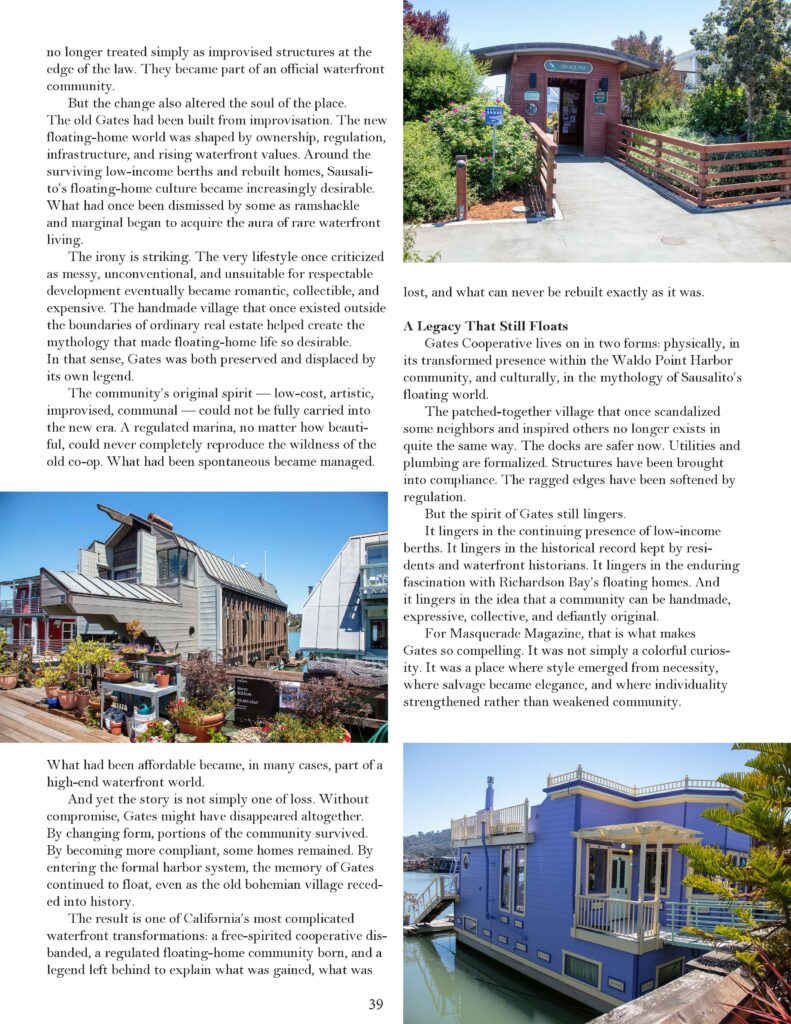
The homes at Gates were assembled from salvaged wood, retired maritime structures, old hulls, patched windows, rope, found hardware, discarded lumber, and whatever else imagination could redeem. Some homes were painted in bright colors. Others resembled artist studios, maritime shacks, floating cottages, or whimsical sculptures. Nothing matched, and that was part of the magic.
Gates had no single architectural language because it had no interest in conformity. Its beauty came from invention. A window might have come from an old house. A railing might have once belonged to a boat. A wall might carry the history of some other structure entirely. Each home became a collage of previous lives.
The entire cooperative seemed to embody a philosophy: beauty does not have to arrive finished. It can be built from fragments, weather, nerve, and vision.
In that sense, Gates was not simply a place to live. It was an artwork in motion.
The spirit of Gates was simple: the residents had not come for luxury. They had come for freedom — the freedom to make a home, to make art, and to make a life that did not look like everyone else’s.
Life on the Water, Together
Yet what made Gates unforgettable was not only its appearance. It was the human atmosphere.
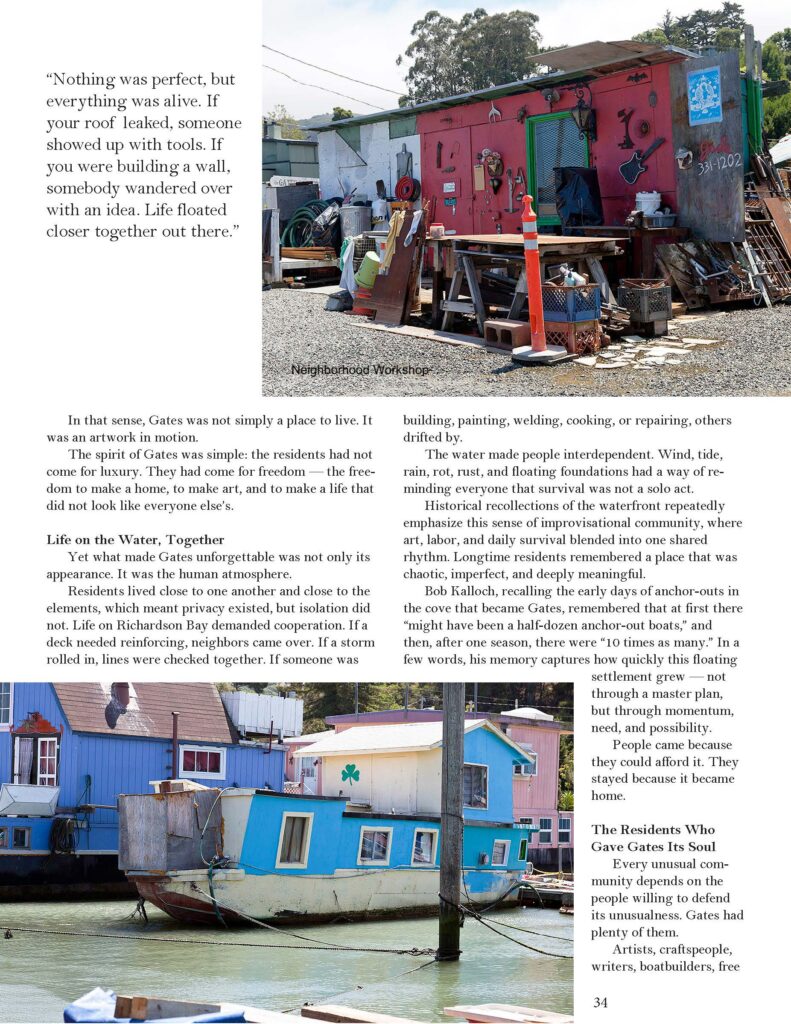
Residents lived close to one another and close to the elements, which meant privacy existed, but isolation did not. Life on Richardson Bay demanded cooperation. If a deck needed reinforcing, neighbors came over. If a storm rolled in, lines were checked together. If someone was building, painting, welding, cooking, or repairing, others drifted by.
The water made people interdependent. Wind, tide, rain, rot, rust, and floating foundations had a way of reminding everyone that survival was not a solo act.
Historical recollections of the waterfront repeatedly emphasize this sense of improvisational community, where art, labor, and daily survival blended into one shared rhythm. Longtime residents remembered a place that was chaotic, imperfect, and deeply meaningful.
Bob Kalloch, recalling the early days of anchor-outs in the cove that became Gates, remembered that at first there “might have been a half-dozen anchor-out boats,” and then, after one season, there were “10 times as many.” In a few words, his memory captures how quickly this floating settlement grew — not through a master plan, but through momentum, need, and possibility.
People came because they could afford it. They stayed because it became home.
The Residents Who Gave Gates Its Soul
Every unusual community depends on the people willing to defend its unusualness. Gates had plenty of them.
Artists, craftspeople, writers, boatbuilders, free spirits, and working-class residents all contributed to the life of the cooperative. Some were drawn by the low cost of living. Some came for the artistic freedom. Some were searching for a way of life that did not require them to surrender their independence. Together, they created a culture that was rough at the edges but rich in character.
Catherine Lyons-Labate, a longtime Richardson Bay resident later associated with preserving the history of the waterfront, helped document and carry this story forward. Her legacy, like that of many Gates residents, reflects a world in which people did not merely live on the water. They negotiated, defended, and defined a culture there.
That culture was not luxurious in the conventional sense. It was resourceful. The luxury was freedom: low-cost living, room for experimentation, and the ability to shape one’s home by hand.
Gates anticipated many values that would later become fashionable — adaptive reuse, sustainable living, alternative housing, community-centered design, and creative placemaking. But the people of Gates lived those values long before they had tidy names.
They were not making a style statement for social media. They were making real lives out of what had been left behind.
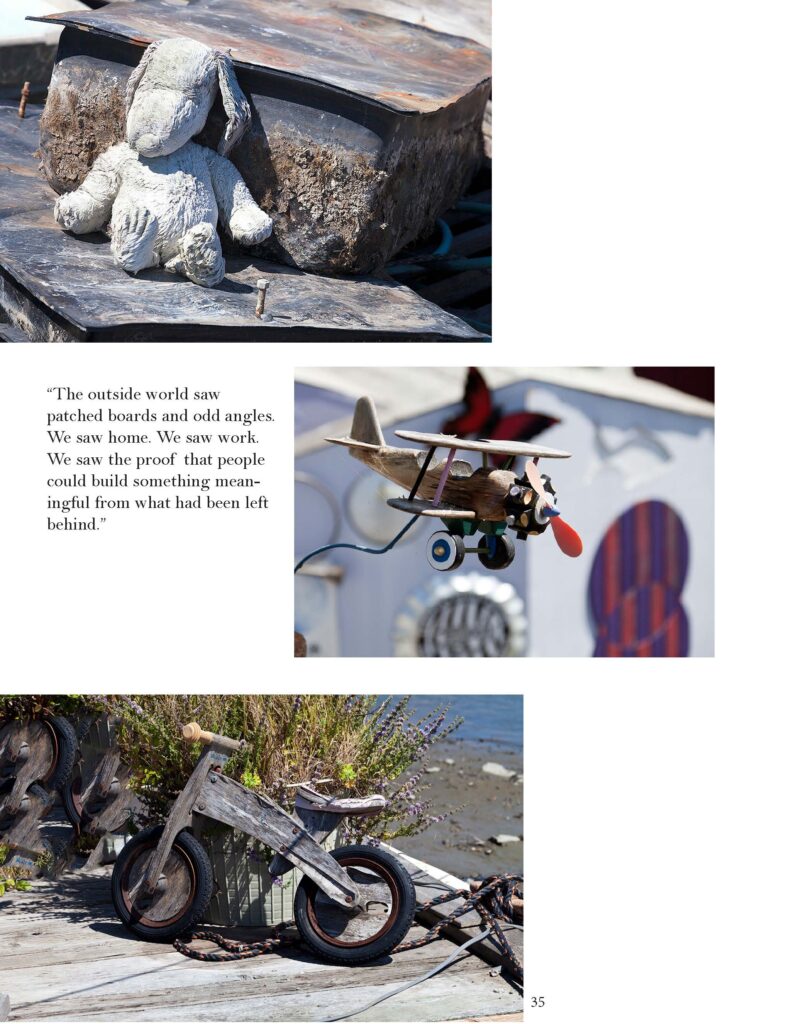
The emotional truth of Gates was this: nothing was perfect, but everything was alive. If a roof leaked, someone showed up with tools. If a wall was being built, somebody wandered over with an idea. Life floated closer together out there.
A Community the Modern World Could Barely Understand
In an era when waterfront property has become some of the most expensive real estate in America, Gates Cooperative feels almost impossible now.
It belonged to a time when people could still improvise a life near the water without first passing through wealth, zoning boards, architectural committees, design approvals, and market forces. That is part of its romance. It is also part of its warning.
Gates raises questions that still matter today. Who gets access to beauty? Who gets to live near the water? Must a home be conventional to be legitimate? Can a community be messy and meaningful at the same time? Does creativity have a place in a world increasingly governed by regulation, insurance, liability, and real estate value?
For residents, the answer was obvious. Their homes may have been patched together, but their lives were not temporary. They had built something real.
For outsiders, the view was more complicated.
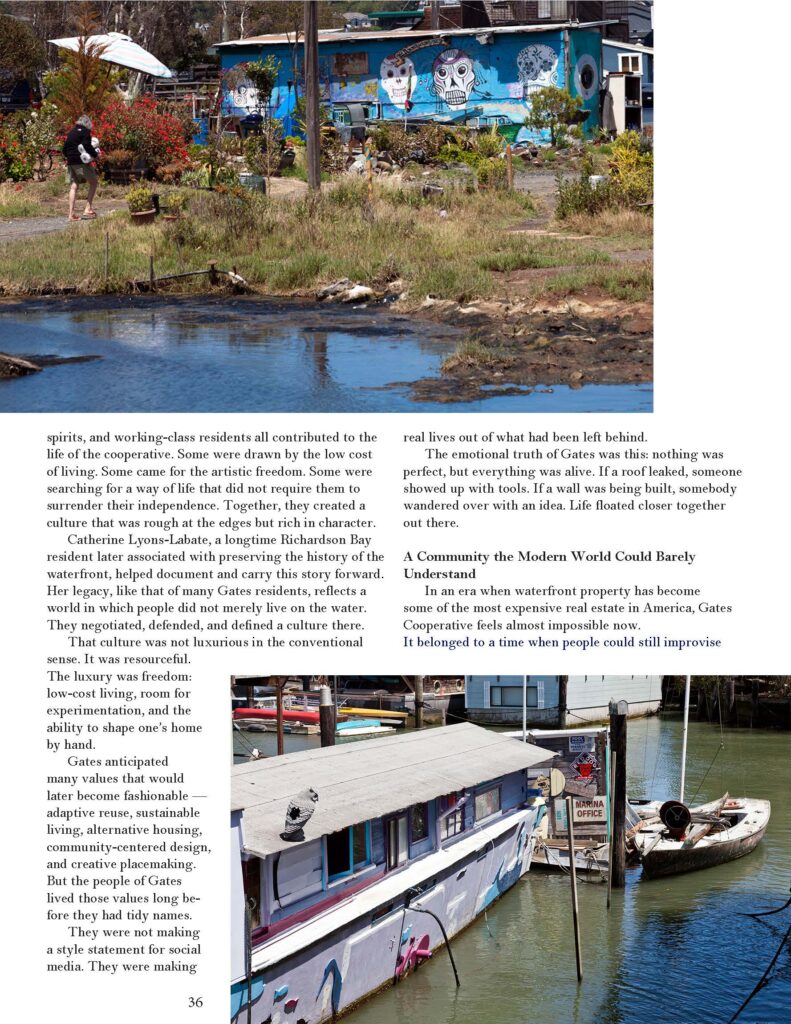
The Houseboat Wars
Naturally, such a community drew criticism as well as admiration. To residents, Gates represented ingenuity, freedom, and belonging. To outsiders, it could look ramshackle, lawless, unsafe, and impossible to regulate.
Those tensions hardened over time into the conflicts remembered as the “houseboat wars,” when local officials, regulators, developers, and waterfront residents clashed over legality, sanitation, safety, property rights, and the future of Richardson Bay.
For officials, the issues were order, health, infrastructure, environmental impact, and code compliance. For residents, the issue was survival. Every inspection notice, every relocation threat, every demand for compliance carried a larger fear: that a handmade community might be judged illegitimate simply because it did not resemble conventional prosperity.
This is where the story of Gates becomes more than local color. The dispute was never only about boats and docks. It was about belonging. It was about who gets to define a proper home. It was about whether unconventional people living unconventional lives could remain part of California’s waterfront future.
Must beauty be orderly to be valued? Does a community built by hand deserve less protection than one built by developers? Can a place be imperfect and still worth saving?
For the residents of Gates, the answer was yes.
They were fighting not just for structures, but for a way of being in the world.
To the outside world, Gates may have looked like patched boards and odd angles. To the people who lived there, it was home — proof that meaning could be built from what others had discarded.
What Happened to Gates Cooperative?
And what, finally, happened to Gates Cooperative?
The answer is complicated because Gates did not end on one exact date. It was not simply closed, demolished, or erased in a single moment. Instead, the original rough-and-ready version of Gates was gradually absorbed, rebuilt, regulated, and transformed.
Historical accounts describe the Co-Op as becoming a subtenant community of Waldo Point Harbor. After decades of legal wrangling, 38 Co-Op boats were eventually placed on code-compliant docks with utilities and plumbing. The anarchic floating village was not preserved exactly as it had been, but neither was it erased. It survived by changing form.
That transformation accelerated in the 2010s. By 2014, Gates Cooperative was widely understood to be “going legit,” as the old floating homes were rehabilitated, dismantled, rebuilt, or moved so they could meet building codes and modern harbor requirements. Some homes were assigned to a new dock, others to existing docks, and by around 2016 the homes were intended to be compliant and officially designated as low-income housing.
In other words, Gates Cooperative’s life span cannot be reduced to a neat pair of dates. Its roots reach back to the late 1940s and 1950s. As a named and organized cooperative, it took shape around the late 1970s and early 1980s. And as its original rough-edged form, it was largely transformed between 2014 and 2016, when it became part of a regulated Waldo Point Harbor floating-home community.
The result was neither total victory nor total defeat. Gates did not remain the wild, patched-together village of memory. But neither did it disappear entirely beneath luxury development. Instead, it entered a difficult middle ground: regulated, rebuilt, preserved in part, and changed forever.
Something was lost in that transition. The rawness. The improvisation. The outlaw poetry of the place.
But something important was also saved.
From Bohemian Co-Op to High-End Floating Community
The disbanding of Gates Cooperative was not the end of Sausalito’s floating-home story. In many ways, it marked the beginning of a different chapter — one more orderly, more regulated, more expensive, and more closely tied to the modern world of waterfront property.
What had started as a rough, handmade village of artists, boatbuilders, free spirits, and working-class residents gradually became part of a more formal marina culture. The old Gates Co-Op was folded into the larger Waldo Point Harbor community, where floating homes would be required to meet modern standards of safety, utilities, plumbing, berthing, and code compliance.
The transformation brought undeniable improvements. The docks became safer. Utilities became reliable. Plumbing was formalized. Residents gained a clearer legal framework. The floating homes that remained were no longer treated simply as improvised structures at the edge of the law. They became part of an official waterfront community.
But the change also altered the soul of the place.
The old Gates had been built from improvisation. The new floating-home world was shaped by ownership, regulation, infrastructure, and rising waterfront values. Around the surviving low-income berths and rebuilt homes, Sausalito’s floating-home culture became increasingly desirable. What had once been dismissed by some as ramshackle and marginal began to acquire the aura of rare waterfront living.
The irony is striking. The very lifestyle once criticized as messy, unconventional, and unsuitable for respectable development eventually became romantic, collectible, and expensive. The handmade village that once existed outside the boundaries of ordinary real estate helped create the mythology that made floating-home life so desirable.
In that sense, Gates was both preserved and displaced by its own legend.
The community’s original spirit — low-cost, artistic, improvised, communal — could not be fully carried into the new era. A regulated marina, no matter how beautiful, could never completely reproduce the wildness of the old co-op. What had been spontaneous became managed. What had been rough became refined. What had been affordable became, in many cases, part of a high-end waterfront world.
And yet the story is not simply one of loss. Without compromise, Gates might have disappeared altogether. By changing form, portions of the community survived. By becoming more compliant, some homes remained. By entering the formal harbor system, the memory of Gates continued to float, even as the old bohemian village receded into history.
The result is one of California’s most complicated waterfront transformations: a free-spirited cooperative disbanded, a regulated floating-home community born, and a legend left behind to explain what was gained, what was lost, and what can never be rebuilt exactly as it was.
A Legacy That Still Floats
Gates Cooperative lives on in two forms: physically, in its transformed presence within the Waldo Point Harbor community, and culturally, in the mythology of Sausalito’s floating world.
The patched-together village that once scandalized some neighbors and inspired others no longer exists in quite the same way. The docks are safer now. Utilities and plumbing are formalized. Structures have been brought into compliance. The ragged edges have been softened by regulation.
But the spirit of Gates still lingers.
It lingers in the continuing presence of low-income berths. It lingers in the historical record kept by residents and waterfront historians. It lingers in the enduring fascination with Richardson Bay’s floating homes. And it lingers in the idea that a community can be handmade, expressive, collective, and defiantly original.
For Masquerade Magazine, that is what makes Gates so compelling. It was not simply a colorful curiosity. It was a place where style emerged from necessity, where salvage became elegance, and where individuality strengthened rather than weakened community.
Gates asked a question that still matters in a world increasingly shaped by standardization and cost: can people still create homes and lives that are expressive, collective, affordable, and free?
Gates answered yes — on water, in paint, through storms, and over decades of conflict.
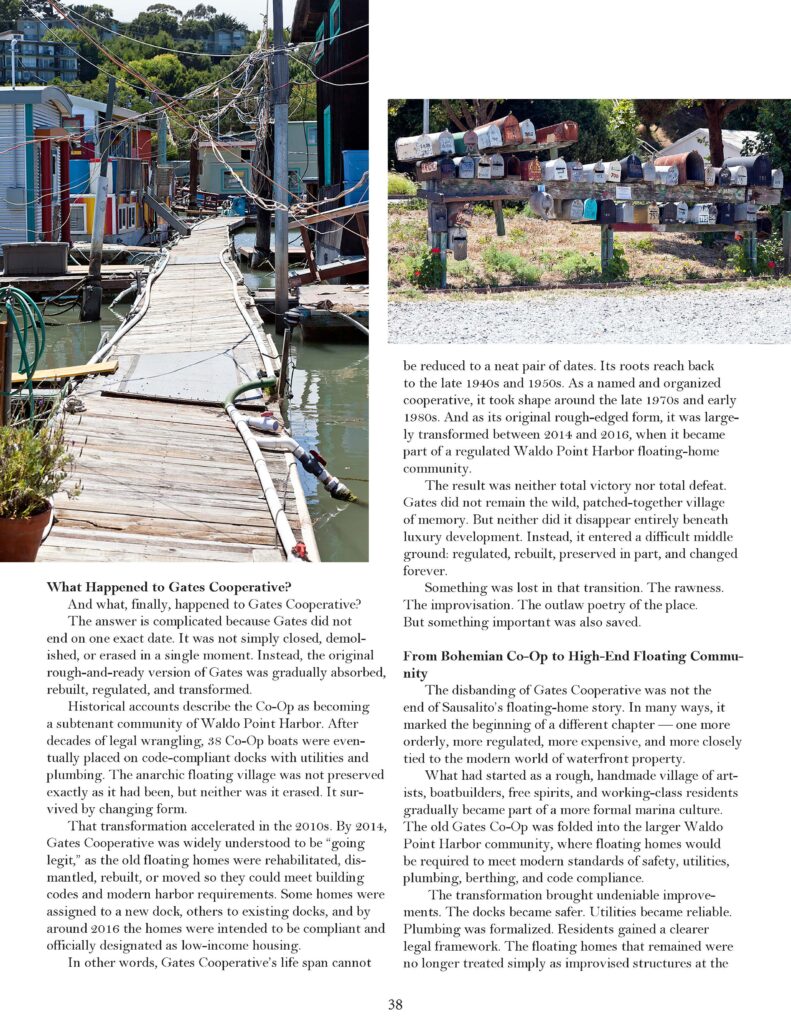
The Water Remembers
Perhaps the final lesson of Gates Cooperative is this: not all beautiful places begin with privilege.
Some begin with leftovers.
Some begin with resistance.
Some begin with people willing to see possibility where others see ruin.
On Richardson Bay, they built a floating village from what had been discarded. In doing so, they built a legacy.
Today, the patched edges are fewer. The docks are safer. The utilities are legal. The old wildness has been softened by regulation. Around it, a new floating-home world has taken shape — more refined, more expensive, and more carefully managed.
But when afternoon light touches the painted walls and the floating homes shift gently with the tide, something of Gates remains.
It remains in the idea that beauty can be built from remnants.
It remains in the belief that community can be handmade.
It remains in the courage of people who chose not to live inside someone else’s definition of home.
Gates Cooperative painted life in color.
And even now, after the battles, rebuilding, compromise, and change, the water still remembers.
