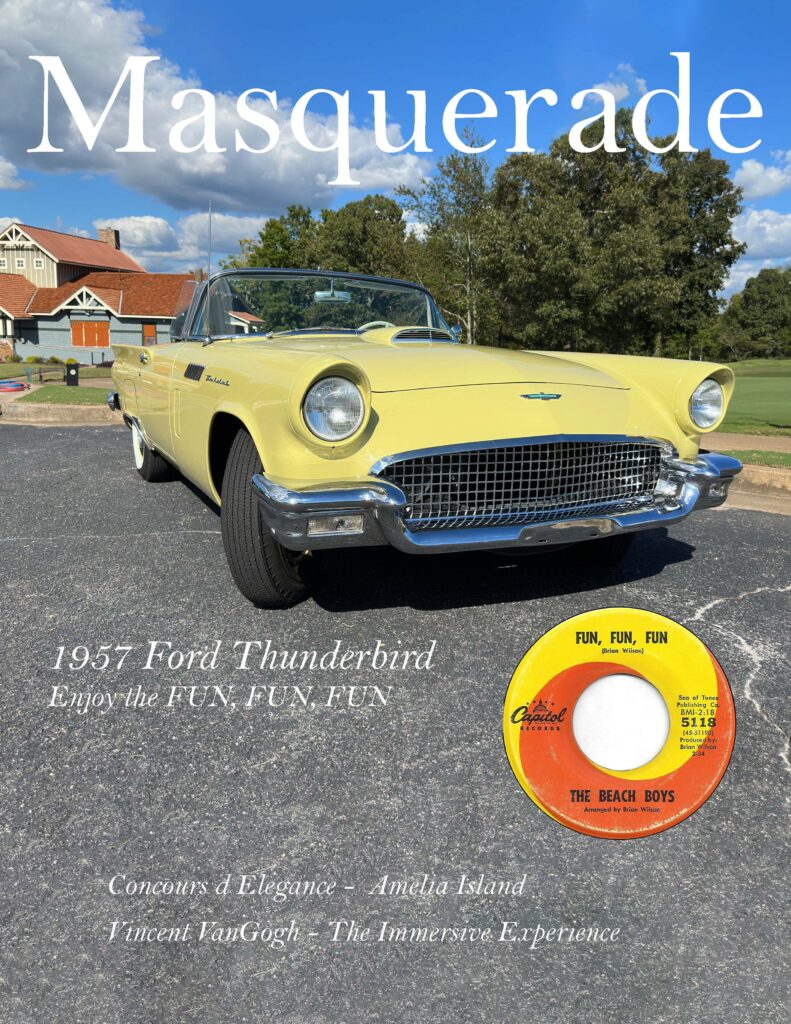
In 1957, a boy fell in love — not just with a girl, but with a golden dream. An Inca Gold Thunderbird, shimmering on the page of a magazine, became the symbol of youth, love, and a life yet to be lived. Decades later, both dreams came true.
Story and Photography by Terry Check
In the late summer of 1957, I was a boy with wide eyes, restless curiosity, and a heart ready for wonder. My world then was small: a black-and-white TV glowing in the corner, the smell of supper drifting from the kitchen, and a stack of magazines on the table promised faraway dreams.
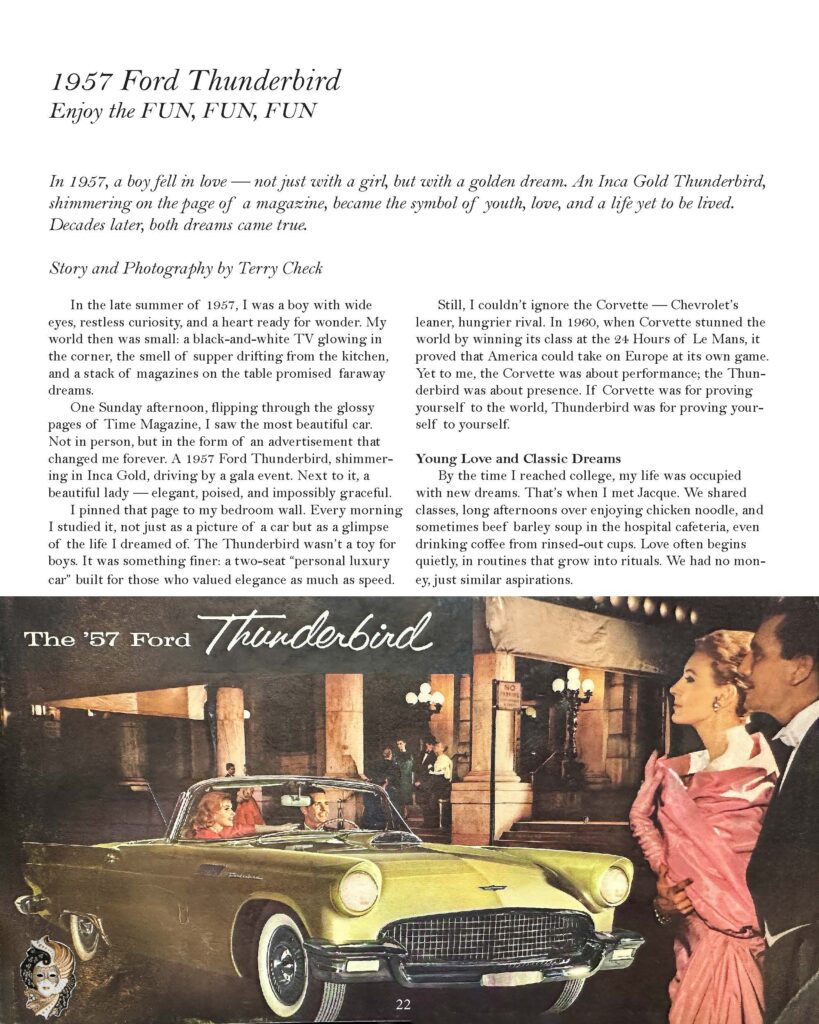
One Sunday afternoon, flipping through the glossy pages of Time Magazine, I saw the most beautiful car. Not in person, but in the form of an advertisement that changed me forever. A 1957 Ford Thunderbird, shimmering in Inca Gold, driving by a gala event. Next to it, a beautiful lady — elegant, poised, and impossibly graceful.
I pinned that page to my bedroom wall. Every morning, I studied it, not just as a picture of a car but as a glimpse of the life I dreamed of. The Thunderbird wasn’t a toy for boys. It was something finer: a two-seat “personal luxury car” built for those who valued elegance as much as speed.
Still, I couldn’t ignore the Corvette — Chevrolet’s leaner, hungrier rival. In 1960, when Corvette stunned the world by winning its class at the 24 Hours of Le Mans, it proved that America could take on Europe at its own game. Yet to me, the Corvette was about performance; the Thunderbird was about presence. If Corvette was for proving yourself to the world, Thunderbird was for proving yourself to yourself.
Young Love and Classic Dreams
By the time I reached college, my life was occupied with new dreams. That’s when I met Jacque. We shared classes, long afternoons over enjoying chicken noodle, and sometimes beef barley soup in the hospital cafeteria, even drinking coffee from rinsed-out cups. Love often begins quietly, in routines that grow into rituals. We had no money, just similar aspirations.
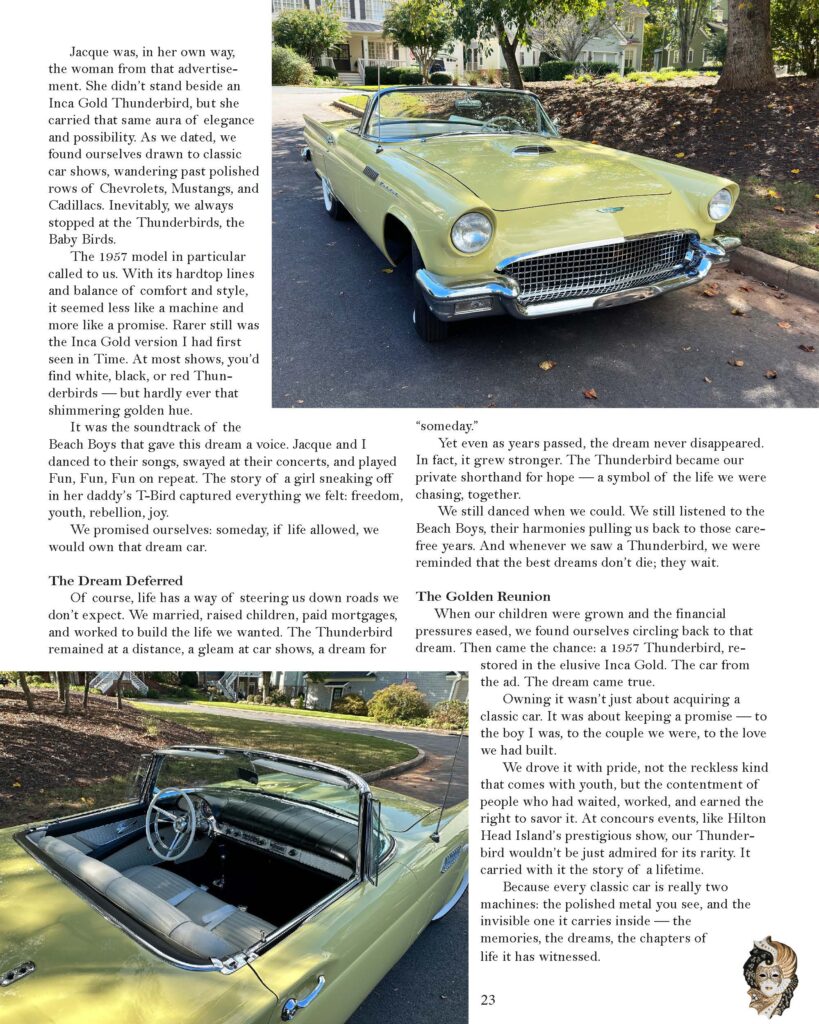
Jacque was, in her own way, the woman from that advertisement. She didn’t stand beside an Inca Gold Thunderbird, but she carried that same aura of elegance and possibility. As we dated, we found ourselves drawn to classic car shows, wandering past polished rows of Chevrolets, Mustangs, and Cadillacs. Inevitably, we always stopped at the Thunderbirds, the Baby Birds.
The 1957 model in particular called to us. With its hardtop lines and balance of comfort and style, it seemed less like a machine and more like a promise. Rarer still was the Inca Gold version I had first seen in Time. At most shows, you’d find white, black, or red Thunderbirds — but hardly ever that shimmering golden hue.
It was the soundtrack of the Beach Boys that gave this dream a voice. Jacque and I danced to their songs, swayed at their concerts, and played Fun, Fun, Fun on repeat. The story of a girl sneaking off in her daddy’s T-Bird captured everything we felt: freedom, youth, rebellion, joy.
We promised ourselves: someday, if life allowed, we would own that dream car.
The Dream Deferred
Of course, life has a way of steering us down roads we don’t expect. We married, raised children, paid mortgages, and worked to build the life we wanted. The Thunderbird remained at a distance, a gleam at car shows, a dream for “someday.”
Yet even as years passed, the dream never disappeared. In fact, it grew stronger. The Thunderbird became our private shorthand for hope — a symbol of the life we were chasing, together.
We still danced when we could. We still listened to the Beach Boys, their harmonies pulling us back to those carefree years. And whenever we saw a Thunderbird, we were reminded that the best dreams don’t die; they wait.
The Golden Reunion
When our children were grown and the financial pressures eased, we found ourselves circling back to that dream. Then came the chance: a 1957 Thunderbird, restored in the elusive Inca Gold. The car from the ad. The dream came true.
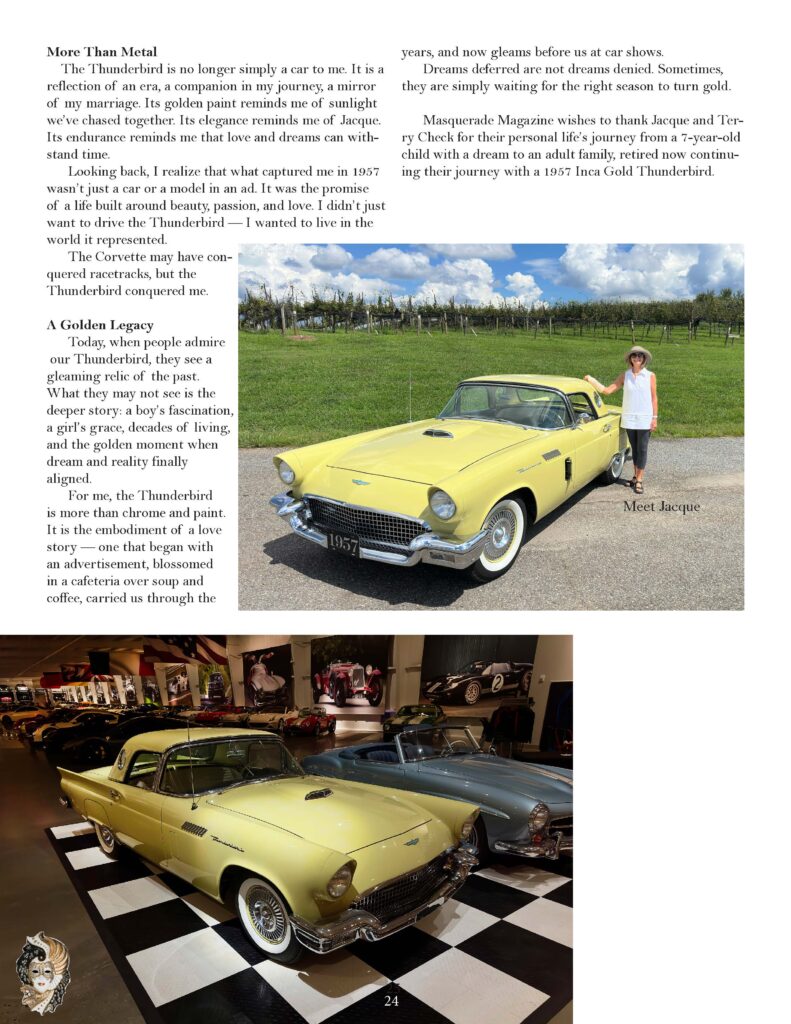
Owning it wasn’t just about acquiring a classic car. It was about keeping a promise — to the boy I was, to the couple we were, to the love we had built.
We drove it with pride, not the reckless kind that comes with youth, but the contentment of people who had waited, worked, and earned the right to savor it. At concours events, like Hilton Head Island’s prestigious show, our Thunderbird wouldn’t be just admired for its rarity. It carried with it the story of a lifetime.
Because every classic car is really two machines: the polished metal you see, and the invisible one it carries inside — the memories, the dreams, the chapters of life it has witnessed.
More Than Metal
The Thunderbird is no longer simply a car to me. It is a reflection of an era, a companion in my journey, a mirror of my marriage. Its golden paint reminds me of sunlight we’ve chased together. Its elegance reminds me of Jacque. Its endurance reminds me that love and dreams can withstand time.
Looking back, I realize that what captured me in 1957 wasn’t just a car or a model in an ad. It was the promise of a life built around beauty, passion, and love. I didn’t just want to drive the Thunderbird — I wanted to live in the world it represented.
The Corvette may have conquered racetracks, but the Thunderbird conquered me.
A Golden Legacy
Today, when people admire our Thunderbird, they see a gleaming relic of the past. What they may not see is the deeper story: a boy’s fascination, a girl’s grace, decades of living, and the golden moment when dream and reality finally aligned.
For me, the Thunderbird is more than chrome and paint. It is the embodiment of a love story — one that began with an advertisement, blossomed in a cafeteria over soup and coffee, carried us through the years, and now gleams before us at car shows.
Dreams deferred are not dreams denied. Sometimes, they are simply waiting for the right season to turn gold. Masquerade Magazine wishes to thank Jacque and Terry Check for their personal journey from a 7-year-old child with a dream to an adult family, retired now continuing their journey with a 1957 Inca Gold Thunderbird.
