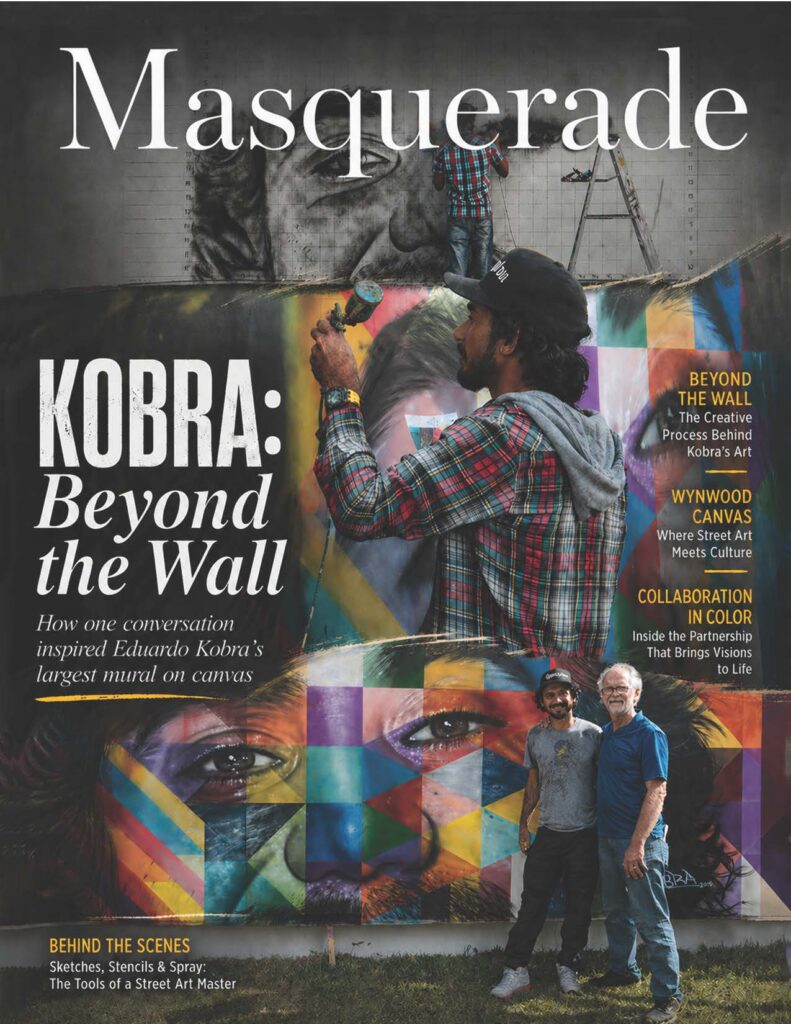
How One Conversation Inspired Eduardo Kobra’s Largest Mural on Canvas
Story and Photography by Terry Check
The Power of a Wall
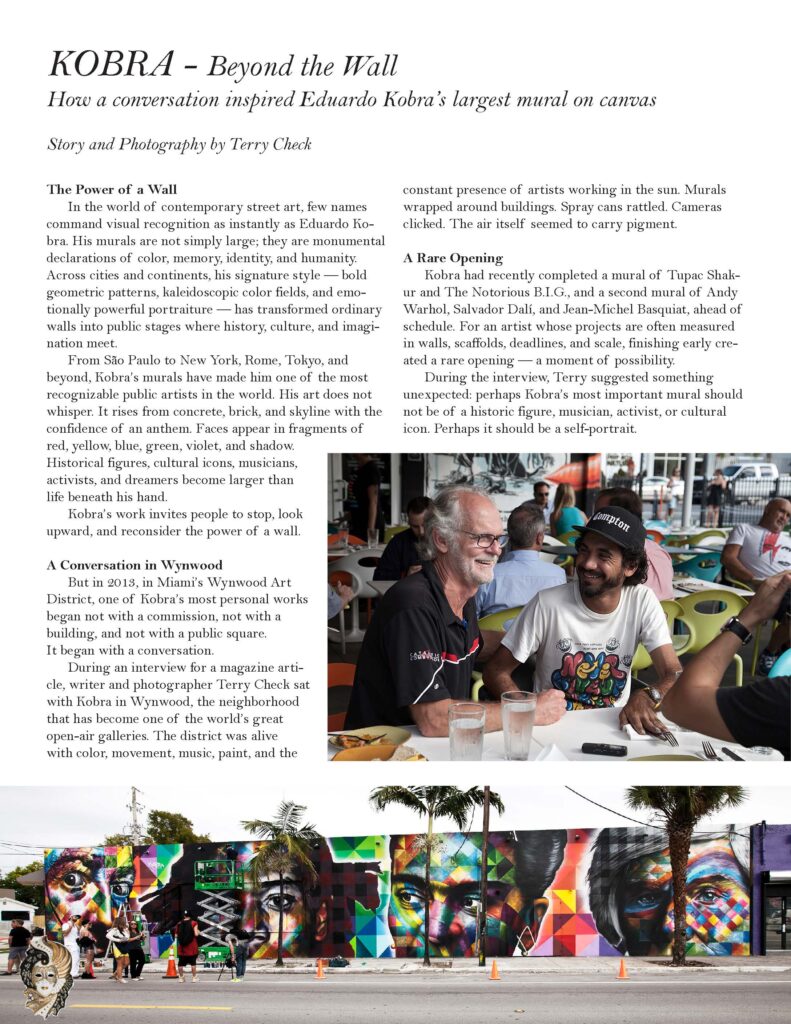
In the world of contemporary street art, few names command visual recognition as instantly as Eduardo Kobra. His murals are not simply large; they are monumental declarations of color, memory, identity, and humanity. Across cities and continents, his signature style — bold geometric patterns, kaleidoscopic color fields, and emotionally powerful portraiture — has transformed ordinary walls into public stages where history, culture, and imagination meet.
From São Paulo to New York, Rome, Tokyo, and beyond, Kobra’s murals have made him one of the most recognizable public artists in the world. His art does not whisper. It rises from concrete, brick, and skyline with the confidence of an anthem. Faces appear in fragments of red, yellow, blue, green, violet, and shadow. Historical figures, cultural icons, musicians, activists, and dreamers become larger than life beneath his hand.
Kobra’s work invites people to stop, look upward, and reconsider the power of a wall.
A Conversation in Wynwood
But in 2013, in Miami’s Wynwood Art District, one of Kobra’s most personal works began not with a commission, not with a building, and not with a public square.
It began with a conversation.
During an interview for a magazine article, writer and photographer Terry Check sat with Kobra in Wynwood, the neighborhood that has become one of the world’s great open-air galleries. The district was alive with color, movement, music, paint, and the constant presence of artists working in the sun. Murals wrapped around buildings. Spray cans rattled. Cameras clicked. The air itself seemed to carry pigment.
A Rare Opening
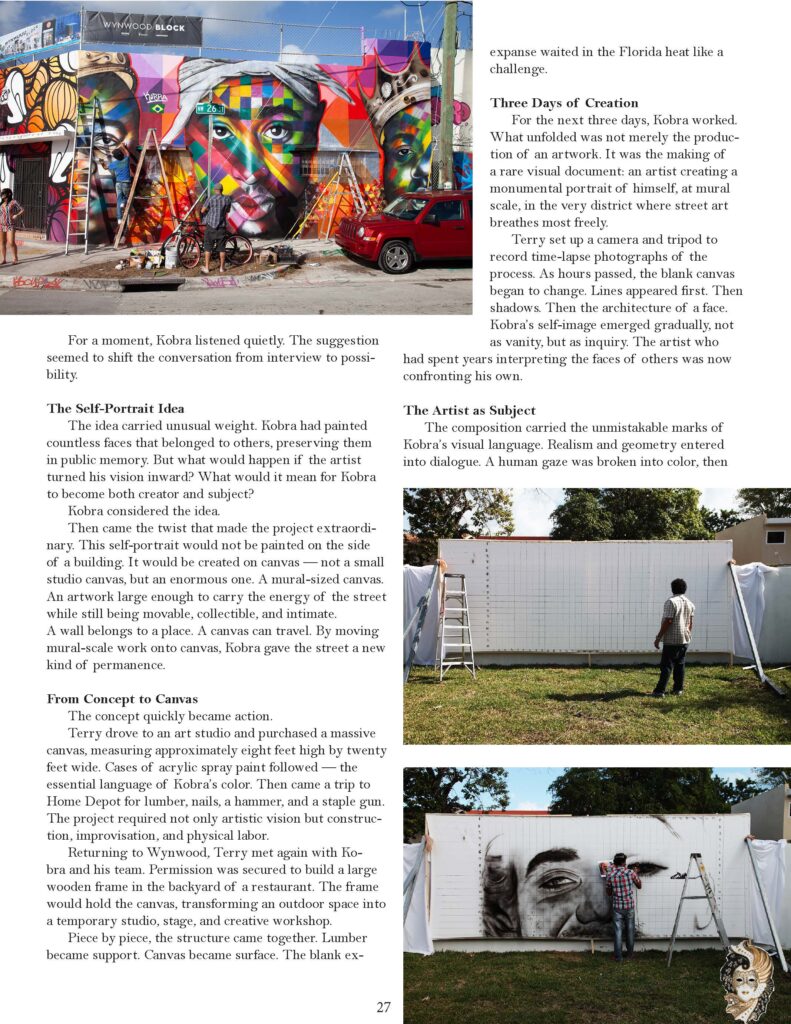
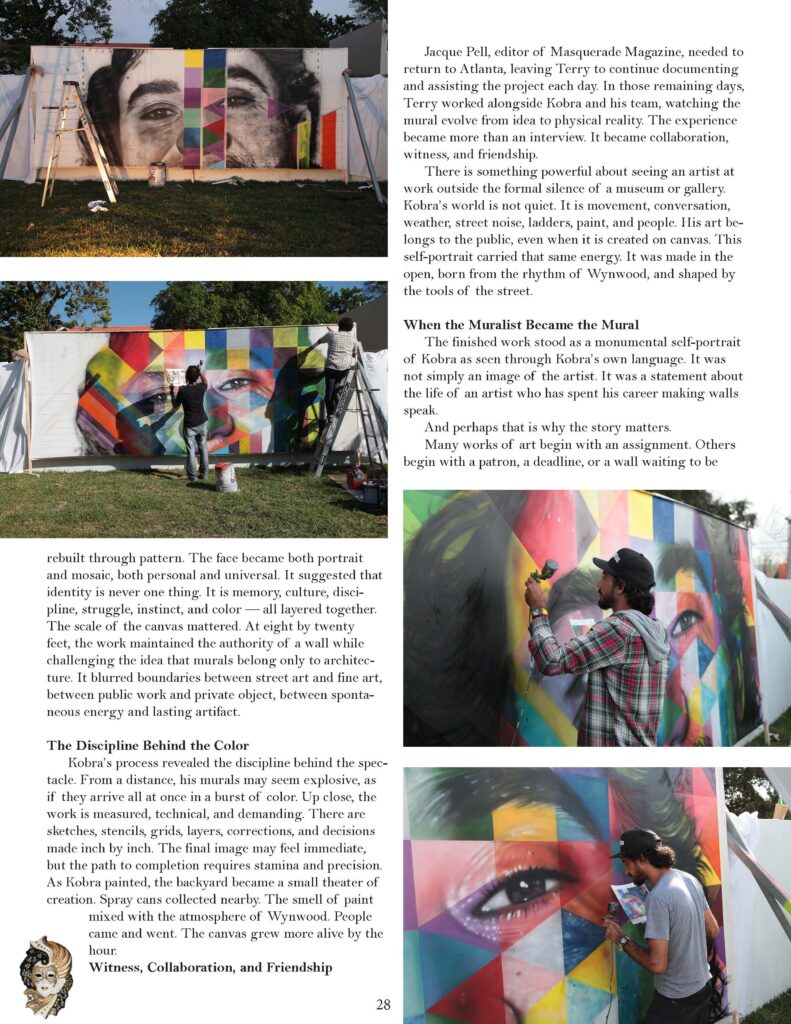
Kobra had recently completed a mural of Tupac Shakur and The Notorious B.I.G., and a second mural of Andy Warhol, Salvador Dalí, and Jean-Michel Basquiat, ahead of schedule. For an artist whose projects are often measured in walls, scaffolds, deadlines, and scale, finishing early created a rare opening — a moment of possibility.
During the interview, Terry suggested something unexpected: perhaps Kobra’s most important mural should not be of a historic figure, musician, activist, or cultural icon. Perhaps it should be a self-portrait.
For a moment, Kobra listened quietly. The suggestion seemed to shift the conversation from interview to possibility.
The Self-Portrait Idea
The idea carried unusual weight. Kobra had painted countless faces that belonged to others, preserving them in public memory. But what would happen if the artist turned his vision inward? What would it mean for Kobra to become both creator and subject?
Kobra considered the idea.
Then came the twist that made the project extraordinary. This self-portrait would not be painted on the side of a building. It would be created on canvas — not a small studio canvas, but an enormous one. A mural-sized canvas. An artwork large enough to carry the energy of the street while still being movable, collectible, and intimate.
A wall belongs to a place. A canvas can travel. By moving mural-scale work onto canvas, Kobra gave the street a new kind of permanence.
From Concept to Canvas
The concept quickly became action.
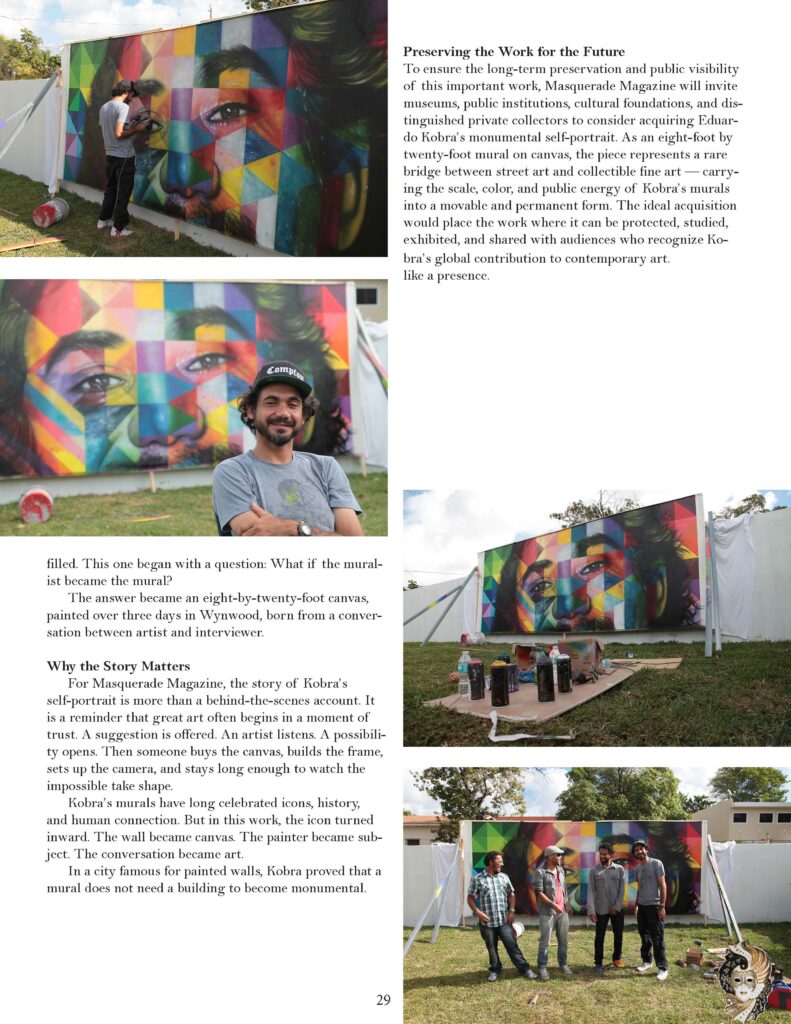
Terry drove to an art studio and purchased a massive canvas, measuring approximately eight feet high by twenty feet wide. Cases of acrylic spray paint followed — the essential language of Kobra’s color. Then came a trip to Home Depot for lumber, nails, a hammer, and a staple gun. The project required not only artistic vision but construction, improvisation, and physical labor.
Returning to Wynwood, Terry met again with Kobra and his team. Permission was secured to build a large wooden frame in the backyard of a restaurant. The frame would hold the canvas, transforming an outdoor space into a temporary studio, stage, and creative workshop.
Piece by piece, the structure came together. Lumber became support. Canvas became surface. The blank expanse waited in the Florida heat like a challenge.
Three Days of Creation
For the next three days, Kobra worked.
What unfolded was not merely the production of an artwork. It was the making of a rare visual document: an artist creating a monumental portrait of himself, at mural scale, in the very district where street art breathes most freely.
Terry set up a camera and tripod to record time-lapse photographs of the process. As hours passed, the blank canvas began to change. Lines appeared first. Then shadows. Then the architecture of a face. Kobra’s self-image emerged gradually, not as vanity, but as inquiry. The artist who had spent years interpreting the faces of others was now confronting his own.
The Artist as Subject
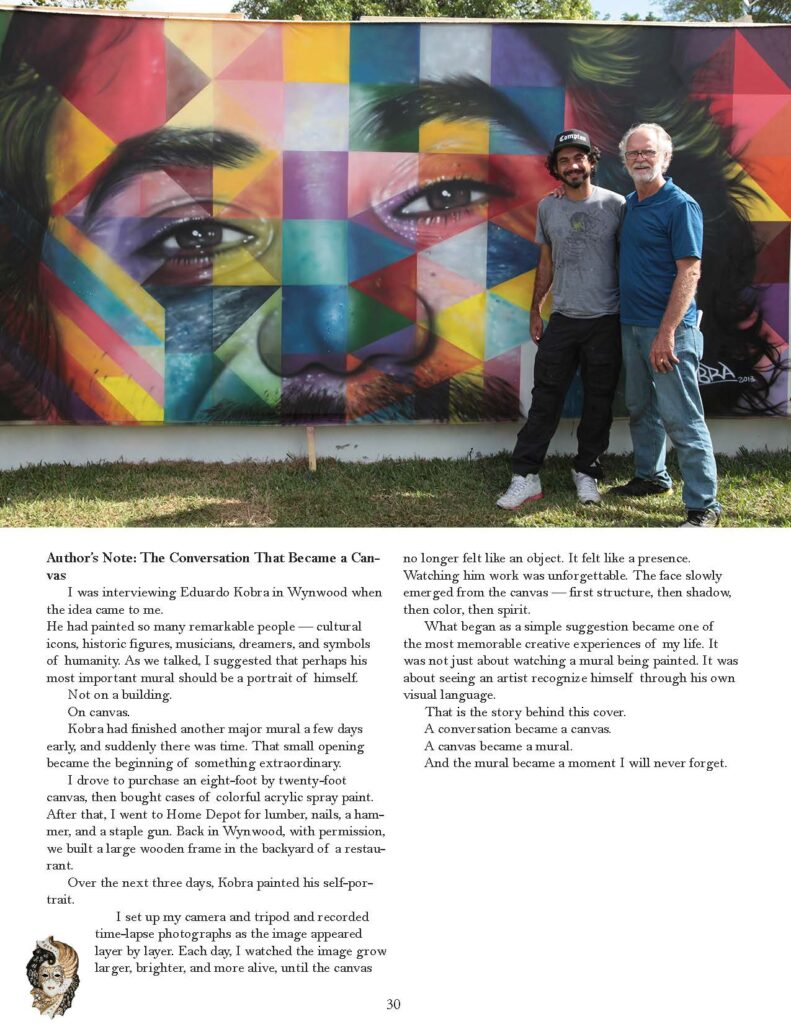
The composition carried the unmistakable marks of Kobra’s visual language. Realism and geometry entered into dialogue. A human gaze was broken into color, then rebuilt through pattern. The face became both portrait and mosaic, both personal and universal. It suggested that identity is never one thing. It is memory, culture, discipline, struggle, instinct, and color — all layered together.
The scale of the canvas mattered. At eight by twenty feet, the work maintained the authority of a wall while challenging the idea that murals belong only to architecture. It blurred boundaries between street art and fine art, between public work and private object, between spontaneous energy and lasting artifact.
The Discipline Behind the Color
Kobra’s process revealed the discipline behind the spectacle. From a distance, his murals may seem explosive, as if they arrive all at once in a burst of color. Up close, the work is measured, technical, and demanding. There are sketches, stencils, grids, layers, corrections, and decisions made inch by inch. The final image may feel immediate, but the path to completion requires stamina and precision.
As Kobra painted, the backyard became a small theater of creation. Spray cans collected nearby. The smell of paint mixed with the atmosphere of Wynwood. People came and went. The canvas grew more alive by the hour.
Witness, Collaboration, and Friendship
Jacque Pell, editor of Masquerade Magazine, needed to return to Atlanta, leaving Terry to continue documenting and assisting the project each day. In those remaining days, Terry worked alongside Kobra and his team, watching the mural evolve from idea to physical reality. The experience became more than an interview. It became collaboration, witness, and friendship.
There is something powerful about seeing an artist at work outside the formal silence of a museum or gallery. Kobra’s world is not quiet. It is movement, conversation, weather, street noise, ladders, paint, and people. His art belongs to the public, even when it is created on canvas. This self-portrait carried that same energy. It was made in the open, born from the rhythm of Wynwood, and shaped by the tools of the street.
When the Muralist Became the Mural
The finished work stood as a monumental self-portrait of Kobra as seen through Kobra’s own language. It was not simply an image of the artist. It was a statement about the life of an artist who has spent his career making walls speak.
And perhaps that is why the story matters.
Many works of art begin with an assignment. Others begin with a patron, a deadline, or a wall waiting to be filled. This one began with a question: What if the muralist became the mural?
The answer became an eight-by-twenty-foot canvas, painted over three days in Wynwood, born from a conversation between artist and interviewer.
Why the Story Matters
For Masquerade Magazine, the story of Kobra’s self-portrait is more than a behind-the-scenes account. It is a reminder that great art often begins in a moment of trust. A suggestion is offered. An artist listens. A possibility opens. Then someone buys the canvas, builds the frame, sets up the camera, and stays long enough to watch the impossible take shape.
Kobra’s murals have long celebrated icons, history, and human connection. But in this work, the icon turned inward. The wall became canvas. The painter became subject. The conversation became art.
In a city famous for painted walls, Kobra proved that a mural does not need a building to become monumental.
Preserving the Work for the Future
To ensure the long-term preservation and public visibility of this important work, Masquerade Magazine will invite museums, public institutions, cultural foundations, and distinguished private collectors to consider acquiring Eduardo Kobra’s monumental self-portrait. As an eight-foot by twenty-foot mural on canvas, the piece represents a rare bridge between street art and collectible fine art — carrying the scale, color, and public energy of Kobra’s murals into a movable and permanent form. The ideal acquisition would place the work where it can be protected, studied, exhibited, and shared with audiences who recognize Kobra’s global contribution to contemporary art.
Author’s Note: The Conversation That Became a Canvas
I was interviewing Eduardo Kobra in Wynwood when the idea came to me.
He had painted so many remarkable people — cultural icons, historic figures, musicians, dreamers, and symbols of humanity. As we talked, I suggested that perhaps his most important mural should be a portrait of himself.
Not on a building.
On canvas.
Kobra had finished another major mural a few days early, and suddenly there was time. That small opening became the beginning of something extraordinary.
I drove to purchase an eight-foot by twenty-foot canvas, then bought cases of colorful acrylic spray paint. After that, I went to Home Depot for lumber, nails, a hammer, and a staple gun. Back in Wynwood, with permission, we built a large wooden frame in the backyard of a restaurant.
Over the next three days, Kobra painted his self-portrait.
I set up my camera and tripod and recorded time-lapse photographs as the image appeared layer by layer. Each day, I watched the image grow larger, brighter, and more alive, until the canvas no longer felt like an object. It felt like a presence.
Watching him work was unforgettable. The face slowly emerged from the canvas — first structure, then shadow, then color, then spirit.
What began as a simple suggestion became one of the most memorable creative experiences of my life. It was not just about watching a mural being painted. It was about seeing an artist recognize himself through his own visual language.
That is the story behind this cover.
A conversation became a canvas.
A canvas became a mural.
And the mural became a moment I will never forget.
