From the Pyramids to the Discovery That Changed Fashion
Story and photography by Terry Check • Editor: Jacque Pell
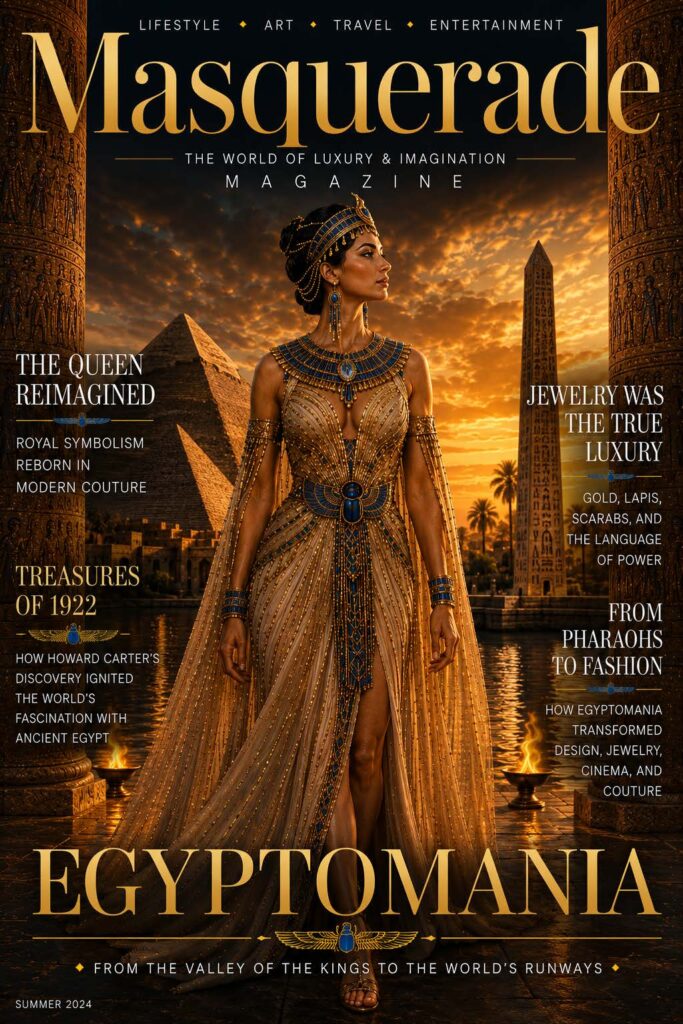
A modern journey through Egypt becomes a passage into 1922—when Howard Carter opened Tutankhamun’s tomb and the world rediscovered the visual language of the Nile.
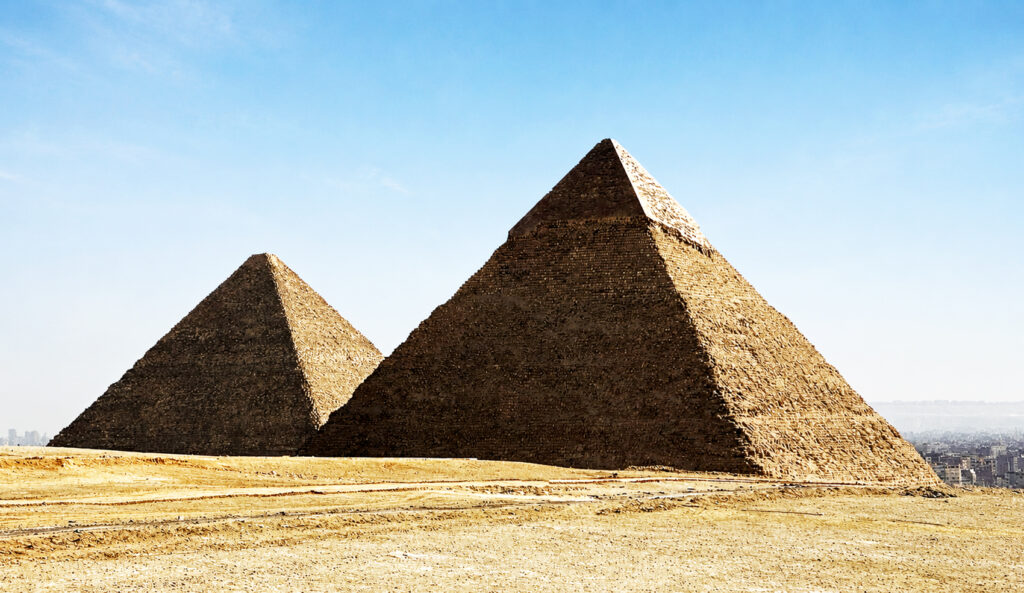
The story of Egyptomania does not begin in a Paris salon, a jeweler’s workshop, or beneath the lights of a fashionable ballroom. It begins in the desert, where the pyramids of Giza rise with a certainty that makes the modern world seem temporary. Their geometry is familiar from a lifetime of photographs, yet nothing prepares the traveler for their physical presence: the scale of the stones, the sharp sweep of the walls, and the way sunlight divides each pyramid into planes of gold and shadow.
We came to Egypt searching for the civilization behind the images—its temples and tombs, its kings and queens, its reverence for the Nile, and its belief that beauty could carry meaning across eternity. What began at Giza would lead us south along the river to Luxor and the Valley of the Kings. There, one name would gather the entire journey into a single moment: Tutankhamun.
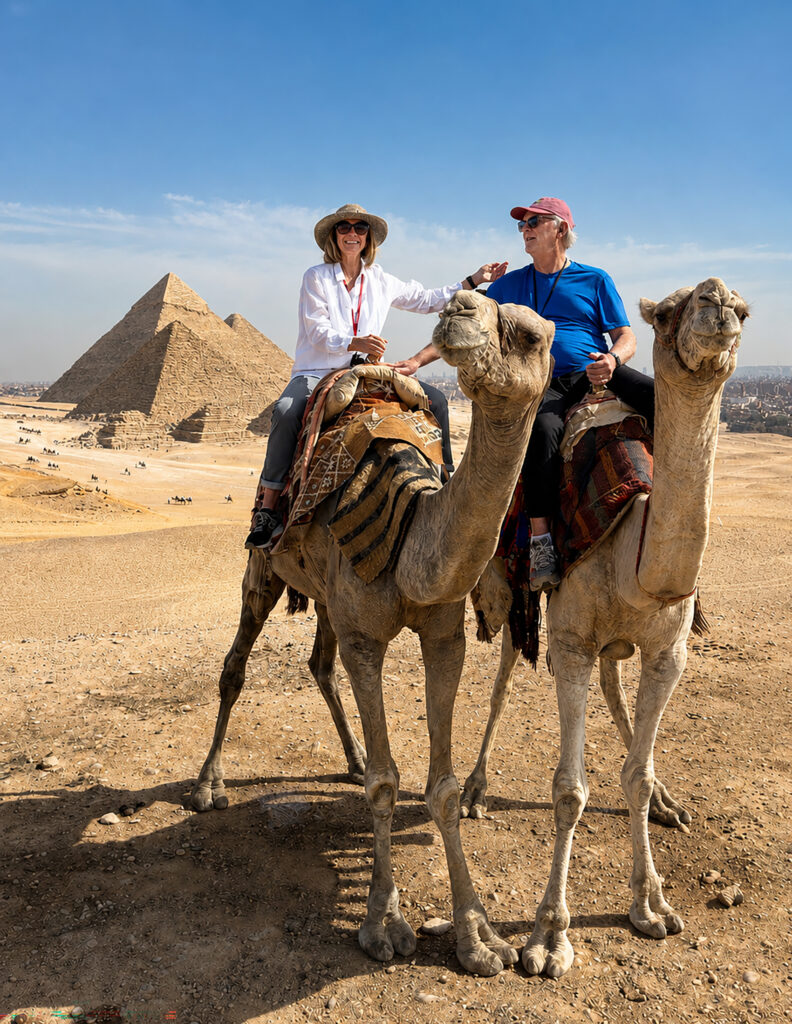
Jacque Pell and Terry Check at Giza—beginning a personal journey that would follow the Nile toward Luxor and the Valley of the Kings.
Our camel ride across the plateau supplied the human scale that monuments often resist. The scene was playful and unmistakably modern—sunglasses, travel hats, laughter—yet the pyramids behind us belonged to a world more than four millennia old. That contrast became the heartbeat of the story: ancient Egypt is never only in the past. It is constantly being encountered, interpreted, photographed, worn, collected, and reimagined.
The River That Carried a Civilization

A traditional sailing vessel on the Nile, where river, farmland, and desert still define the rhythms of Egypt.
To travel through Egypt is to understand the Nile as more than a river. It is a road, a calendar, a source of food, a border between fertility and desert, and the central line of a civilization. Along its banks, green fields press against ochre hills. Villages, palms, and temple ruins appear in succession, each tied to the water that made settlement possible.
As we moved south, the landscape prepared us for Luxor—the ancient city of Thebes, where royal power, sacred architecture, and the mythology of the afterlife reached their most theatrical expression. The journey itself became part of the narrative. We were not arriving at an isolated archaeological site; we were following the same geographic corridor that carried pharaohs, priests, workers, pilgrims, and funerary processions.
The visual vocabulary of Egypt was already assembling around us: black and gold, lapis blue, turquoise, scarabs, winged forms, lotus blossoms, broad collars, towering crowns, and columns covered with hieroglyphs. These symbols would later be transformed by European designers into the glamour of Egyptomania. But here, beside the Nile, they still belonged to their original landscape.
Luxor: The Great Stage of the Gods
The monumental remains of Luxor’s temple complexes reveal the scale and ceremonial power of ancient Thebes.
Luxor is an open-air archive of ambition. Colossi stand beside processional ways; walls carry scenes of victory, worship, and divine authority; broken capitals lie beside columns that still command the sky. The stones are weathered, but their intention remains clear. Architecture was designed to overwhelm the senses and affirm an ordered universe in which the pharaoh stood between humanity and the gods.
At Karnak and Luxor, the repetition of columns creates a rhythm almost musical in its effect. Light falls between them in narrow shafts. Carved figures emerge from shadow. The visitor moves through spaces conceived not simply as buildings, but as ceremonial experiences. It is easy to understand why later artists and designers found Egypt irresistible: nearly every surface offers a pattern, emblem, silhouette, or dramatic contrast waiting to be translated.
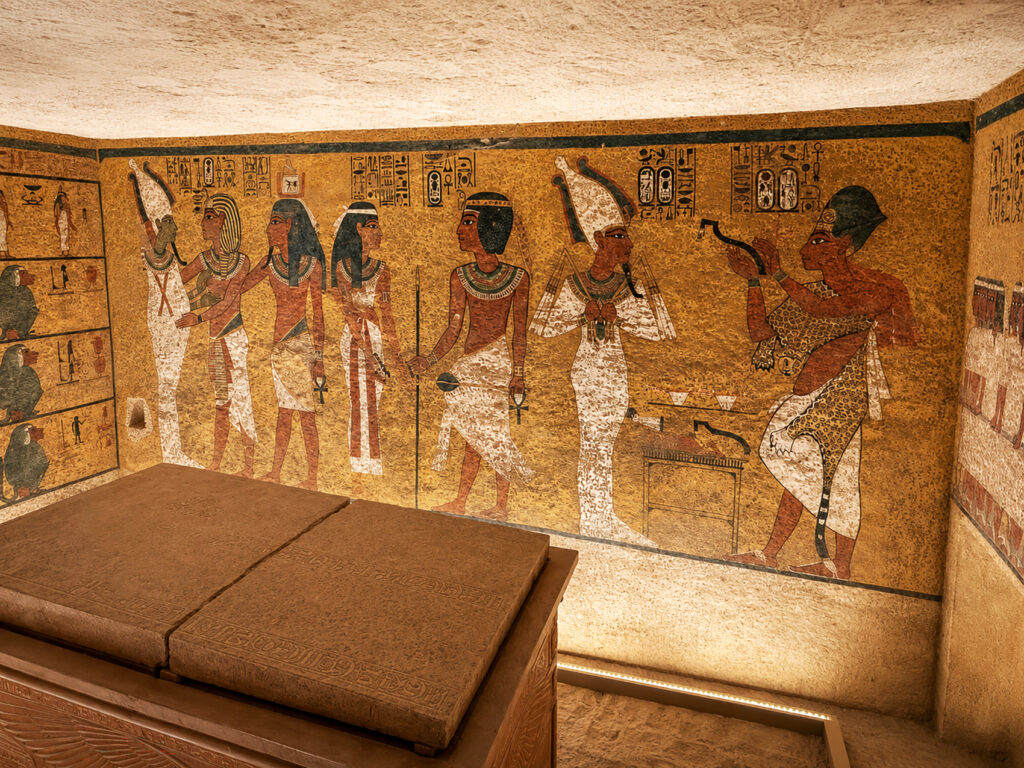
Inside a royal tomb, painted figures and hieroglyphic texts transform the chamber into a sacred map of the afterlife.
The tomb paintings add color to that architecture. Ochre, red, black, white, green, and blue survive in scenes of gods, rulers, offerings, and ritual passage. The figures are not decoration in the modern sense. They are active participants in a spiritual system intended to guide and protect the dead. Even now, the painted walls create the sensation that one has entered a story still unfolding.
In Search of the Boy King
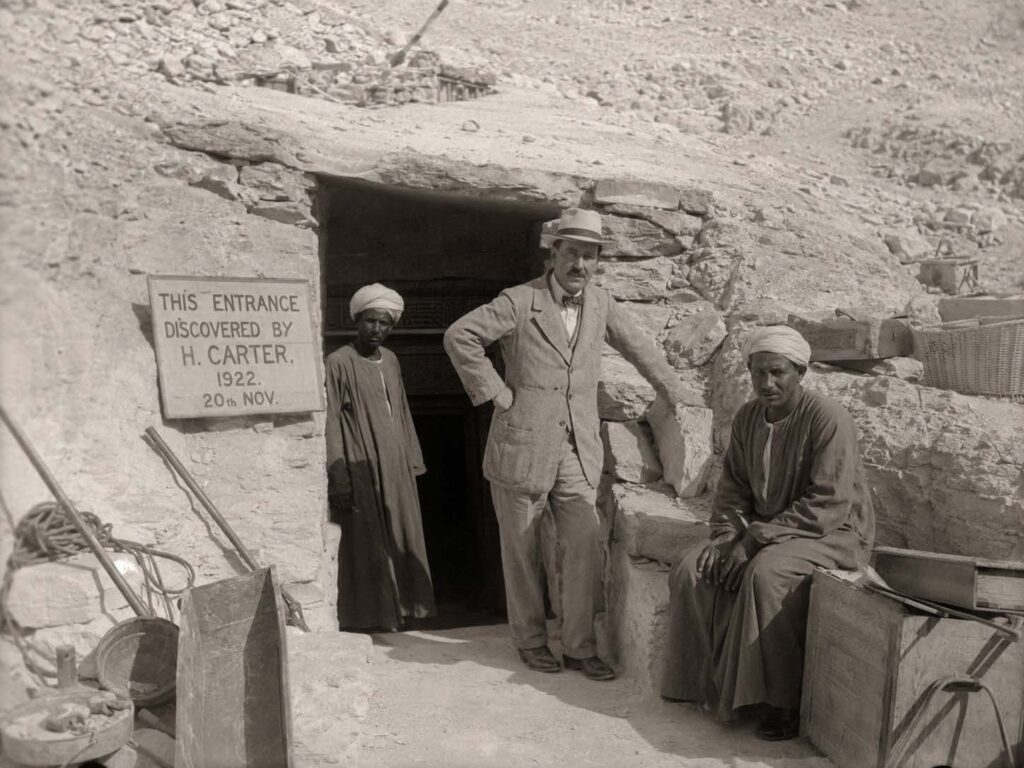
Across the Nile from Luxor, the fertile riverbank gives way to a dry, mountainous world. The Valley of the Kings does not announce itself with pyramids. Its royal tombs are cut into the earth, concealed within a landscape of stone and heat. This was the setting in which Howard Carter spent years searching for a king whose burial place had disappeared beneath debris and later construction.
Howard Carter at the entrance associated with Tutankhamun’s tomb, surrounded by Egyptian members of the excavation team. Historical-style archival image.
In November 1922, a step was uncovered beneath the remains of ancient workers’ huts. More steps followed, descending to a sealed doorway. The discovery was methodical, not magical: careful excavation, recording, patience, and the work of Egyptian laborers whose contributions were essential to the find. Yet the result felt like the opening of a legend.
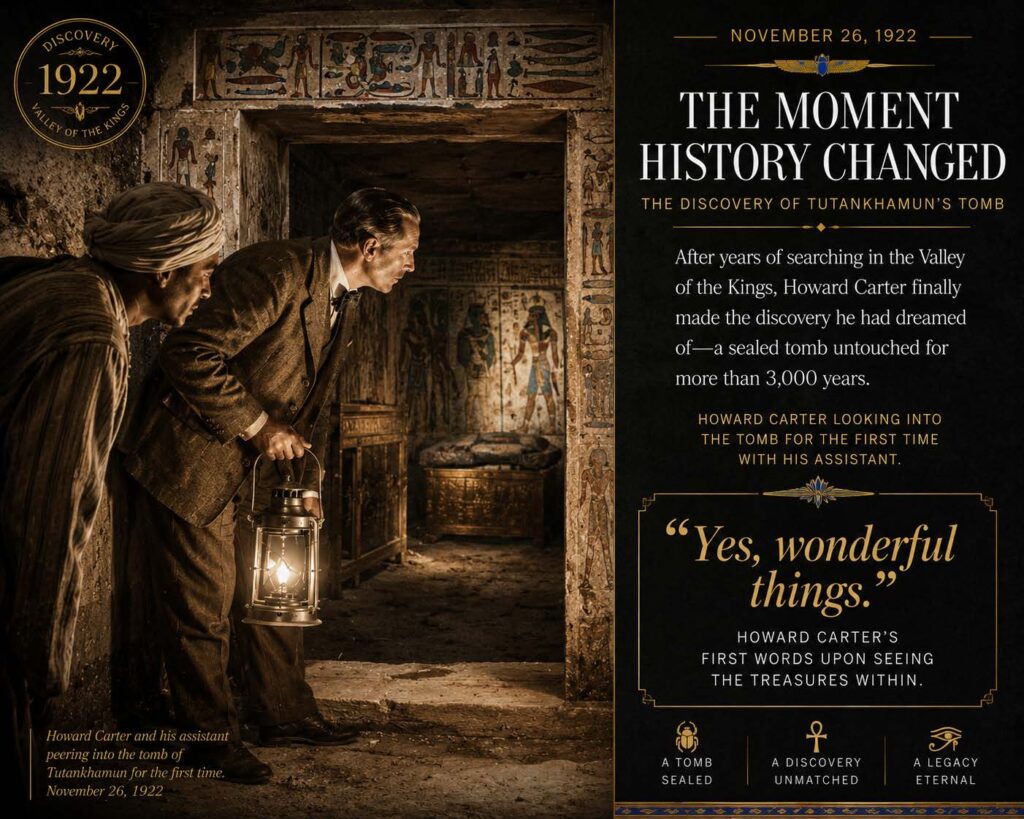
When Carter made a small opening in the sealed entrance and looked inside by candlelight, Lord Carnarvon asked whether he could see anything. Carter’s famous reply—recorded in slightly different forms—has become inseparable from the discovery: ‘Yes, wonderful things.’
A dramatic editorial reconstruction of Howard Carter looking into the tomb for the first time. This image is an artistic interpretation, not a historical photograph.
| “Yes, wonderful things.” |
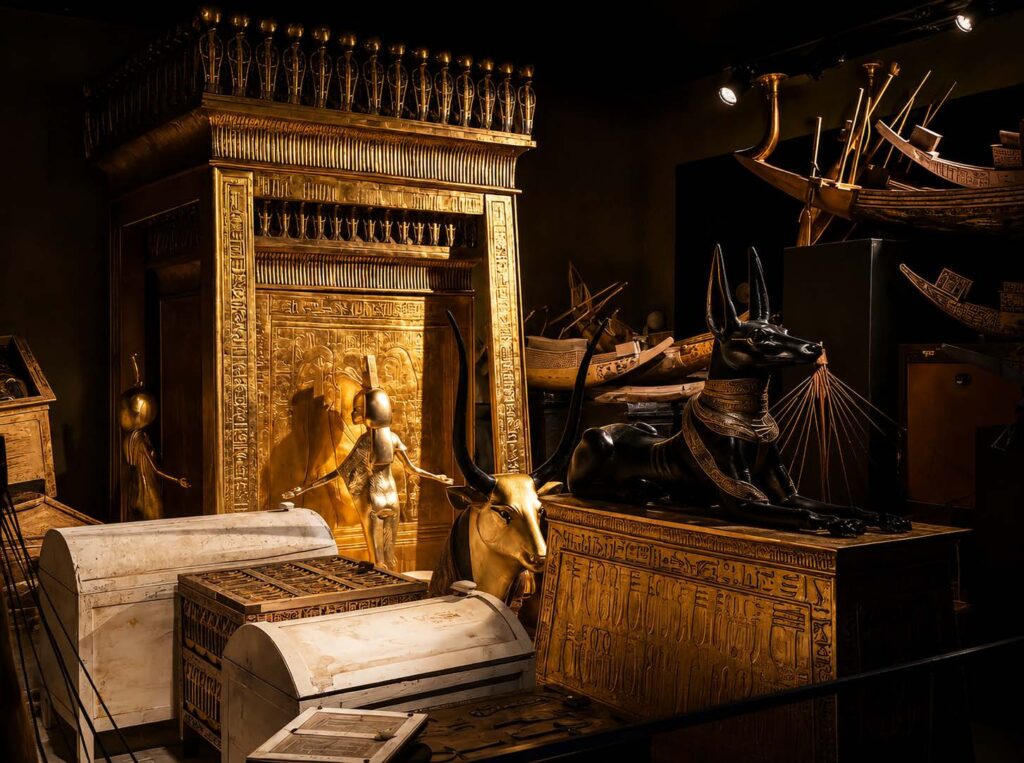
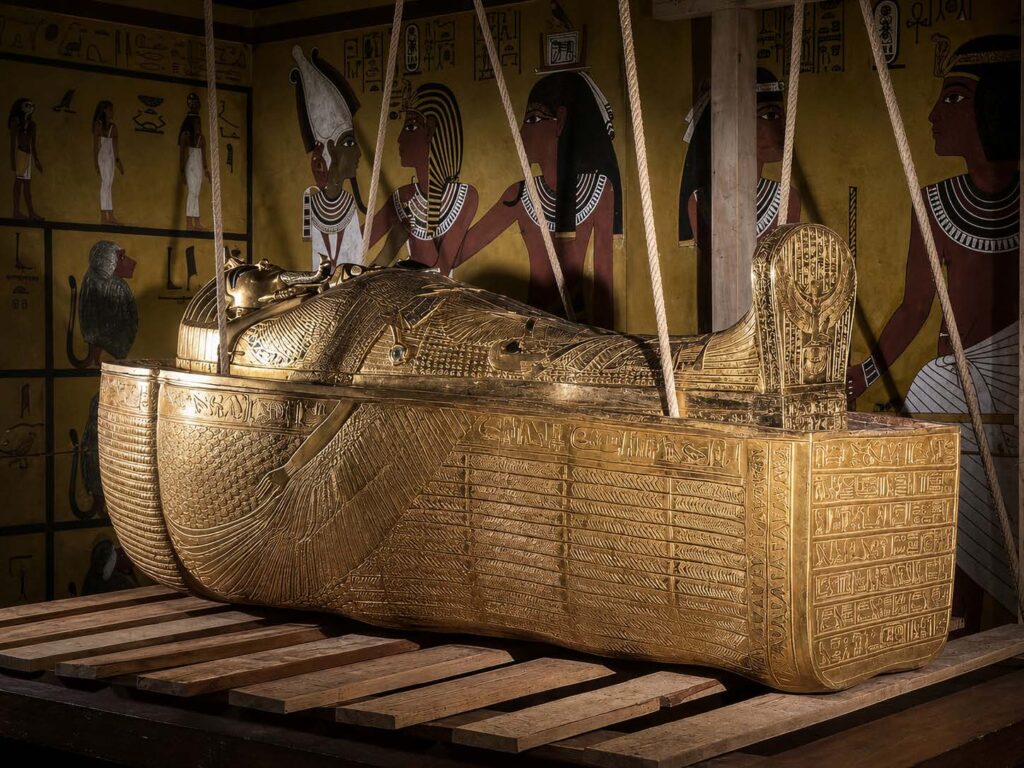
The phrase endures because it captures the astonishment of the scene. In the dim chamber stood gilded couches, chests, statues, disassembled chariots, ritual objects, and furniture crowded together in apparent disorder. Beyond them lay additional sealed rooms and, ultimately, the nested shrines, coffins, and mummy of Tutankhamun. The tomb was not completely untouched, but it survived with a wealth of material unmatched by any other royal burial discovered in the Valley of the Kings.
Treasures associated with Tutankhamun’s burial: gilded furniture, ritual forms, model boats, and protective imagery.
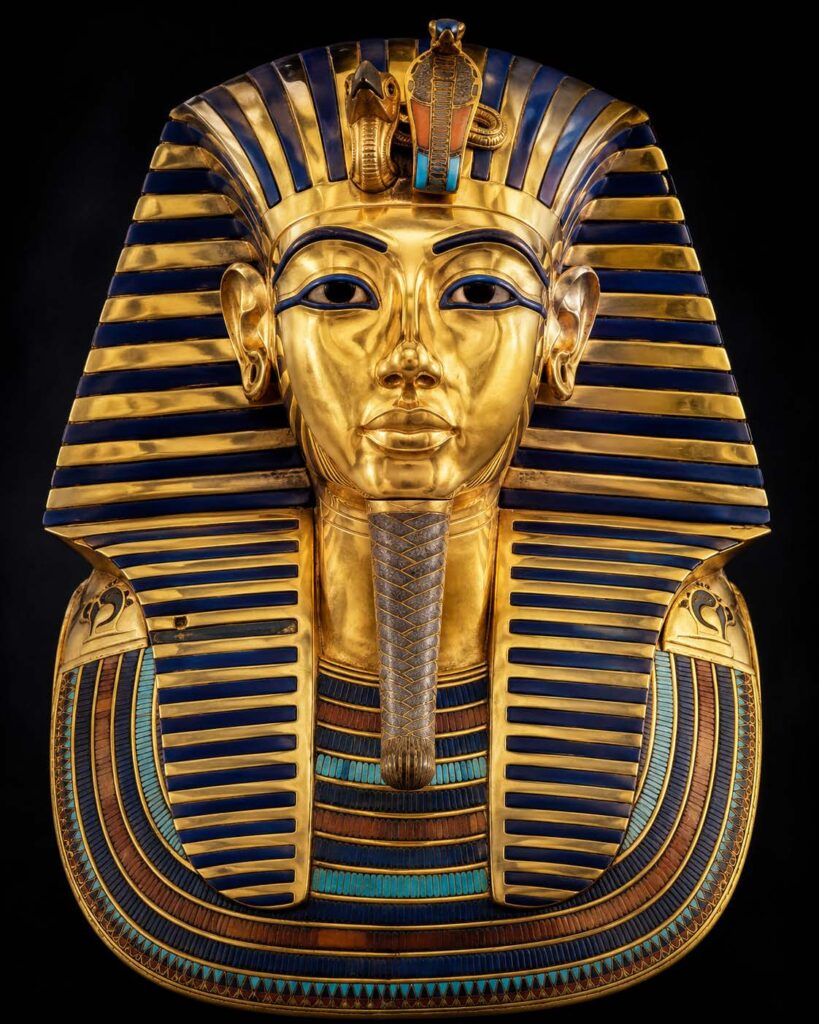
Tutankhamun’s gold funerary mask became the defining face of the discovery and one of the most recognizable works of ancient art.
The mask distilled the visual power of the entire find. Gold suggested divine flesh; blue glass and stone created the striped nemes headdress; the cobra and vulture proclaimed royal authority. The face is idealized, serene, and almost impossibly modern in its graphic clarity. Reproduced in newspapers, exhibitions, books, and later popular culture, it became the emblem through which millions encountered ancient Egypt.
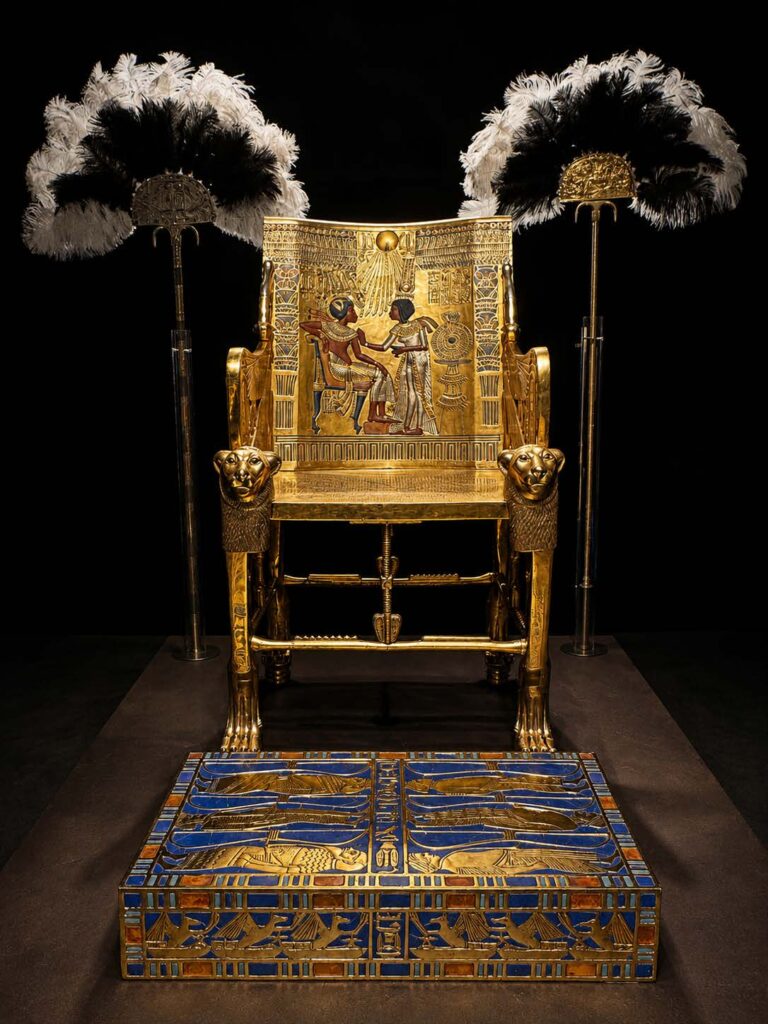
Tutankhamun’s ceremonial throne and jeweled footstool display the extraordinary craftsmanship revealed by the 1922 discovery.
The throne offered another revelation: intimacy. Its back panel shows the young king and his wife, Ankhesenamun, in a tender domestic scene beneath the rays of the sun. Around that image are lion forms, royal symbols, colored inlays, and a footstool decorated with bound enemies. Beauty, affection, politics, religion, and power are compressed into a single object.
THE BIRTH OF MODERN EGYPTOMANIA
When the World Went Egyptian
Europe and America had experienced earlier waves of fascination with Egypt, especially after Napoleon’s expedition and the decipherment of hieroglyphs. But Tutankhamun’s tomb gave that fascination a spectacular new catalyst. Newspapers turned archaeology into international drama. Photographs of gilded objects traveled faster than the objects themselves. Egypt became not only a place and a history, but a visual sensation.
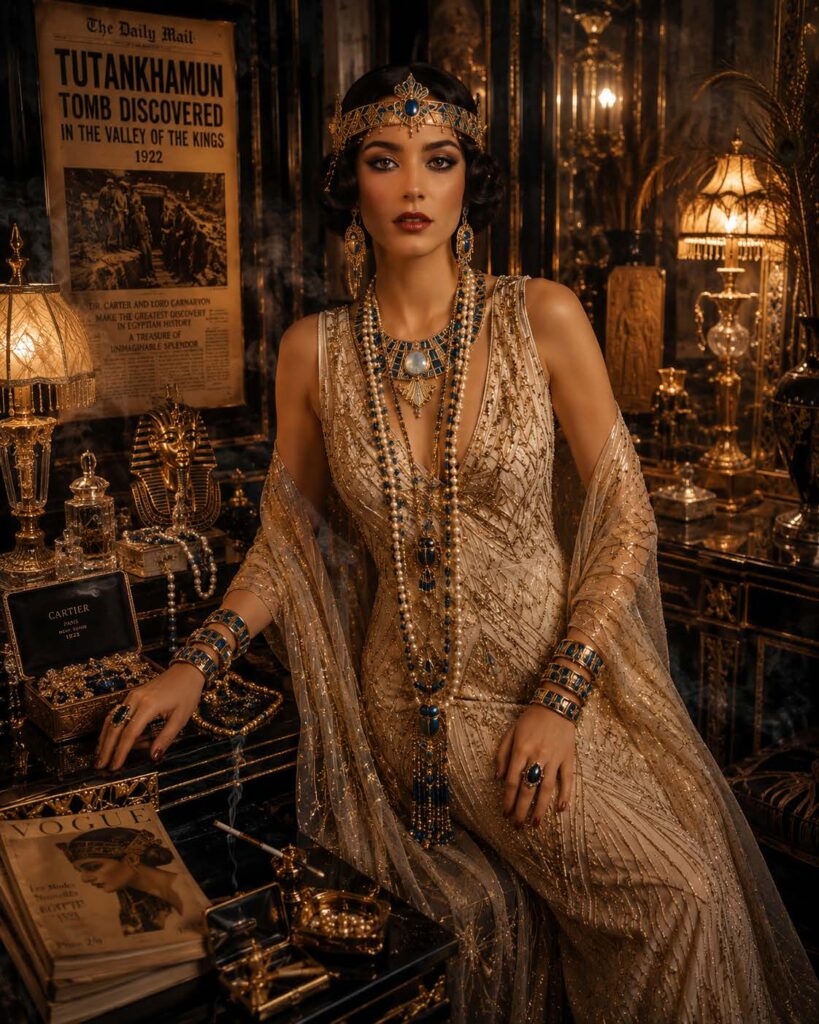
An imagined 1920s salon where news of Tutankhamun’s tomb merges with Egyptian-inspired fashion and jewelry. Artistic interpretation.
The timing was perfect. The discovery arrived during the Jazz Age, when fashion was abandoning heavy Edwardian conventions and embracing shorter hair, freer silhouettes, geometric decoration, theatrical nightlife, and a new appetite for the exotic. Egyptian motifs—already well suited to Art Deco—appeared on evening dresses, headbands, cigarette cases, furniture, theater sets, advertisements, and jewelry.
A fictional 1923 fashion cover created in the visual spirit of the period. It should be identified in publication as a modern artistic interpretation, not an authentic Vogue cover.
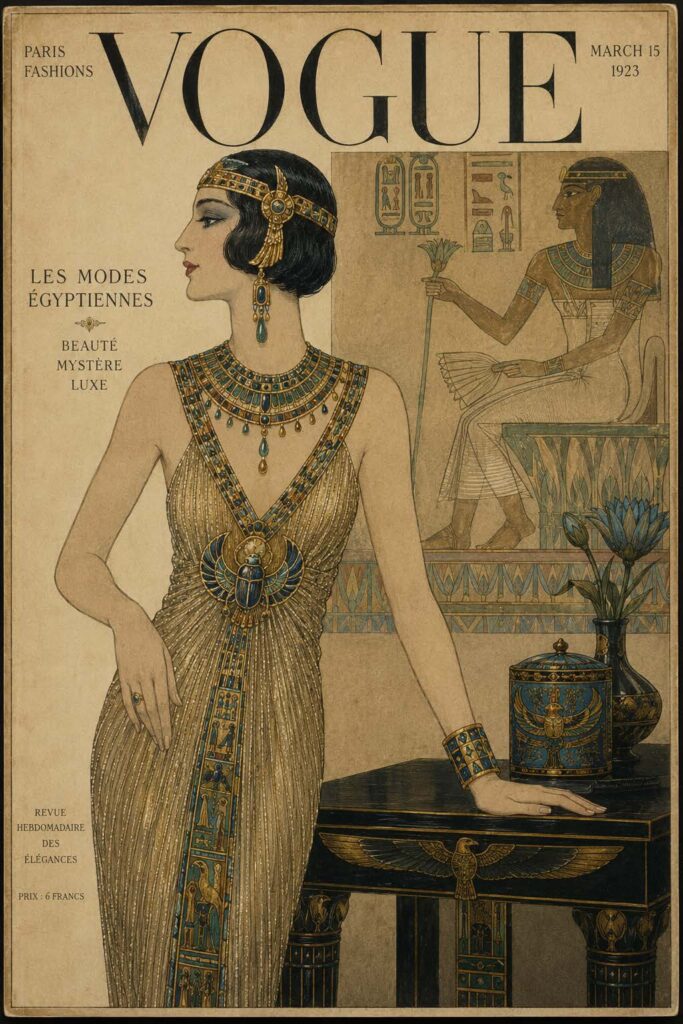
Egyptian Evening Mode: a modern fashion plate imagining how lotus, scarab, sun-disc, and geometric motifs might have been translated into 1920s couture.
Designers did not simply copy archaeological objects. They edited, enlarged, simplified, and recombined them. A broad Egyptian collar became the neckline of a beaded gown. The winged scarab became a brooch or belt clasp. The lotus became an embroidered repeat. Lapis blue, turquoise, coral, onyx, and gold formed a palette that looked ancient and unmistakably modern at the same time.
The Visionaries
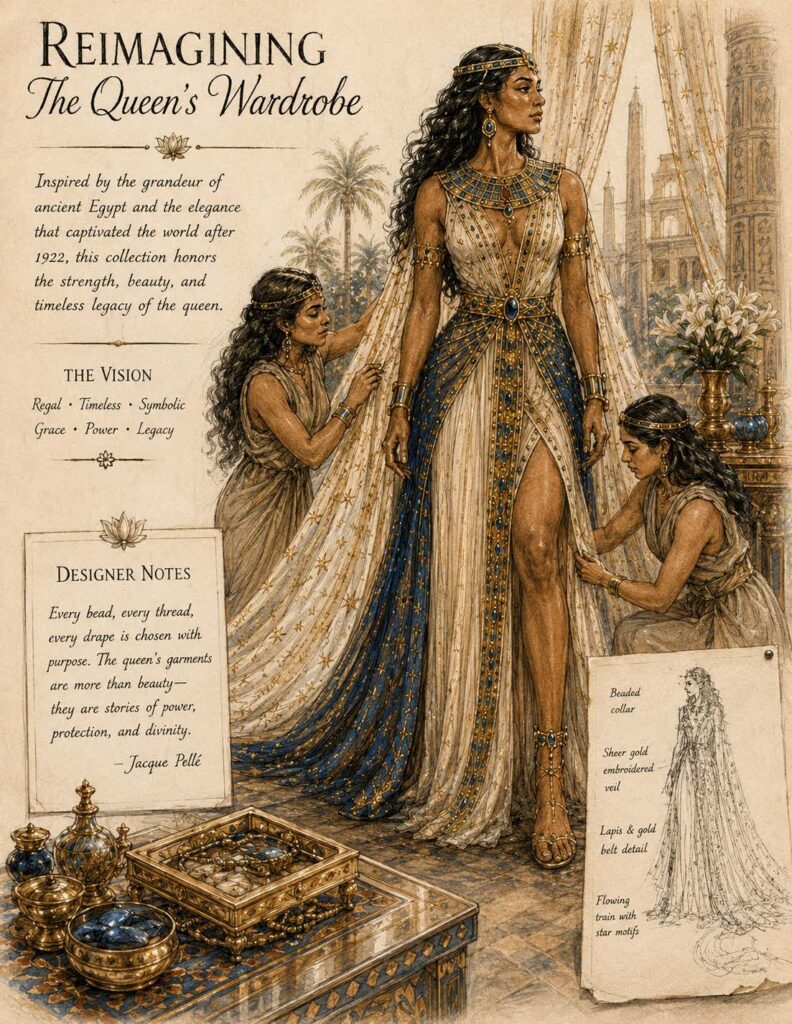
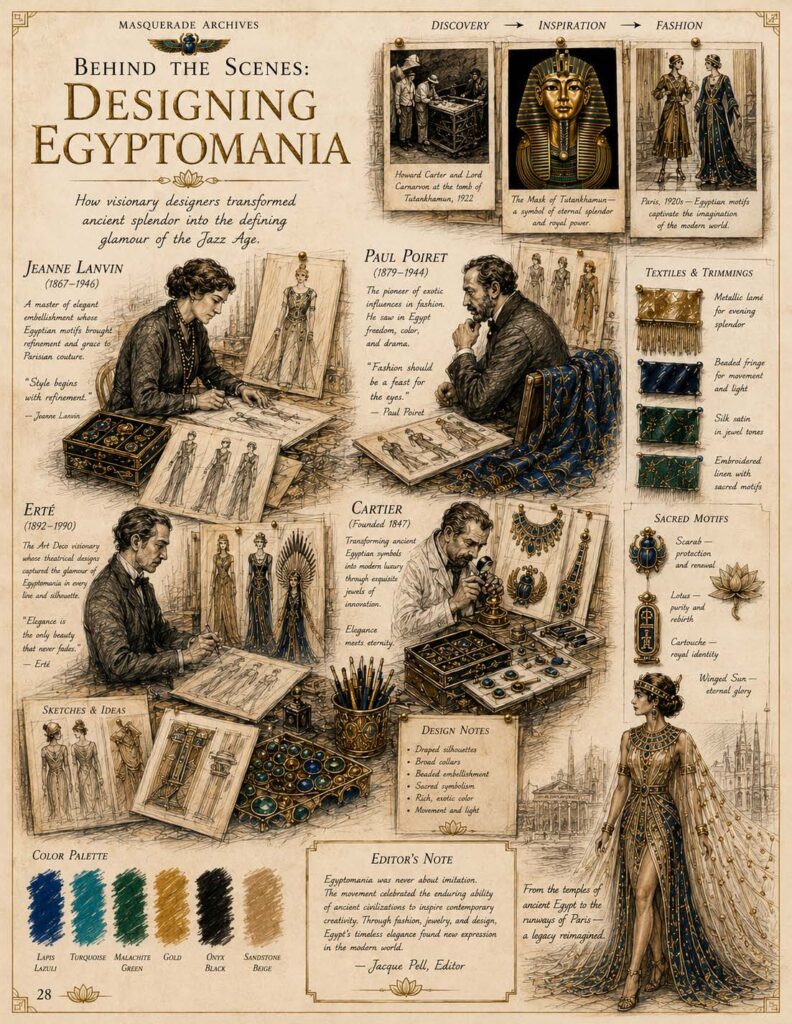
Behind the Scenes: Designing Egyptomania—an illustrated editorial overview of the artists, couturiers, materials, and motifs behind the movement.
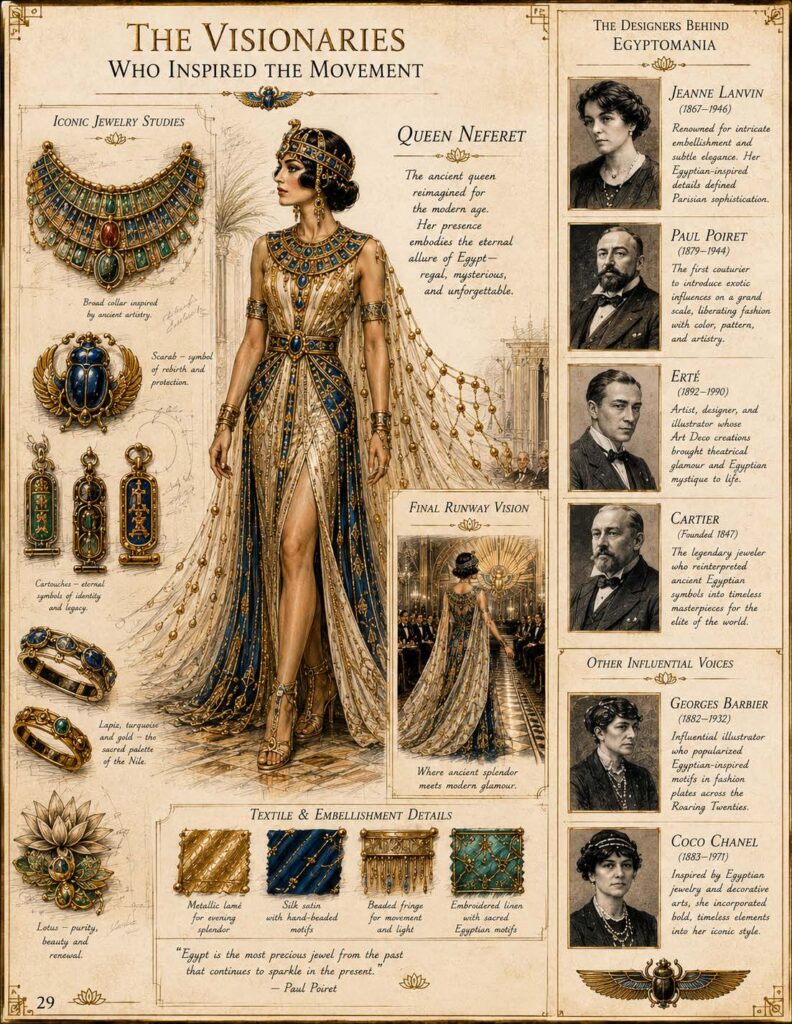
Jeanne Lanvin brought refinement and intricate embellishment to Paris couture. Paul Poiret had already introduced audiences to dramatic, non-Western influences and liberated silhouettes. Erté translated exoticism into the elegant line and theatrical glamour of Art Deco illustration. Cartier transformed ancient symbols into jewels for an international elite, often pairing Egyptian forms with onyx, diamonds, turquoise, lapis, coral, and emeralds.
Their approaches differed, but they shared a willingness to treat history as a living design archive. The tomb supplied objects; modernity supplied motion. Ancient symmetry met the new vertical line of the evening dress. Protective emblems became personal adornment. Royal imagery moved from temple and tomb to stage, salon, and ballroom.
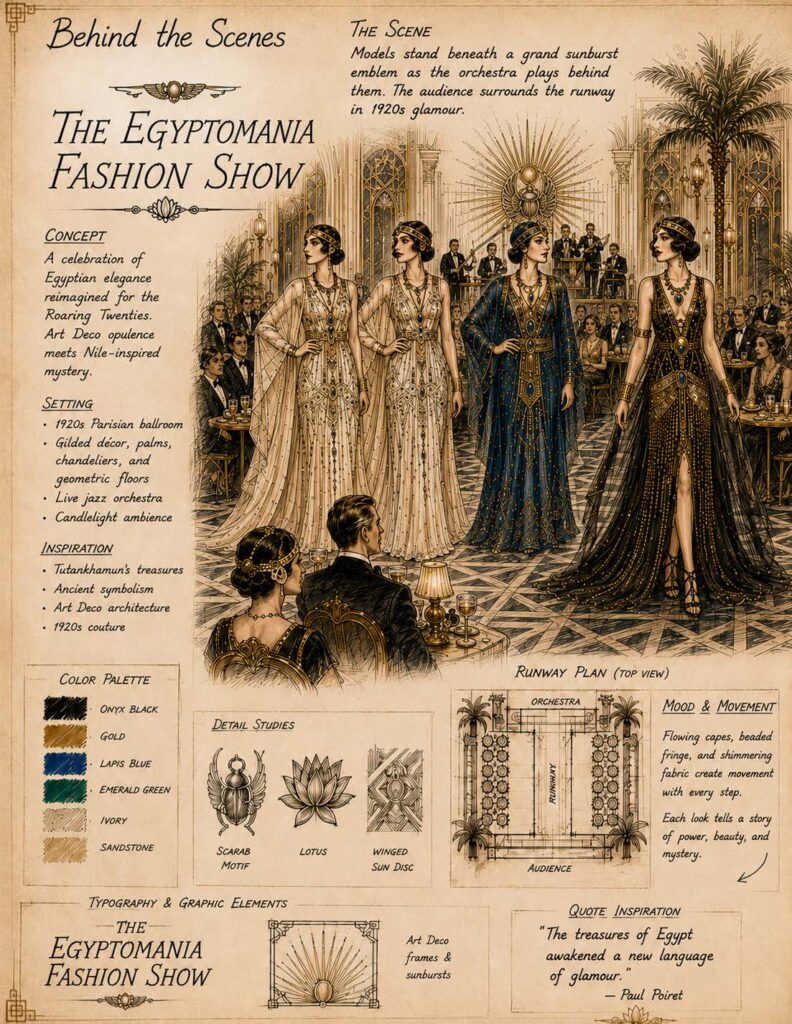
The Visionaries Who Inspired the Movement—an editorial design study linking Egyptian motifs with the designers who reshaped them for the modern age.
This is where our feature deliberately changes register. The first half follows real places, surviving monuments, and the documented discovery of Tutankhamun’s tomb. The second half explores interpretation. The queens, gowns, fashion plates, and design boards that follow are not archaeological reconstructions. They are contemporary editorial fantasies—visual essays on the way Egypt continues to stimulate the imagination.
Reimagining the Queen
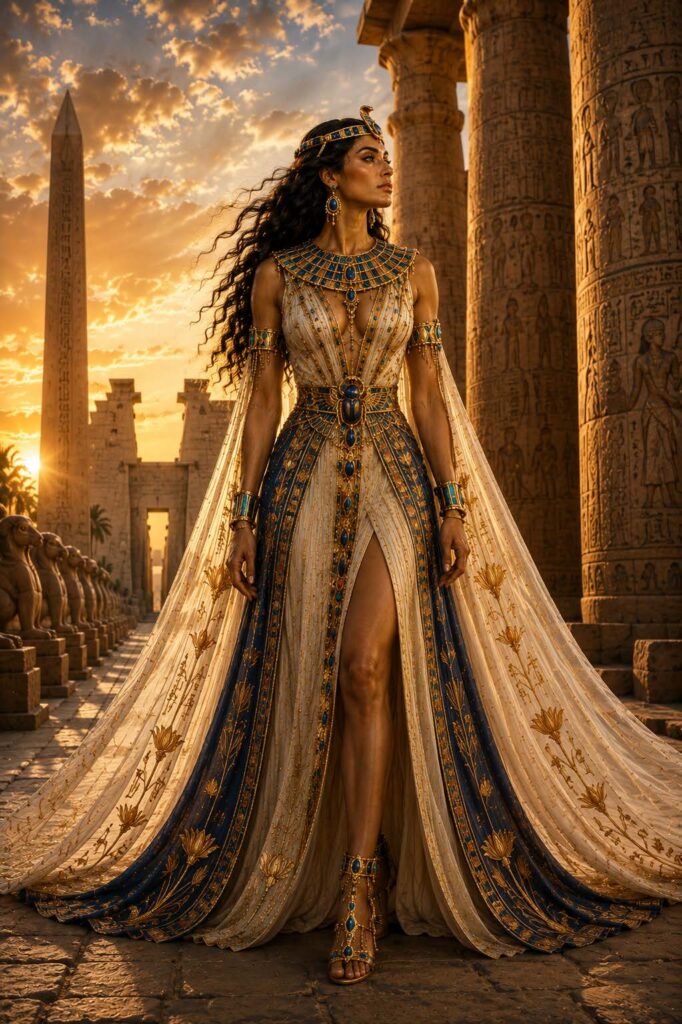
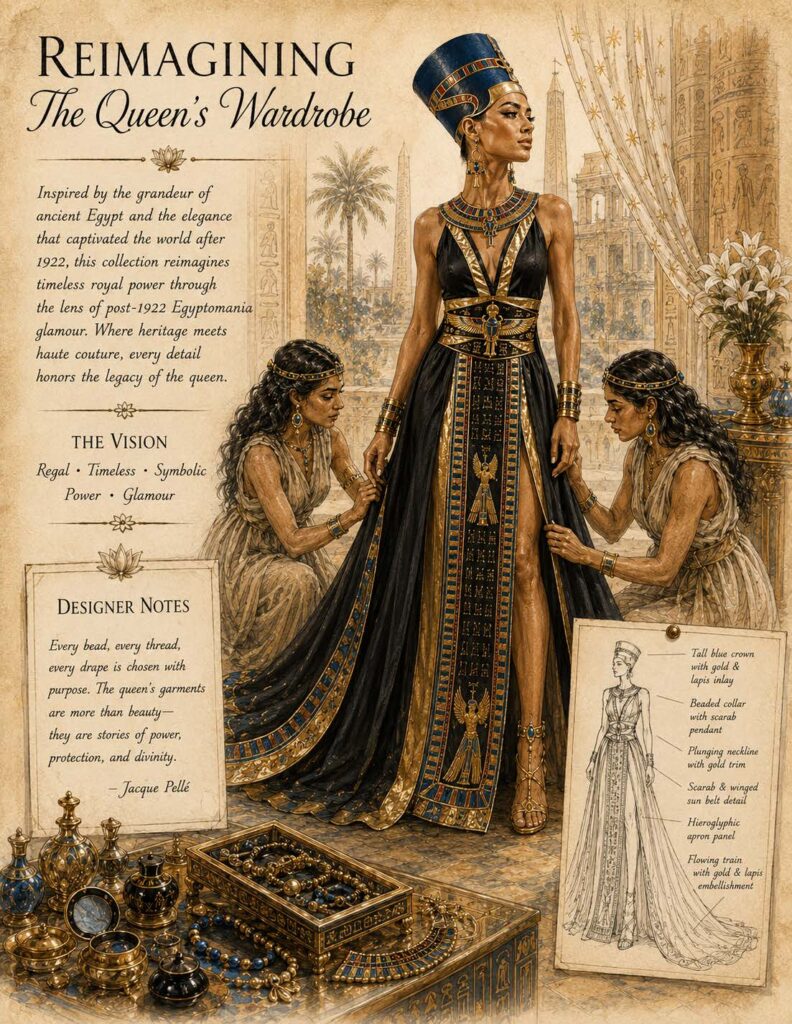
Reimagining the Queen’s Wardrobe: a black-and-gold couture concept built from scarab, winged-sun, broad-collar, and hieroglyphic motifs.
Our imagined queen is not presented as a specific historical ruler. She represents the enduring idea of Egyptian sovereignty: poised, symbolic, and inseparable from color and ornament. Her tall blue crown gives the silhouette architectural height. A broad collar frames the face. Gold trim follows the geometry of the body, while a central hieroglyphic panel creates the visual authority of a royal inscription.
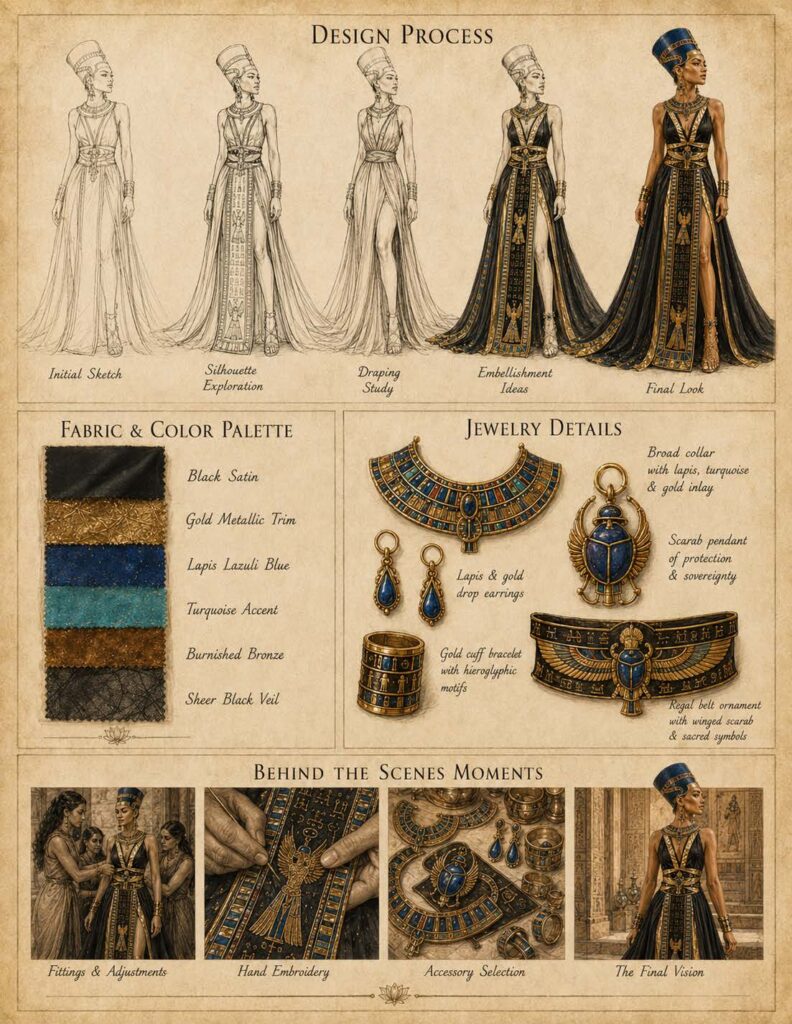
Design Process: the final black-and-gold look develops from sketch and draping study to textile, jewelry, and embellishment decisions.
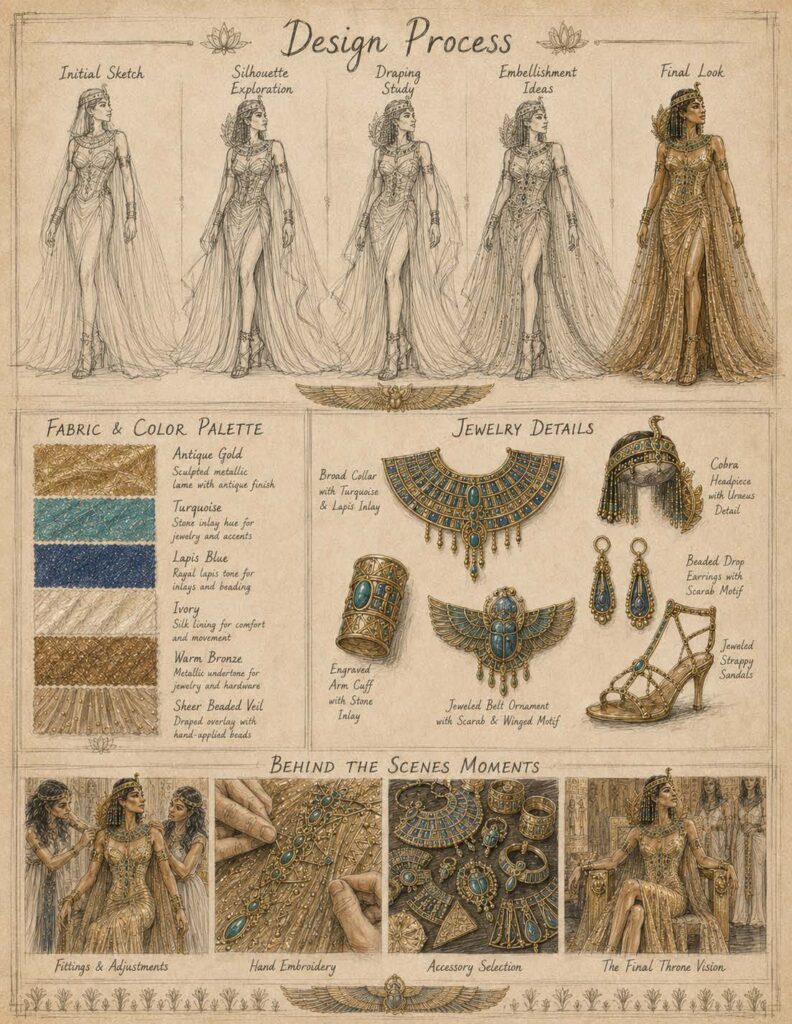
The design process makes the act of transformation visible. The silhouette begins as line, then acquires drape, structure, and movement. Black satin gives depth; metallic gold defines edges; lapis and turquoise provide concentrated color. Jewelry is treated as architecture: collar, cuff, earrings, scarab pendant, and winged belt ornament align the body with a system of symbols.
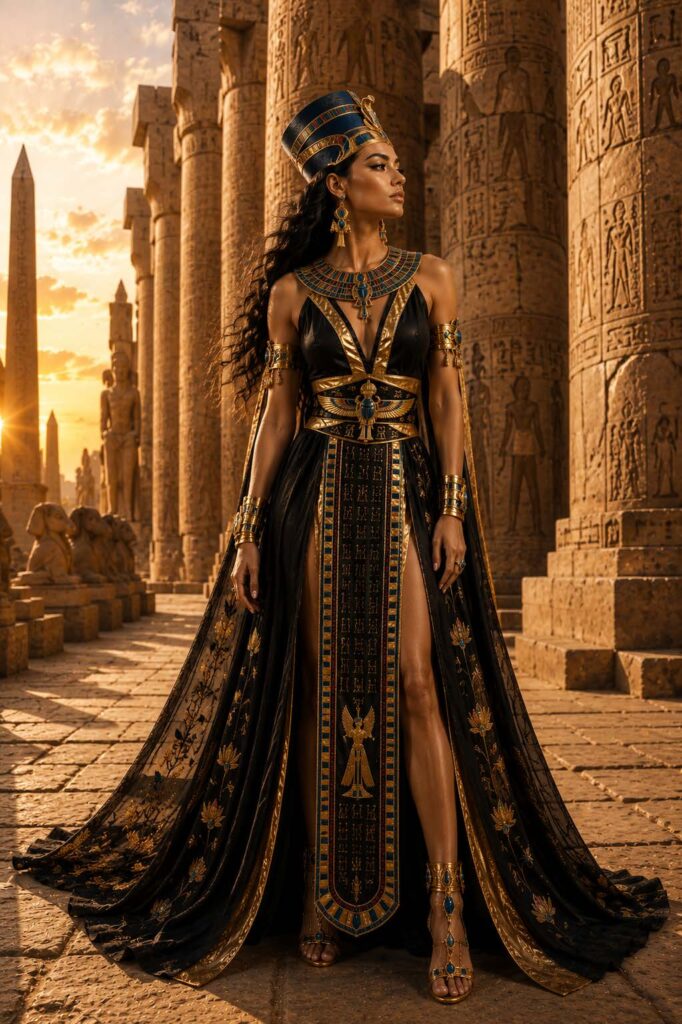
The completed black-and-gold couture vision at a monumental temple setting. Artistic interpretation.
Placed among columns and obelisks, the final gown creates a deliberate tension. The setting suggests antiquity, but the garment belongs to fantasy couture. The plunging neckline, high slit, fitted waist, and sweeping train are modern inventions. Their purpose is not to claim historical accuracy, but to show how ancient imagery can be reshaped into a contemporary language of confidence and spectacle.
Reimagining the Queen’s Wardrobe: an ivory-and-lapis variation emphasizing fluidity, light, and the ceremonial sweep of the train.
The ivory-and-blue variation changes the emotional register. Where black and gold suggest night, power, and mystery, ivory and lapis suggest sunlight, air, and movement. The sheer train becomes almost architectural, like a curtain lifted by the Nile breeze. Lotus embroidery softens the geometry, while the beaded collar and belt retain the commanding visual structure associated with royal dress.
The ivory-and-lapis queen in a cinematic temple landscape. Artistic interpretation inspired by Egyptomania rather than historical dress.
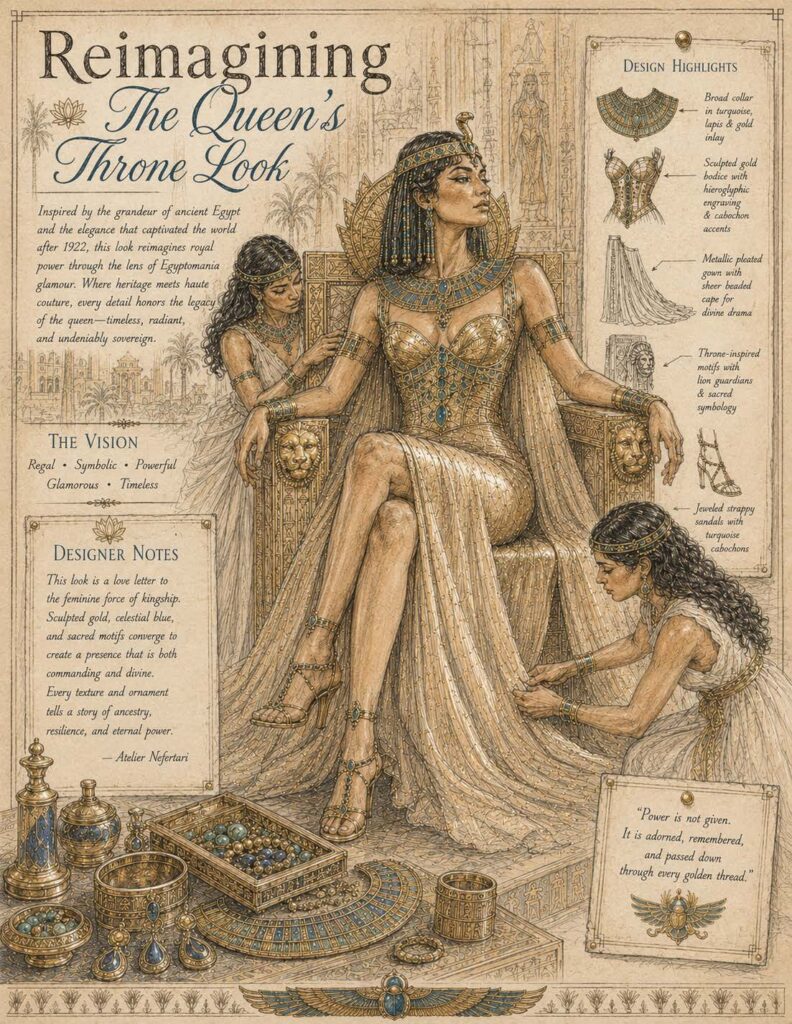
Reimagining the Queen’s Throne Look
Artistic interpretation for Masquerade Magazine. This editorial board reimagines the queen’s throne look, linking a sculpted gold gown, turquoise and lapis jewelry, lion-guardian motifs, and ceremonial royal symbolism.
Design Process
Artistic interpretation for Masquerade Magazine. The design process moves from initial sketch and silhouette exploration to draping, embellishment, fabric palette, jewelry details, fittings, and the completed couture vision.
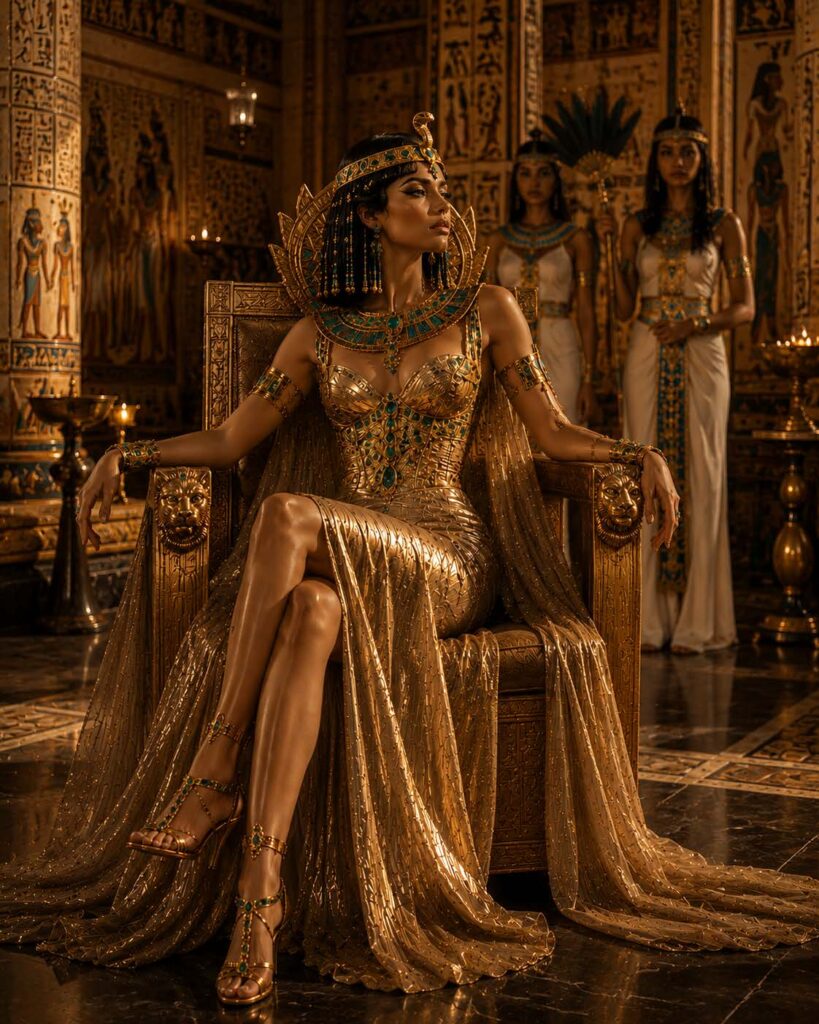
The Final Throne Vision
The completed gold-and-turquoise throne vision transforms the design studies into a cinematic couture portrait. Artistic interpretation inspired by Egyptomania rather than historical dress.
The Fashion Show That Never Was
Behind the Scenes: The Egyptomania Fashion Show—an imagined 1920s ballroom where Nile-inspired couture meets Art Deco theater.
Imagine Paris in the early 1920s. A jazz orchestra plays beneath palms and gilded sunbursts. Guests gather around a geometric runway as models appear in ivory, lapis, gold, emerald, and black. Beaded fringe catches the light. Capes move behind them. Scarabs, lotuses, winged discs, and cartouches are magnified into theatrical emblems.
No single historical show looked exactly like this. The scene is a composite fantasy, but it expresses something historically true: Egyptomania was performance. It invited people to inhabit a dream of antiquity remade for electric light, modern music, photography, and mass media. The past became glamorous because it was staged as the future
The Spell Remains
Our journey began beneath the pyramids and followed the Nile toward Luxor. We entered temples where columns still hold the memory of ceremony. We descended into painted chambers and crossed the austere landscape of the Valley of the Kings. In searching for Tutankhamun, we found the hinge between two worlds: ancient Egypt as it survived underground, and modern Egyptomania as it exploded across the twentieth-century imagination.
The discovery of 1922 did more than reveal treasure. It released a visual language. Gold, lapis, scarabs, lotuses, falcons, crowns, collars, and hieroglyphic geometry moved from tomb to newspaper, from museum to atelier, from archaeology to fashion. Some interpretations were scholarly; others were fanciful. Together, they proved that ancient Egypt could be endlessly rediscovered.
A contemporary queen in black-and-gold couture closes the visual journey—from ancient monument to modern imagination.
Standing among the ruins, it is tempting to think of Egypt as timeless. But perhaps its real power is more active than that. Egypt is continually entering new times. Every generation sees the pyramids again, encounters the face of Tutankhamun again, and reshapes the symbols of the Nile according to its own desires.
| “We went to Egypt in search of a tomb. We returned with the story of an imagination that never stopped traveling.” |
Editorial and Image Note
This cover story combines travel photography, archaeological subjects, historical-style imagery, and newly created artistic interpretations. In the published story, every reconstruction, fictional fashion cover, conceptual queen, and design board should be clearly captioned as an artistic interpretation.
