A dreamlike journey through jazz, velvet, friendship, and the hidden glamour of the Roaring Twenties
Story by Terry Check
The Dream Begins
The dream came to me near dawn.
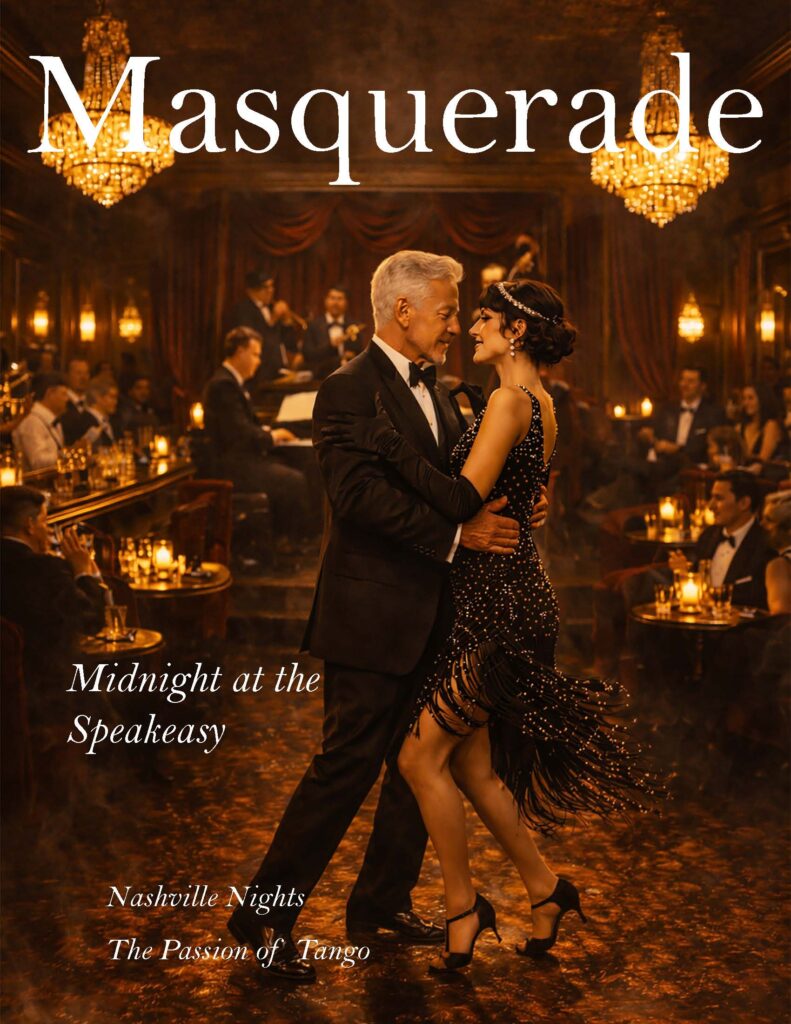
I had gone to sleep thinking about the Roaring Twenties — about jazz, hidden doors, old glamour, and the kind of elegance that seems to belong most naturally to midnight. Somewhere between memory and imagination, I drifted into another era and found myself on a rain-darkened city street beneath amber lamps, dressed for evening and standing beside two friends as though I had always belonged there.
Graham Hale stood at my left, calm and self-possessed, a man whose quiet presence never needed to announce itself. To my right was Luke Mercer, quick with a grin and already half in love with the night before we had even entered it. Ahead of us was an unmarked door beneath a bronze lantern, nothing more — and yet everything about it suggested that something extraordinary waited below.
“This is it,” Graham said.
Luke smiled. “Then let’s not keep midnight waiting.”
The Hidden Door
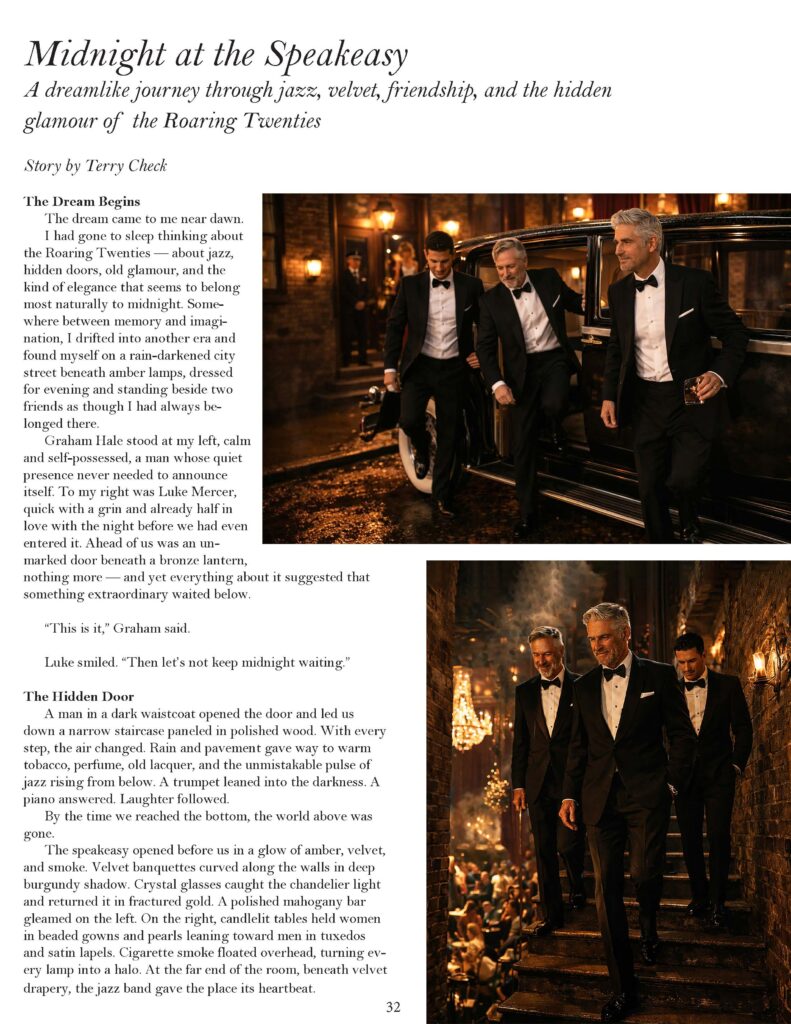
A man in a dark waistcoat opened the door and led us down a narrow staircase paneled in polished wood. With every step, the air changed. Rain and pavement gave way to warm tobacco, perfume, old lacquer, and the unmistakable pulse of jazz rising from below. A trumpet leaned into the darkness. A piano answered. Laughter followed.
By the time we reached the bottom, the world above was gone.
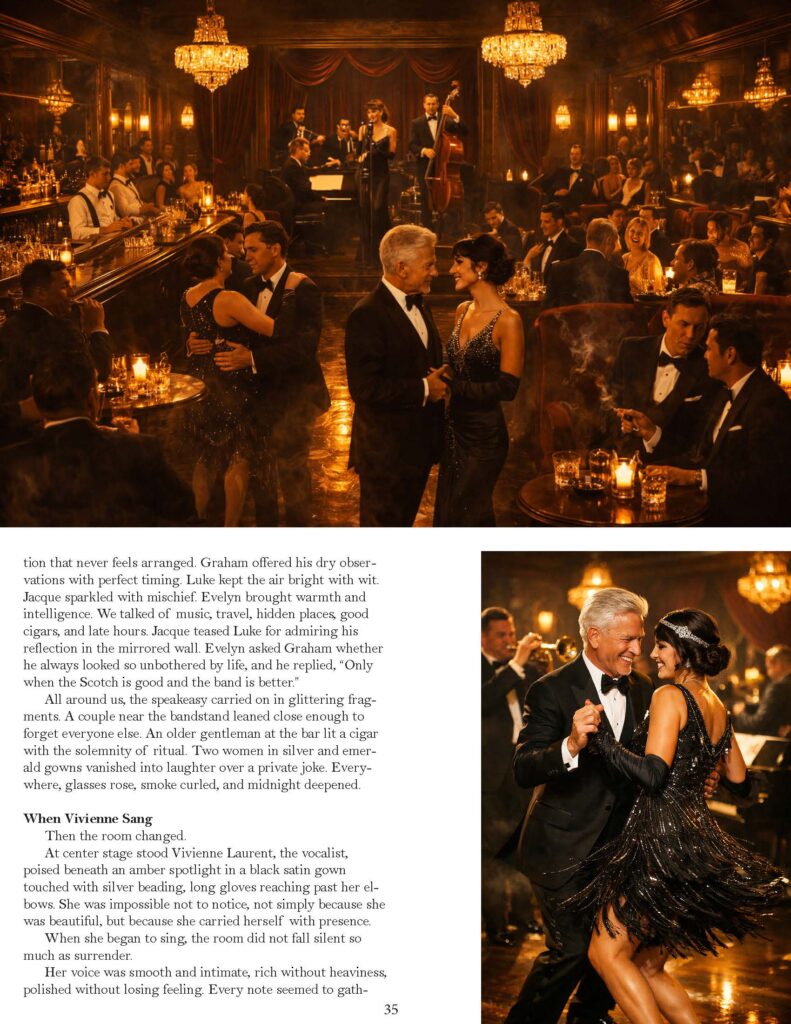
The speakeasy opened before us in a glow of amber, velvet, and smoke. Velvet banquettes curved along the walls in deep burgundy shadow. Crystal glasses caught the chandelier light and returned it in fractured gold. A polished mahogany bar gleamed on the left. On the right, candlelit tables held women in beaded gowns and pearls leaning toward men in tuxedos and satin lapels. Cigarette smoke floated overhead, turning every lamp into a halo. At the far end of the room, beneath velvet drapery, the jazz band gave the place its heartbeat.
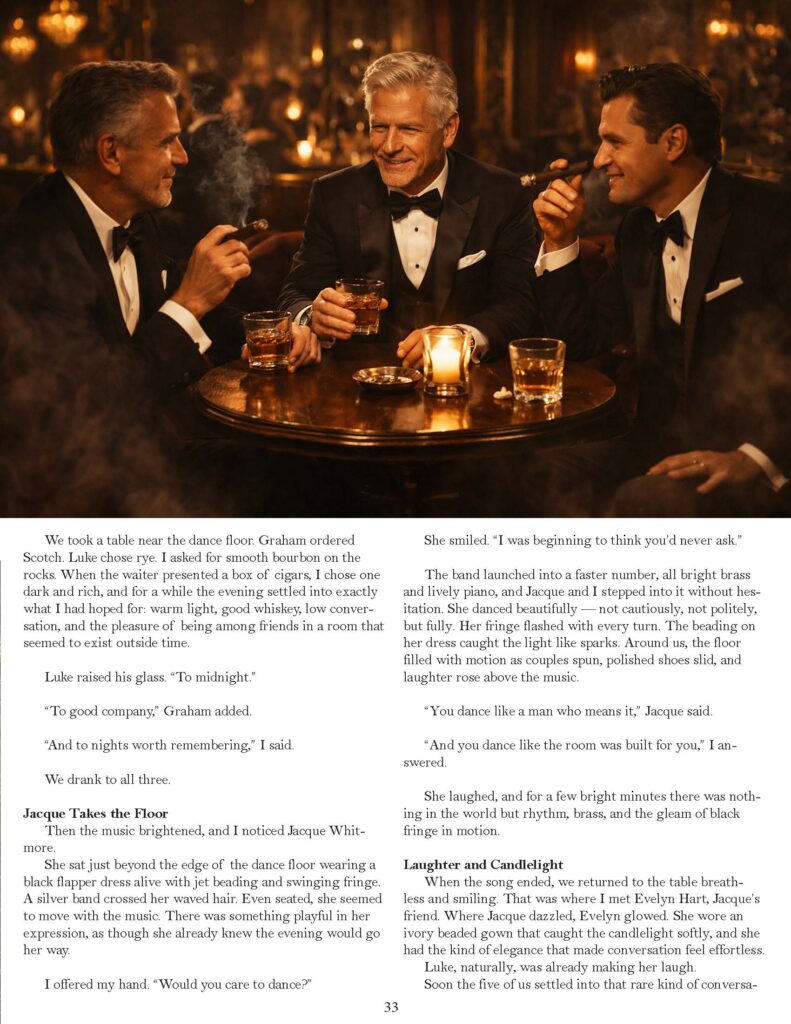
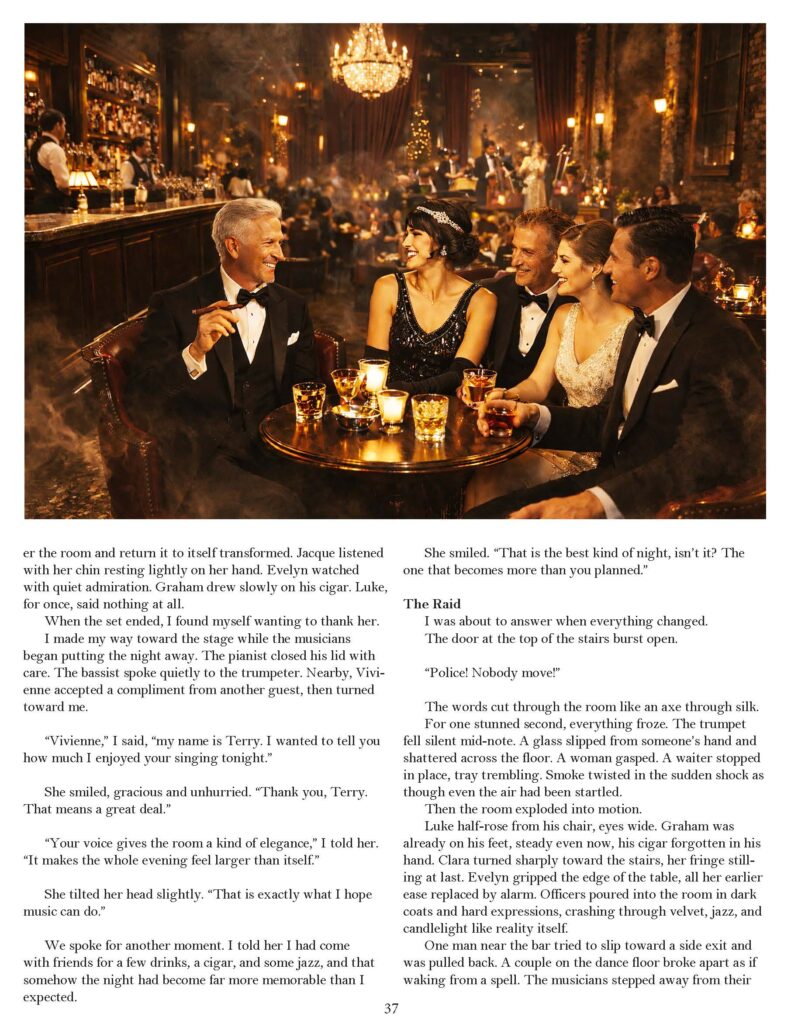
We took a table near the dance floor. Graham ordered Scotch. Luke chose rye. I asked for smooth bourbon on the rocks. When the waiter presented a box of cigars, I chose one dark and rich, and for a while the evening settled into exactly what I had hoped for: warm light, good whiskey, low conversation, and the pleasure of being among friends in a room that seemed to exist outside time.
Luke raised his glass. “To midnight.”
“To good company,” Graham added.
“And to nights worth remembering,” I said.
We drank to all three.
Jacque Takes the Floor
Then the music brightened, and I noticed Jacque Whitmore.
She sat just beyond the edge of the dance floor wearing a black flapper dress alive with jet beading and swinging fringe. A silver band crossed her waved hair. Even seated, she seemed to move with the music. There was something playful in her expression, as though she already knew the evening would go her way.
I offered my hand. “Would you care to dance?”
She smiled. “I was beginning to think you’d never ask.”
The band launched into a faster number, all bright brass and lively piano, and Jacque and I stepped into it without hesitation. She danced beautifully — not cautiously, not politely, but fully. Her fringe flashed with every turn. The beading on her dress caught the light like sparks. Around us, the floor filled with motion as couples spun, polished shoes slid, and laughter rose above the music.
“You dance like a man who means it,” Jacque said.
“And you dance like the room was built for you,” I answered.
She laughed, and for a few bright minutes there was nothing in the world but rhythm, brass, and the gleam of black fringe in motion.
Laughter and Candlelight
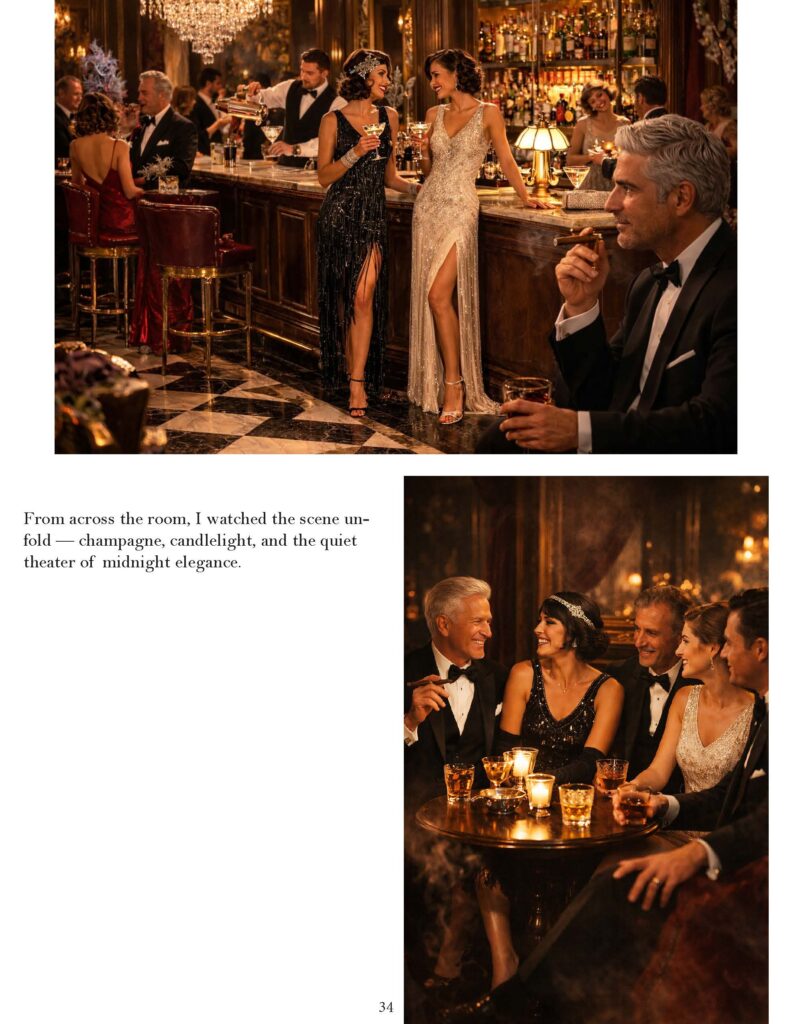
When the song ended, we returned to the table breathless and smiling. That was where I met Evelyn Hart, Jacque’s friend. Where Jacque dazzled, Evelyn glowed. She wore an ivory beaded gown that caught the candlelight softly, and she had the kind of elegance that made conversation feel effortless.
Luke, naturally, was already making her laugh.
Soon the five of us settled into that rare kind of conversation that never feels arranged. Graham offered his dry observations with perfect timing. Luke kept the air bright with wit. Jacque sparkled with mischief. Evelyn brought warmth and intelligence. We talked about music, travel, hidden places, good cigars, and late hours. Jacque teased Luke for admiring his reflection in the mirrored wall. Evelyn asked Graham whether he always looked so unbothered by life, and he replied, “Only when the Scotch is good and the band is better.”
All around us, the speakeasy carried on in glittering fragments. A couple near the bandstand leaned close enough to forget everyone else. An older gentleman at the bar lit a cigar with the solemnity of ritual. Two women in silver and emerald gowns vanished into laughter over a private joke. Everywhere, glasses rose, smoke curled, and midnight deepened.
When Vivienne Sang
Then the room changed.
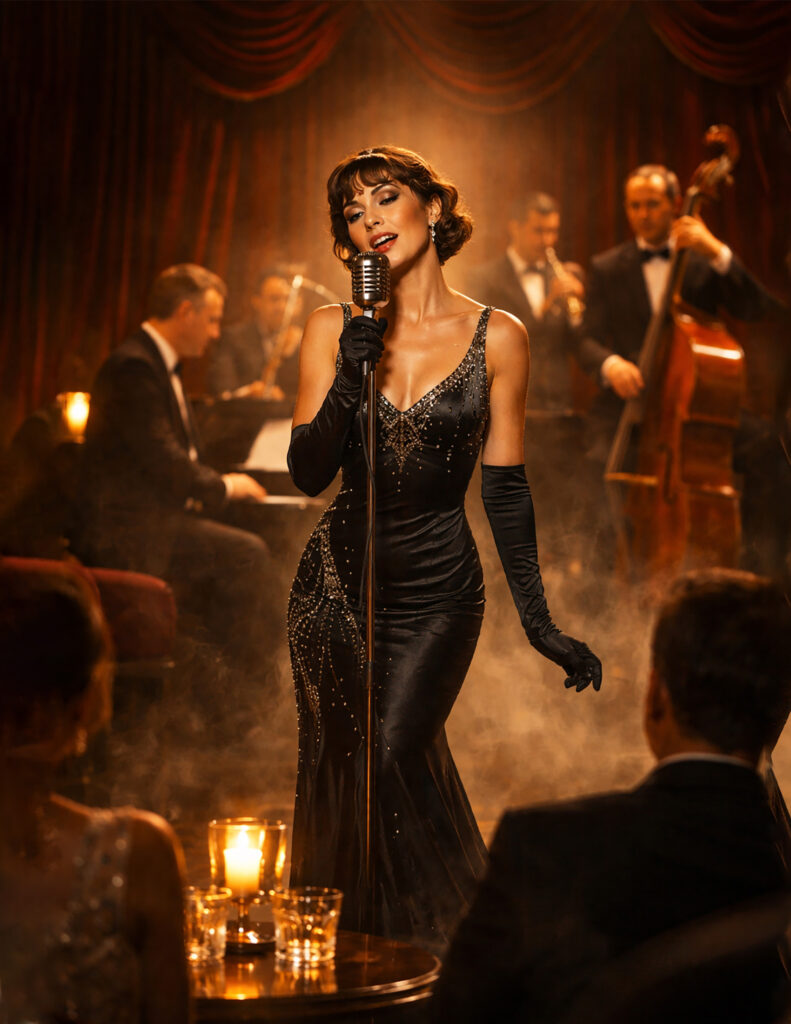
At center stage stood Vivienne Laurent, the vocalist, poised beneath an amber spotlight in a black satin gown touched with silver beading, long gloves reaching past her elbows. She was impossible not to notice, not simply because she was beautiful, but because she carried herself with presence.
When she began to sing, the room did not fall silent so much as surrender.
Her voice was smooth and intimate, rich without heaviness, polished without losing feeling. Every note seemed to gather the room and return it to itself transformed. Jacque listened with her chin resting lightly on her hand. Evelyn watched with quiet admiration. Graham drew slowly on his cigar. Luke, for once, said nothing at all.
When the set ended, I found myself wanting to thank her.
I made my way toward the stage while the musicians began putting the night away. The pianist closed his lid with care. The bassist spoke quietly to the trumpeter. Nearby, Vivienne accepted a compliment from another guest, then turned toward me.
“Vivienne,” I said, “my name is Terry. I wanted to tell you how much I enjoyed your singing tonight.”
She smiled, gracious and unhurried. “Thank you, Terry. That means a great deal.”
“Your voice gives the room a kind of elegance,” I told her. “It makes the whole evening feel larger than itself.”
She tilted her head slightly. “That is exactly what I hope music can do.”
We spoke for another moment. I told her I had come with friends for a few drinks, a cigar, and some jazz, and that somehow the night had become far more memorable than I expected.
She smiled. “That is the best kind of night, isn’t it? The one that becomes more than you planned.”
The Raid
I was about to answer when everything changed.
The door at the top of the stairs burst open.
“Police! Nobody move!”
The words cut through the room like an axe through silk.
For one stunned second, everything froze. The trumpet fell silent mid-note. A glass slipped from someone’s hand and shattered across the floor. A woman gasped. A waiter stopped in place, tray trembling. Smoke twisted in the sudden shock as though even the air had been startled.
Then the room exploded into motion.
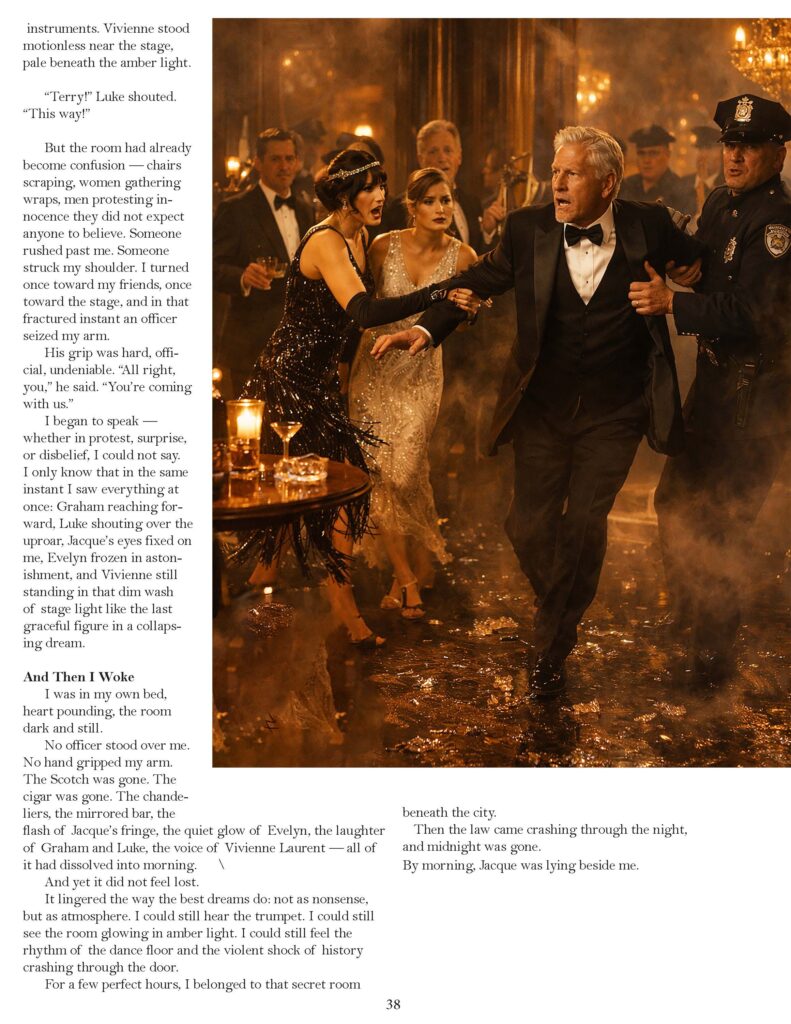
Luke half-rose from his chair, eyes wide. Graham was already on his feet, steady even now, his cigar forgotten in his hand. Jacque turned sharply toward the stairs, her fringe stilling at last. Evelyn gripped the edge of the table, all her earlier ease replaced by alarm. Officers poured into the room in dark coats and hard expressions, crashing through velvet, jazz, and candlelight like reality itself.
One man near the bar tried to slip toward a side exit and was pulled back. A couple on the dance floor broke apart as if waking from a spell. The musicians stepped away from their instruments. Vivienne stood motionless near the stage, pale beneath the amber light.
“Terry!” Luke shouted. “This way!”
But the room had already become confusion — chairs scraping, women gathering wraps, men protesting innocence they did not expect anyone to believe. Someone rushed past me. Someone struck my shoulder. I turned once toward my friends, once toward the stage, and in that fractured instant an officer seized my arm.
His grip was hard, official, undeniable.
“All right, you,” he said. “You’re coming with us.”
I began to speak — whether in protest, surprise, or disbelief, I could not say. I only know that in the same instant I saw everything at once: Graham reaching forward, Luke shouting over the uproar, Jacque’s eyes fixed on me, Evelyn frozen in astonishment, and Vivienne still standing in that dim wash of stage light like the last graceful figure in a collapsing dream.
And Then I Woke
I was in my own bed, heart pounding, the room dark and still.
No officer stood over me. No hand gripped my arm. The Scotch was gone. The cigar was gone. The chandeliers, the mirrored bar, the flash of Jacque’s fringe, the quiet glow of Evelyn, the laughter of Graham and Luke, the voice of Vivienne Laurent — all of it had dissolved into morning.
And yet it did not feel lost.
It lingered the way the best dreams do: not as nonsense, but as atmosphere. I could still hear the trumpet. I could still see the room glowing in amber light. I could still feel the rhythm of the dance floor and the violent shock of history crashing through the door.
For a few perfect hours, I belonged to that secret room beneath the city. Bottom of Form
Then the law came crashing through the night,
and midnight was gone.
By morning, Jacque was lying beside me.
