A journey through prayer, pilgrimage, merchants, mosaics, and sacred memory inside the Old City
Story and Photography by Terry Check
Morning enters Old Jerusalem not simply as light, but as sound: footsteps on limestone, shopkeepers lifting metal doors, church bells echoing above the rooftops, the murmur of pilgrims gathering in narrow lanes, and prayers rising quietly against ancient stone.
The Old City does not reveal itself all at once. It appears in fragments: an arched doorway, a merchant’s hand arranging olive wood carvings, the scent of cardamom coffee, a folded paper prayer pressed into a wall, a golden mosaic glowing in candlelight. To walk here is to feel history not as something behind glass, but as something alive beneath your feet.
Through the lens, Old Jerusalem does not feel like a destination. It feels like a living archive.
Within its walls, Jewish, Christian, Muslim, and Armenian histories meet in close quarters. The sacred is not distant or ceremonial only; it is woven into daily life. Pilgrims pray. Merchants bargain. Clergy pass through shadows. Tour guides raise small flags above the crowd. Residents carry groceries through lanes that have heard centuries of language, song, grief, and devotion.
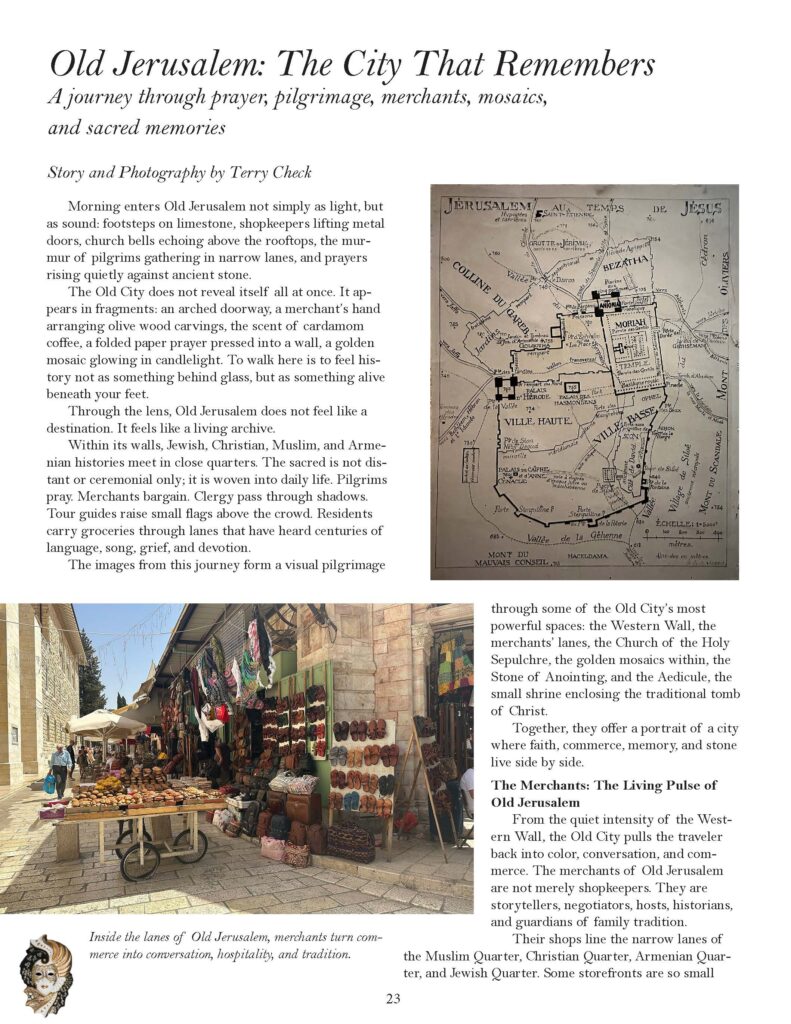
The images from this journey form a visual pilgrimage through some of the Old City’s most powerful spaces: the Western Wall, the merchants’ lanes, the Church of the Holy Sepulchre, the golden mosaics within, the Stone of Anointing, and the Aedicule, the small shrine enclosing the traditional tomb of Christ.
Together, they offer a portrait of a city where faith, commerce, memory, and stone live side by side.
The Merchants: The Living Pulse of Old Jerusalem
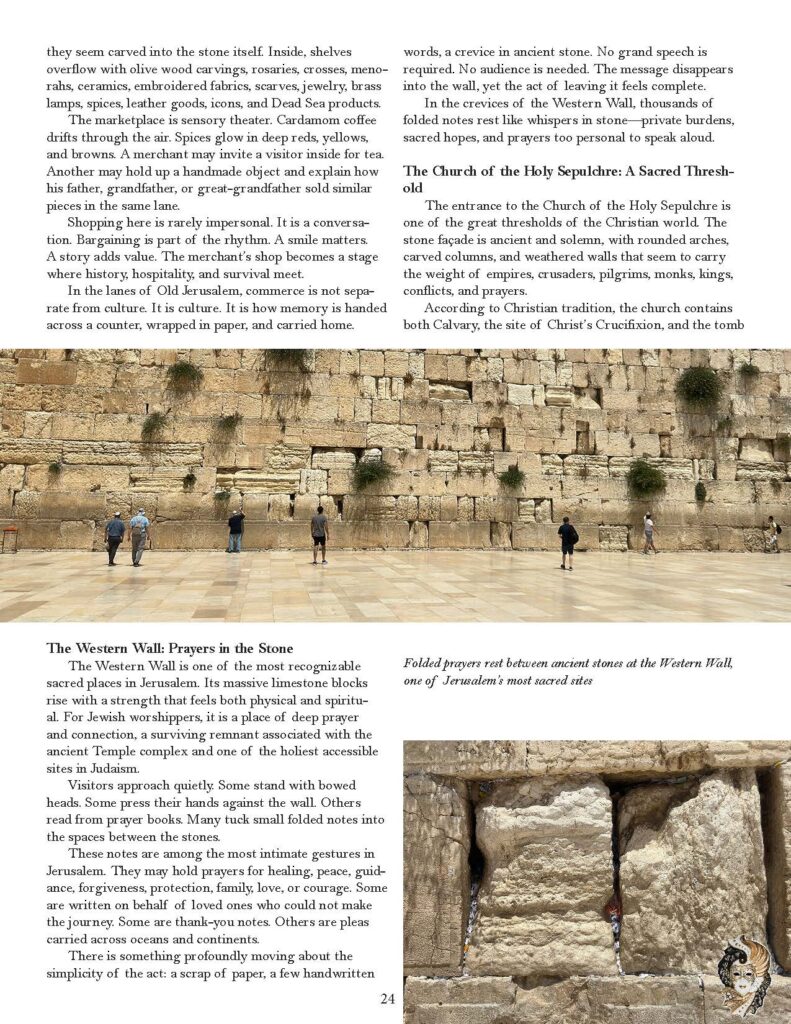
From the quiet intensity of the Western Wall, the Old City pulls the traveler back into color, conversation, and commerce. The merchants of Old Jerusalem are not merely shopkeepers. They are storytellers, negotiators, hosts, historians, and guardians of family tradition.
Their shops line the narrow lanes of the Muslim Quarter, Christian Quarter, Armenian Quarter, and Jewish Quarter. Some storefronts are so small they seem carved into the stone itself. Inside, shelves overflow with olive wood carvings, rosaries, crosses, menorahs, ceramics, embroidered fabrics, scarves, jewelry, brass lamps, spices, leather goods, icons, and Dead Sea products.
The marketplace is sensory theater. Cardamom coffee drifts through the air. Spices glow in deep reds, yellows, and browns. A merchant may invite a visitor inside for tea. Another may hold up a handmade object and explain how his father, grandfather, or great-grandfather sold similar pieces in the same lane.
Shopping here is rarely impersonal. It is a conversation. Bargaining is part of the rhythm. A smile matters. A story adds value. The merchant’s shop becomes a stage where history, hospitality, and survival meet.
In the lanes of Old Jerusalem, commerce is not separate from culture. It is culture. It is how memory is handed across a counter, wrapped in paper, and carried home.
The Western Wall: Prayers in the Stone
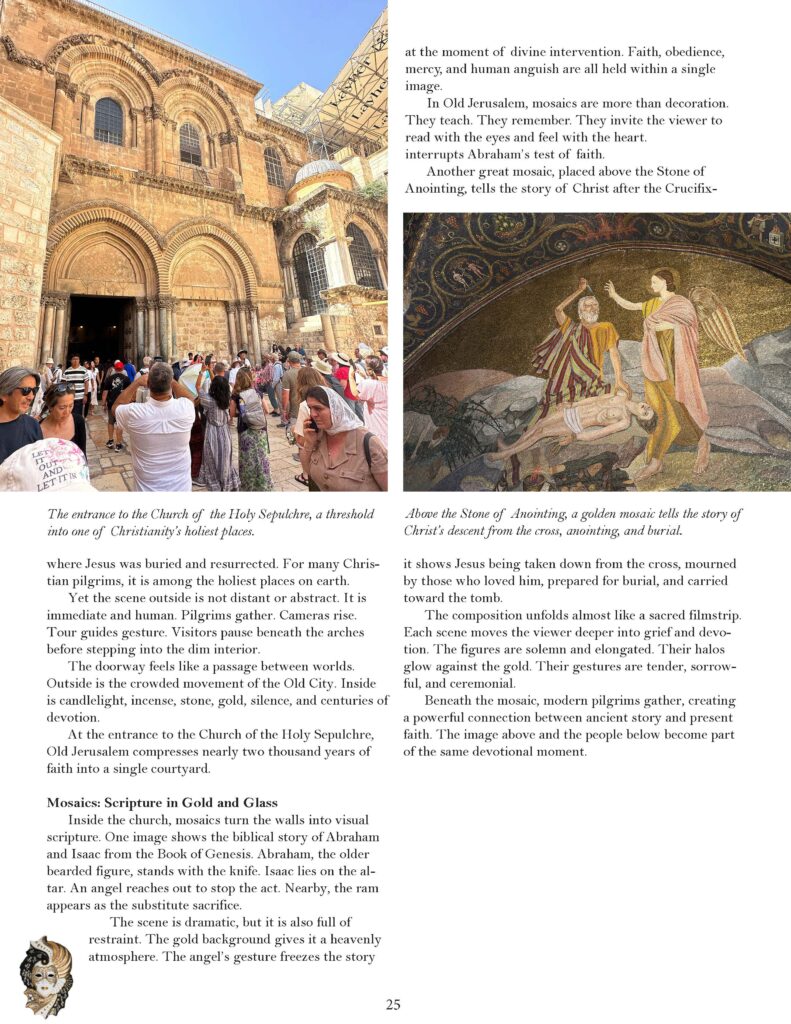
The Western Wall is one of the most recognizable sacred places in Jerusalem. Its massive limestone blocks rise with a strength that feels both physical and spiritual. For Jewish worshippers, it is a place of deep prayer and connection, a surviving remnant associated with the ancient Temple complex and one of the holiest accessible sites in Judaism.
Visitors approach quietly. Some stand with bowed heads. Some press their hands against the wall. Others read from prayer books. Many tuck small folded notes into the spaces between the stones.
These notes are among the most intimate gestures in Jerusalem. They may hold prayers for healing, peace, guidance, forgiveness, protection, family, love, or courage. Some are written on behalf of loved ones who could not make the journey. Some are thank-you notes. Others are pleas carried across oceans and continents.
There is something profoundly moving about the simplicity of the act: a scrap of paper, a few handwritten words, a crevice in ancient stone. No grand speech is required. No audience is needed. The message disappears into the wall, yet the act of leaving it feels complete.
In the crevices of the Western Wall, thousands of folded notes rest like whispers in stone—private burdens, sacred hopes, and prayers too personal to speak aloud.
The Church of the Holy Sepulchre: A Sacred Threshold
The entrance to the Church of the Holy Sepulchre is one of the great thresholds of the Christian world. The stone façade is ancient and solemn, with rounded arches, carved columns, and weathered walls that seem to carry the weight of empires, crusaders, pilgrims, monks, kings, conflicts, and prayers.
According to Christian tradition, the church contains both Calvary, the site of Christ’s Crucifixion, and the tomb where Jesus was buried and resurrected. For many Christian pilgrims, it is among the holiest places on earth.
Yet the scene outside is not distant or abstract. It is immediate and human. Pilgrims gather. Cameras rise. Tour guides gesture. Visitors pause beneath the arches before stepping into the dim interior.
The doorway feels like a passage between worlds. Outside is the crowded movement of the Old City. Inside is candlelight, incense, stone, gold, silence, and centuries of devotion.
At the entrance to the Church of the Holy Sepulchre, Old Jerusalem compresses nearly two thousand years of faith into a single courtyard.
Mosaics: Scripture in Gold and Glass
Inside the church, mosaics turn the walls into visual scripture. One image shows the biblical story of Abraham and Isaac from the Book of Genesis. Abraham, the older bearded figure, stands with the knife. Isaac lies on the altar. An angel reaches out to stop the act. Nearby, the ram appears as the substitute sacrifice.
The scene is dramatic, but it is also full of restraint. The gold background gives it a heavenly atmosphere. The angel’s gesture freezes the story at the moment of divine intervention. Faith, obedience, mercy, and human anguish are all held within a single image.
In Old Jerusalem, mosaics are more than decoration. They teach. They remember. They invite the viewer to read with the eyes and feel with the heart.
Another great mosaic, placed above the Stone of Anointing, tells the story of Christ after the Crucifixion. It shows Jesus being taken down from the cross, mourned by those who loved him, prepared for burial, and carried toward the tomb.
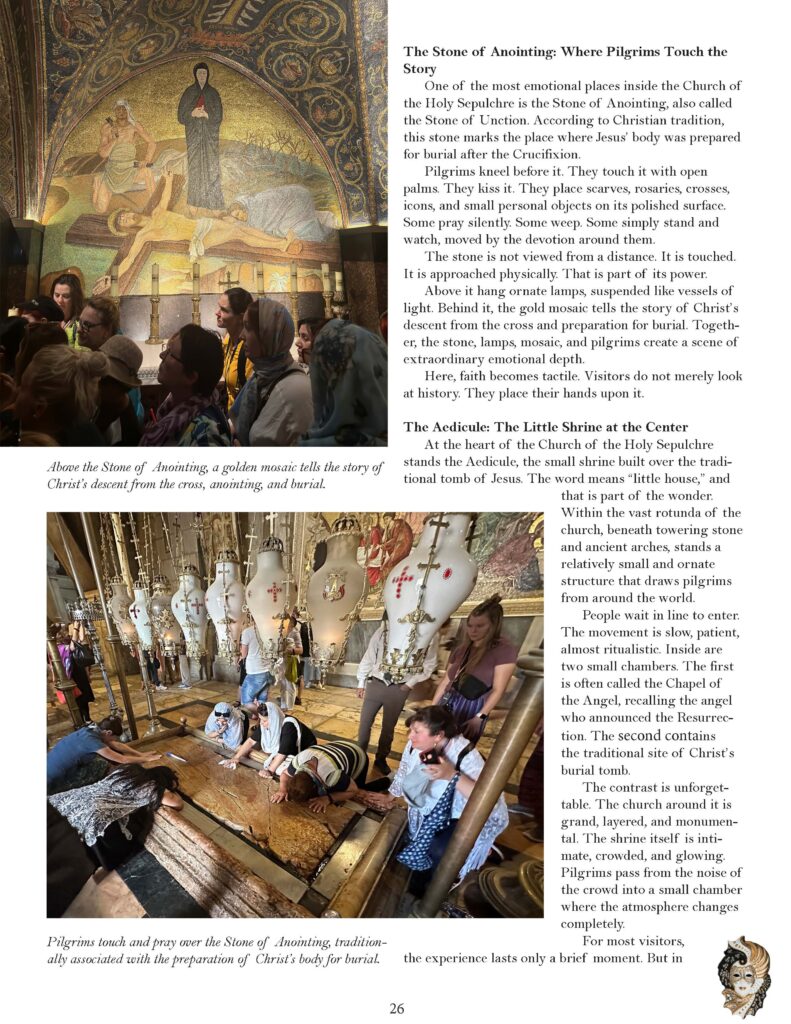
The composition unfolds almost like a sacred filmstrip. Each scene moves the viewer deeper into grief and devotion. The figures are solemn and elongated. Their halos glow against the gold. Their gestures are tender, sorrowful, and ceremonial.
Beneath the mosaic, modern pilgrims gather, creating a powerful connection between ancient story and present faith. The image above and the people below become part of the same devotional moment.
The Stone of Anointing: Where Pilgrims Touch the Story
One of the most emotional places inside the Church of the Holy Sepulchre is the Stone of Anointing, also called the Stone of Unction. According to Christian tradition, this stone marks the place where Jesus’ body was prepared for burial after the Crucifixion.
Pilgrims kneel before it. They touch it with open palms. They kiss it. They place scarves, rosaries, crosses, icons, and small personal objects on its polished surface. Some pray silently. Some weep. Some simply stand and watch, moved by the devotion around them.
The stone is not viewed from a distance. It is touched. It is approached physically. That is part of its power.
Above it hang ornate lamps, suspended like vessels of light. Behind it, the gold mosaic tells the story of Christ’s descent from the cross and preparation for burial. Together, the stone, lamps, mosaic, and pilgrims create a scene of extraordinary emotional depth.
Here, faith becomes tactile. Visitors do not merely look at history. They place their hands upon it.
The Aedicule: The Little Shrine at the Center
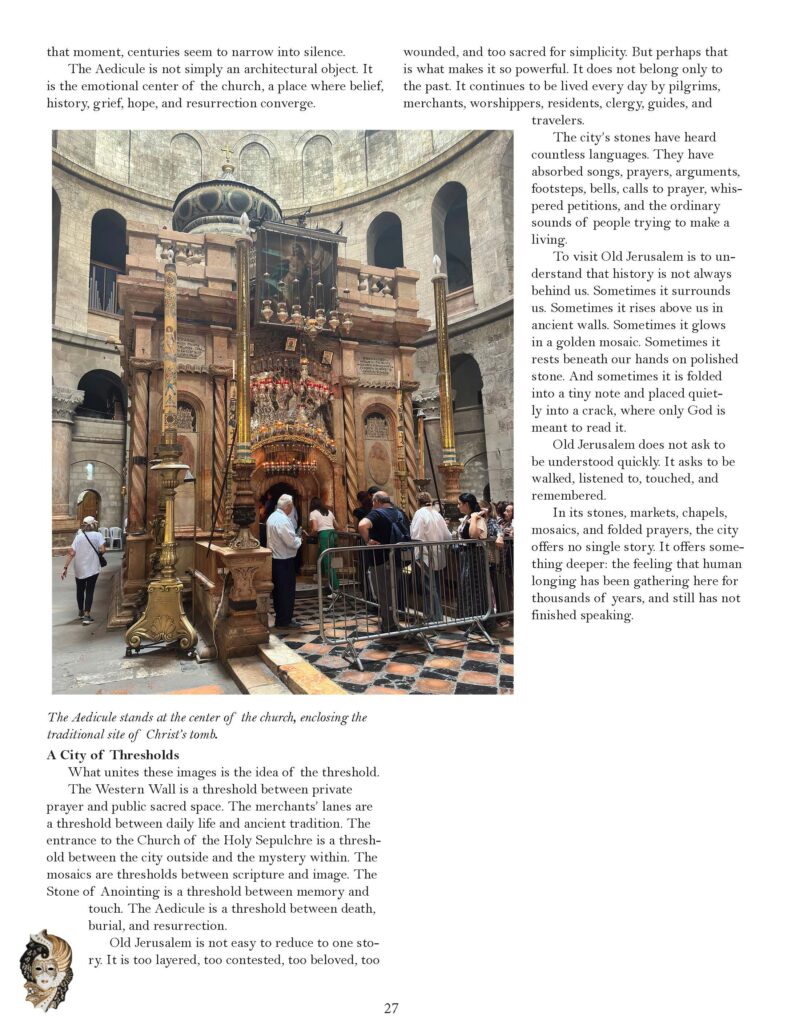
At the heart of the Church of the Holy Sepulchre stands the Aedicule, the small shrine built over the traditional tomb of Jesus. The word means “little house,” and that is part of the wonder. Within the vast rotunda of the church, beneath towering stone and ancient arches, stands a relatively small and ornate structure that draws pilgrims from around the world.
People wait in line to enter. The movement is slow, patient, almost ritualistic. Inside are two small chambers. The first is often called the Chapel of the Angel, recalling the angel who announced the Resurrection. The second contains the traditional site of Christ’s burial tomb.
The contrast is unforgettable. The church around it is grand, layered, and monumental. The shrine itself is intimate, crowded, and glowing. Pilgrims pass from the noise of the crowd into a small chamber where the atmosphere changes completely.
For most visitors, the experience lasts only a brief moment. But in that moment, centuries seem to narrow into silence.
The Aedicule is not simply an architectural object. It is the emotional center of the church, a place where belief, history, grief, hope, and resurrection converge.
A City of Thresholds
What unites these images is the idea of the threshold.
The Western Wall is a threshold between private prayer and public sacred space. The merchants’ lanes are a threshold between daily life and ancient tradition. The entrance to the Church of the Holy Sepulchre is a threshold between the city outside and the mystery within. The mosaics are thresholds between scripture and image. The Stone of Anointing is a threshold between memory and touch. The Aedicule is a threshold between death, burial, and resurrection.
Old Jerusalem is not easy to reduce to one story. It is too layered, too contested, too beloved, too wounded, and too sacred for simplicity. But perhaps that is what makes it so powerful. It does not belong only to the past. It continues to be lived every day by pilgrims, merchants, worshippers, residents, clergy, guides, and travelers.
The city’s stones have heard countless languages. They have absorbed songs, prayers, arguments, footsteps, bells, calls to prayer, whispered petitions, and the ordinary sounds of people trying to make a living.
To visit Old Jerusalem is to understand that history is not always behind us. Sometimes it surrounds us. Sometimes it rises above us in ancient walls. Sometimes it glows in a golden mosaic. Sometimes it rests beneath our hands on polished stone. And sometimes it is folded into a tiny note and placed quietly into a crack, where only God is meant to read it.
Old Jerusalem does not ask to be understood quickly. It asks to be walked, listened to, touched, and remembered.
In its stones, markets, chapels, mosaics, and folded prayers, the city offers no single story. It offers something deeper: the feeling that human longing has been gathering here for thousands of years, and still has not finished speaking.
