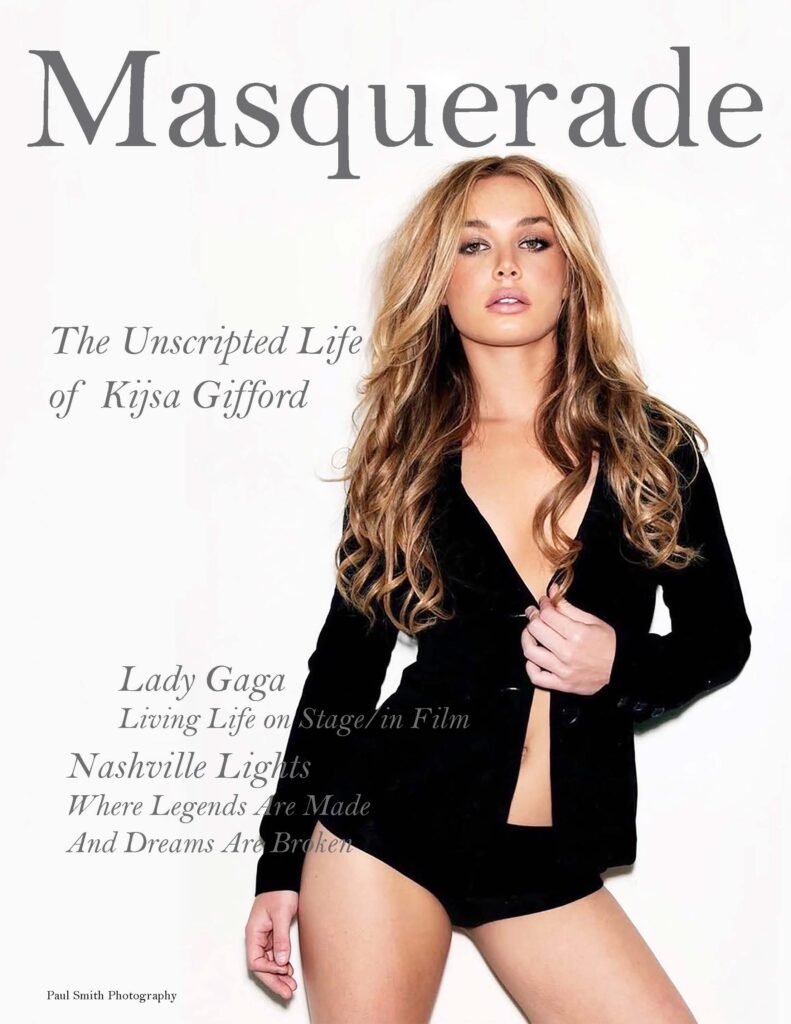
When the lights fade and the noise subsides, Kijsa Gifford sits with herself—unmasked, unfiltered, and unafraid to admit that becoming the woman she is today took both breaking and rebuilding. Beneath the elegance of her Hollywood ascent lies a story far more layered: an elite athlete who walked away from the expected, a young woman who wrestled with social anxiety and silence, and an artist who decided that waiting to be chosen was no longer an option.
With the founding of Norma Jean Entertainment, Gifford steps into the lineage of women who turned creative resistance into revolution. Her mission is clear: to tell stories that honor the complexity of women—youthful and aging, flawed and fearless, beautiful and bruised. She carries echoes of the past (Marilyn’s bloodline and old Hollywood’s golden glow) yet embodies a new narrative—one where control belongs to the creator, not the machine.
In conversation with Masquerade Magazine, Kijsa invites us into her world of reflection and reinvention, where authenticity isn’t a brand, it’s a battle won daily.
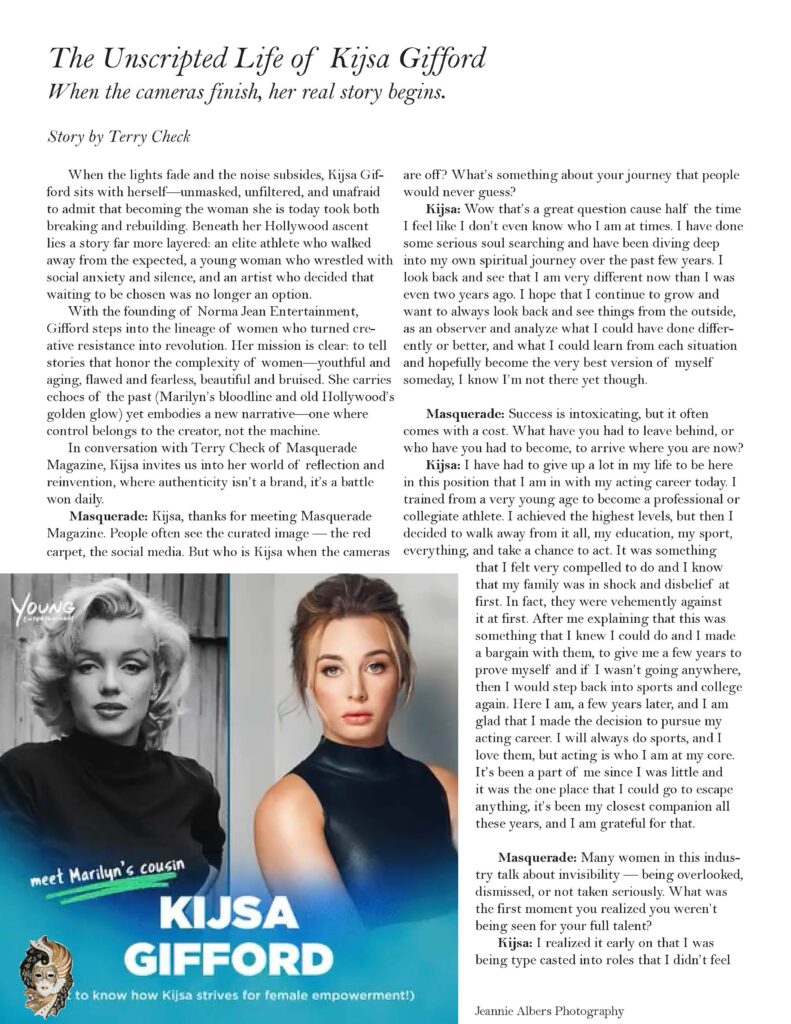
Masquerade: Kijsa, thanks for meeting Masquerade Magazine. People often see the curated image — the red carpet, the social media. But who is Kijsa when the cameras are off? What’s something about your journey that people would never guess?
Kijsa: Wow that’s a great question cause half the time I feel like I don’t even know who I am at times. I have done some serious soul searching and have been diving deep into my own spiritual journey over the past few years. I look back and see that I am very different now than I was even two years ago. I hope that I continue to grow and want to always look back and see things from the outside, as an observer and analyze what I could have done differently or better, and what I could learn from each situation and hopefully become the very best version of myself someday, I know I’m not there yet though.
Masquerade: Success is intoxicating, but it often comes with a cost. What have you had to leave behind, or who have you had to become, to arrive where you are now?
Kijsa: I have had to give up a lot in my life to be here in this position that I am in with my acting career today. I trained from a very young age to become a professional or collegiate athlete. I achieved the highest levels, but then I decided to walk away from it all, my education, my sport, everything, and take a chance on acting. It was something that I felt very compelled to do and I know that my family was in shock and disbelief at first. In fact, they were vehemently against it at first. After me explaining that this was something that I knew I could do and I made a bargain with them, to give me a few years to prove myself and if I wasn’t getting anywhere, then I would step back into sports and college again. Here I am, a few years later and I am glad that I made the decision to pursue my acting career. I will always do sports and I love them, but acting is who I am at my core. It’s been a part of me since I was little and it was the one place that I could go to escape anything, it’s been my closest companion all these years, and I am grateful for that.
Masquerade: Many women in this industry talk about invisibility — being overlooked, dismissed, or not taken seriously. What was the first moment you realized you weren’t being seen for your full talent?
Kijsa: I realized it pretty early on that I was being type casted into roles that I didn’t feel really fit who I was as a person. I was being offered a lot of nude roles, roles where I was entitled or a bully …….. Said enough, I need to be the change that I want to see in the world. I realized that if I was going to have the career that I wanted, with a body of work that I was proud of, that truly reflected women’s perspectives, then I had to become the master of my own destiny and take control. That’s when I launched my production company, Norma Jean Entertainment.
Masquerade: Let’s talk ancestry. In 2022, DNA evidence confirmed Charles Stanley Gifford as Marilyn Monroe’s biological father. You carry that same Gifford name. Did this discovery reshape how you see your family’s story?
Kijsa: No not at all. I have known my whole life actually. We always knew that we were Mayflower Descendants, Sons of Liberty, the founders of Cape Cod, and Sons of the Revolutionary War Descendants, plus it was always rumored that she was a Gifford by blood. The DNA evidence just confirmed what was already known to be true amongst family. We share some pretty cool ancestors together including many of the former Presidents, and the Giffords were very prominent in early America like in Massachusetts and New York.
Masquerade: Reese Witherspoon built Hello Sunshine into a cultural force. How do you see Norma Jean Entertainment comparing — and what do you want to do differently in how women’s stories are developed and owned?
Kijsa: Oh my gosh, I absolutely LOVE Reese Witherspoon, she is one of my favorite actresses and her body of work is outstanding. She is such an icon and I look up to her very much. With Norma Jean Entertainment, I want to be able to tell our stories, our way, through our eyes. I really want to see better character development and allow the world to experience our unique storytelling too. We have seen a recent shift in Hollywood where there are rumblings of adding more women-based films, directors, etc. We aren’t there yet to be honest; we still have a long way to go, but I hope to put my mark on it if I can. I would like to see more roles for both younger and older women. It sometimes appears that older women are seen less in movies after age 40, and I want to change that. Women’s value sits more with their divine wisdom and experiences, than with their age or appearance. The stories they hold and their depth is unparalleled.
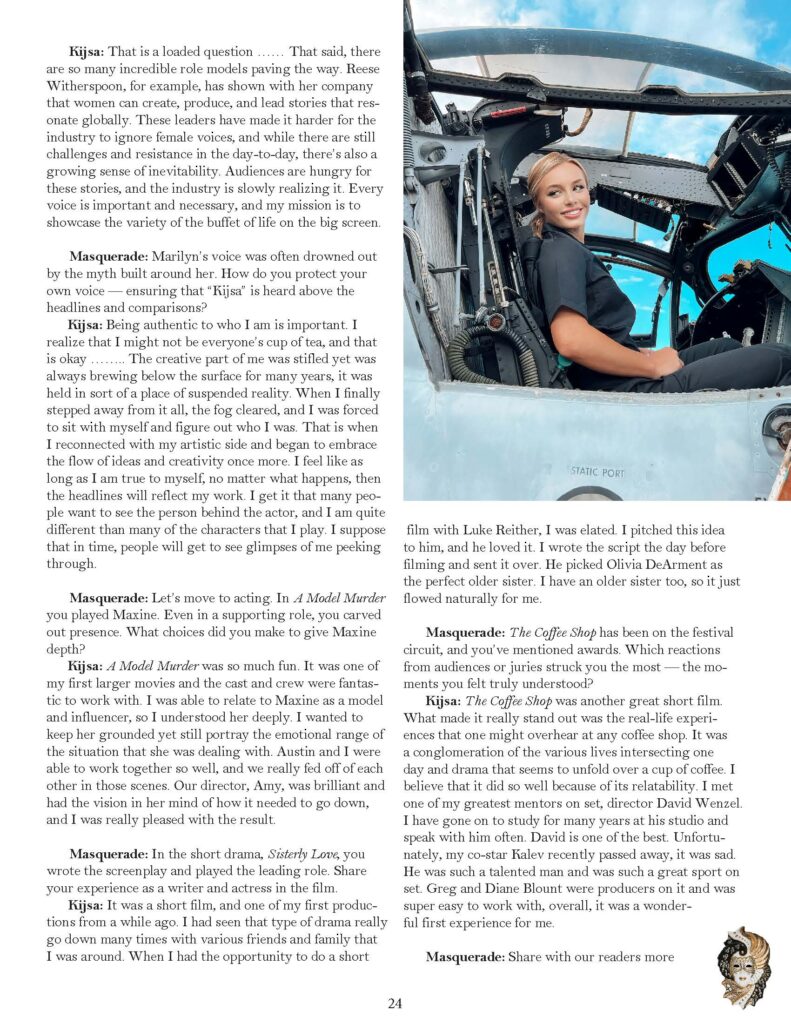
Masquerade: Do you think Hollywood is truly ready for female-owned production companies that challenge the old system, or is there still resistance you feel day-to-day?
Kijsa: Gosh that is a loaded question …… That said, there are so many incredible role models paving the way. Reese Witherspoon, for example, has shown with her company that women can create, produce, and lead stories that resonate globally. These leaders have made it harder for the industry to ignore female voices, and while there are still challenges and resistance in the day-to-day, there’s also a growing sense of inevitability. Audiences are hungry for these stories, and the industry is slowly realizing it. Every voice is important and necessary, and my mission is to showcase the variety of the buffet of life on the big screen.
Masquerade: Marilyn’s voice was often drowned out by the myth built around her. How do you protect your own voice — ensuring that “Kijsa” is heard above the headlines and comparisons?
Kijsa: Being authentic to who I am is important. I realize that I might not be everyone’s cup of tea, and that is okay …….. The creative part of me was stifled yet was always brewing below the surface for many years, it was held in sort of a place of suspended reality. When I finally stepped away from it all, the fog cleared, and I was forced to sit with myself and figure out who I was. That is when I reconnected with my artistic side and began to embrace the flow of ideas and creativity once more. I feel like as long as I am true to myself, no matter what happens, then the headlines will reflect my work. I get it that many people want to see the person behind the actor, and I am quite different than many of the characters that I play. I suppose that in time, people will get to see glimpses of me peeking through.

Masquerade: Let’s move to acting. In A Model Murder you played Maxine. Even in a supporting role, you carved out presence. What choices did you make to give Maxine depth?
Kijsa: A Model Murder was so much fun. It was one of my first larger movies and the cast and crew were fantastic to work with. I was able to relate to Maxine as a model and influencer, so I understood her deeply. I wanted to keep her grounded yet still portray the emotional range of the situation that she was dealing with. Austin and I were able to work together so well, and we really fed off of each other in those scenes. Our director, Amy was brilliant and had the vision in her mind of how it needed to go down, and I was really pleased with the end result.
Masquerade: In the short drama, Sisterly Love, you wrote the screenplay and played the leading role. Share your experience as a writer and actress in the film.
Kijsa: It was a short film, and one of my first productions from a while ago. I had seen that type of drama really go down many times with various friends and family that I was around. When I had the opportunity to do a short film with Luke Reither, I was elated. I pitched this idea to him and he loved it. I wrote the script the day before filming and sent it over. He picked Olivia DeArment as the perfect older sister. I have an older sister too, so it just flowed naturally for me.
Masquerade: The Coffee Shop has been on the festival circuit, and you’ve mentioned awards. Which reactions from audiences or juries struck you the most — the moments you felt truly understood?
Kijsa: The Coffee Shop was another great short film. What made it really stand out was the real-life experiences that one might actually overhear at any coffee shop. It was a conglomeration of the various lives intersecting one day and drama that seems to unfold over a cup of coffee. I believe that it did so well because of its relatability.
I met one of my greatest mentors on set, director David Wenzel. I have gone on to study many years at his studio and speak with him often. David is one of the best. Unfortunately, my co-star Kalev recently passed away, it was really sad. He was such a talented man and was such a great sport on set. Greg and Diane Blount were producers on it and was super easy to work with, overall, it was a wonderful first experience for me.
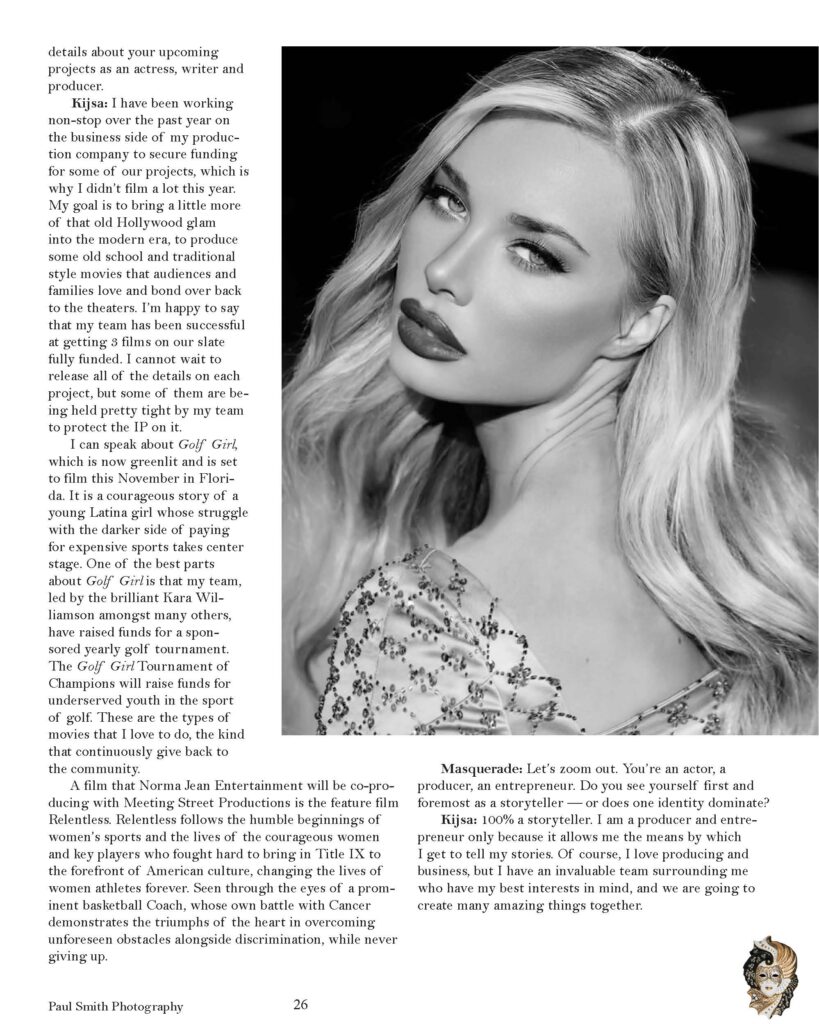
Masquerade: Share with our readers more details about your upcoming projects as an actress, writer and producer.
Kijsa: I have been working non-stop over the past year on the business side of my production company to secure funding for some of our projects, which is why I didn’t film a lot this year. My goal is to bring a little more of that old Hollywood glam into the modern era, to produce some old school and traditional style movies that audiences and families love and bond over back to the theaters. I’m happy to say that my team has been successful at getting 3 films on our slate fully funded. I cannot wait to release all of the details on each project, but some of them are being held pretty tight by my team to protect the IP on it.
I can speak about Golf Girl which is now greenlit and is set to film this November in Florida. It is a courageous story of a young Latina girl whose struggle with the darker side of paying for expensive sports takes center stage. One of the best parts about Golf Girl is that my team, led by the brilliant Kara Williamson amongst many others, have raised funds for a sponsored yearly golf tournament. The Golf Girl Tournament of Champions will raise funds for underserved youth in the sport of golf. These are the types of movies that I love to do, the kind that continuously give back to the community.
A film that Norma Jean Entertainment will be co-producing with Meeting Street Productions is the feature film Relentless. Relentless follows the humble beginnings of women’s sports and the lives of the courageous women and key players who fought hard to bring in Title IX to the forefront of American culture, changing the lives of women athletes forever. Seen through the eyes of a prominent basketball Coach, whose own battle with Cancer demonstrates the triumphs of the heart in overcoming unforeseen obstacles alongside discrimination, while never giving up.
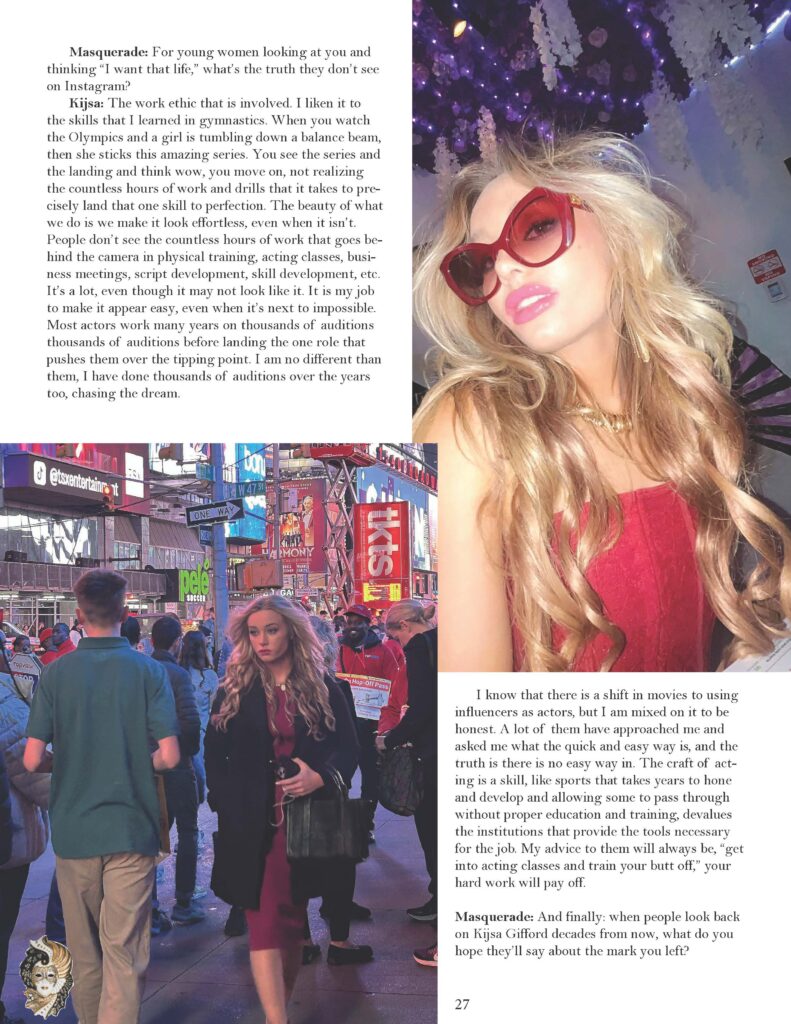
Masquerade: Let’s zoom out. You’re an actor, a producer, an entrepreneur. Do you see yourself first and foremost as a storyteller — or does one identity dominate?
Kijsa: 100% a storyteller. I am a producer and entrepreneur only because it allows me the means by which I get to tell my stories. Of course, I love producing and business, but I have an invaluable team surrounding me who have my best interests in mind and we are going to create many amazing things together.
Masquerade: For young women looking at you and thinking “I want that life,” what’s the truth they don’t see on Instagram?
Kijsa: The work ethic that is involved. I liken it to the skills that I learned in gymnastics. When you watch the Olympics and a girl is tumbling down a balance beam, then she sticks this amazing series. You see the series and the landing and think wow, you move on, not realizing the countless hours of work and drills that it takes to precisely land that one skill to perfection. The beauty of what we do is we make it look effortless, even when it isn’t. People don’t see the countless hours of work that goes behind the camera in physical training, acting classes, business meetings, script development, skill development, etc. It’s a lot, even though it may not look like it. It is my job to make it appear easy, even when it’s next to impossible. The vast majority of actors work many years on thousands of auditions before landing the one role that pushes them over the tipping point. I am no different than them, I have done thousands of auditions over the years too, chasing the dream.
I know that there is a shift in movies to using influencers as actors, but I am mixed on it to be honest. A lot of them have approached me and asked me what the quick and easy way in is, and the truth is there is no easy way in. The craft of acting is a skill, similar to sports that takes years to hone and develop and allowing some to pass through without proper education and training, devalues the institutions that provide the tools necessary for the job. My advice to them will always be, “get into acting classes and train your butt off,” your hard work will pay off.
Masquerade: And finally: when people look back on Kijsa Gifford decades from now, what do you hope they’ll say about the mark you left?
Kijsa: If my passion for acting can be used as a tool to uplift someone, make a sad person laugh, transport the viewer into a new world, or make the audience feel something, then I have achieved my goals. I would love to be able to use my platform, movies, and business to give back to the world. I want to leave the world in a better place than when I arrived.
As the interview winds down, Gifford’s words linger in the air, soft yet steady, like the
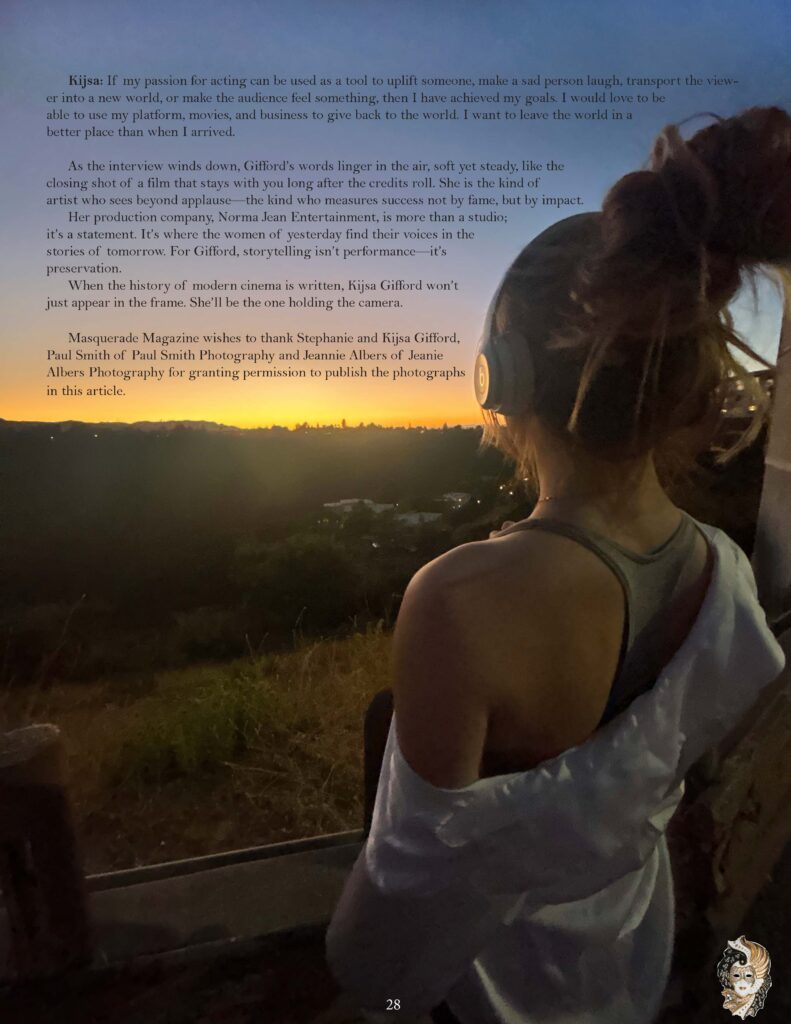
closing shot of a film that stays with you long after the credits roll. She is the kind of
artist who sees beyond applause—the kind who measures success not by fame, but by impact.
Her production company, Norma Jean Entertainment, is more than a studio; it’s a statement. It’s where the women of yesterday find their voices in the stories of tomorrow. For Gifford, storytelling isn’t performance, it’s preservation. When the history of modern cinema is written, Kijsa Gifford won’t just appear in the frame. She’ll be the one holding the camera.
Masquerade Magazine wishes to thank Stephanie and Kijsa Gifford, Paul Smith of Paul Smith Photography and Jeannie Albers of Jeanie Albers Photography for granting permission to publish the photographs in this article.
