Once dismissed as vandalism, graffiti finds its gallery — and the streets, at last, are heard.
Story and Photography by Terry Check
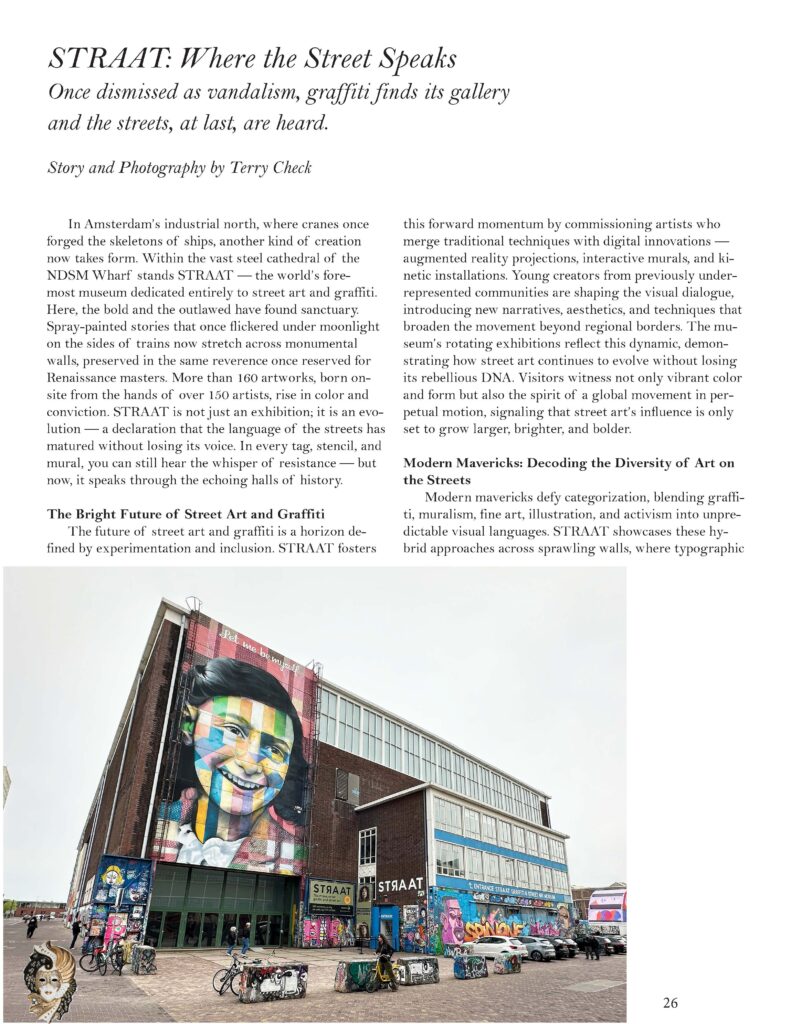
In Amsterdam’s industrial north, where cranes once forged the skeletons of ships, another kind of creation now takes form. Within the vast steel cathedral of the NDSM Wharf stands STRAAT — the world’s foremost museum dedicated entirely to street art and graffiti. Here, the bold and the outlawed have found sanctuary. Spray-painted stories that once flickered under moonlight on the sides of trains now stretch across monumental walls, preserved in the same reverence once reserved for Renaissance masters. More than 160 artworks, born on-site from the hands of over 150 artists, rise in color and conviction. STRAAT is not just an exhibition; it is an evolution — a declaration that the language of the streets has matured without losing its voice. In every tag, stencil, and mural, you can still hear the whisper of resistance — but now, it speaks through the echoing halls of history.
The Bright Future of Street Art and Graffiti
The future of street art and graffiti is a horizon defined by experimentation and inclusion. STRAAT fosters this forward momentum by commissioning artists who merge traditional techniques with digital innovations — augmented reality projections, interactive murals, and kinetic installations. Young creators from previously underrepresented communities are shaping the visual dialogue, introducing new narratives, aesthetics, and techniques that broaden the movement beyond regional borders. The museum’s rotating exhibitions reflect this dynamic, demonstrating how street art continues to evolve without losing its rebellious DNA. Visitors witness not only vibrant color and form but also the spirit of a global movement in perpetual motion, signaling that street art’s influence is only set to grow larger, brighter, and bolder.
Modern Mavericks: Decoding the Diversity of Art on the Streets
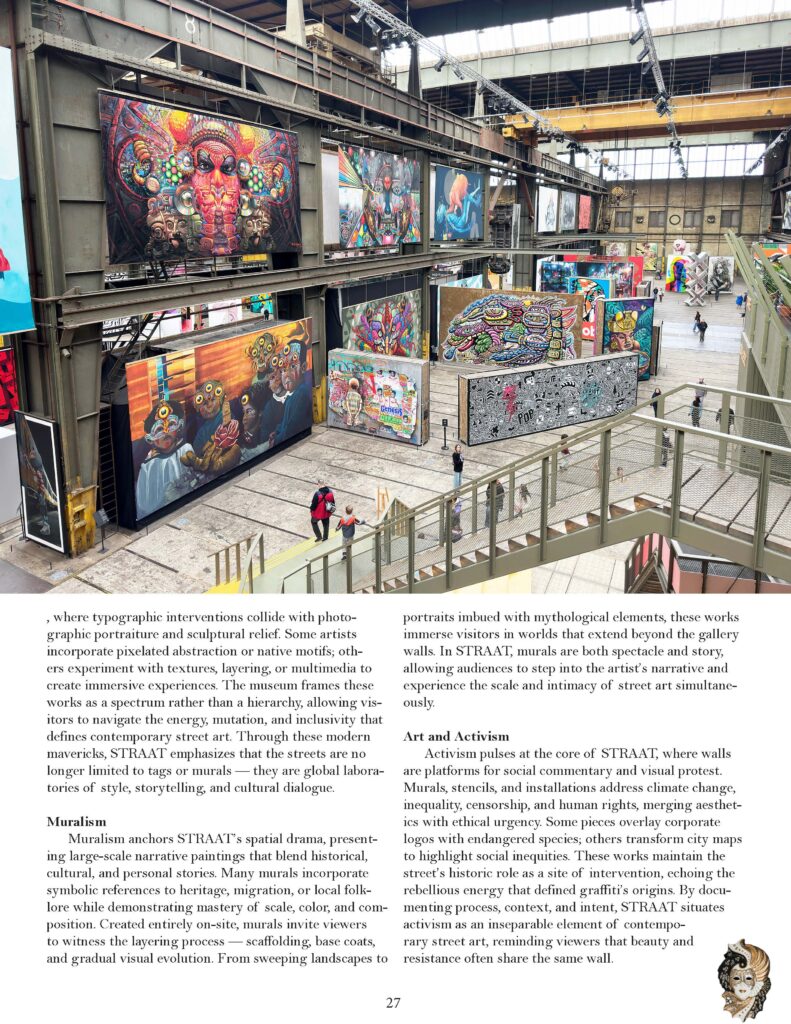
Modern mavericks defy categorization, blending graffiti, muralism, fine art, illustration, and activism into unpredictable visual languages. STRAAT showcases these hybrid approaches across sprawling walls, where typographic interventions collide with photographic portraiture and sculptural relief. Some artists incorporate pixelated abstraction or native motifs; others experiment with textures, layering, or multimedia to create immersive experiences. The museum frames these works as a spectrum rather than a hierarchy, allowing visitors to navigate the energy, mutation, and inclusivity that defines contemporary street art. Through these modern mavericks, STRAAT emphasizes that the streets are no longer limited to tags or murals — they are global laboratories of style, storytelling, and cultural dialogue.
Muralism
Muralism anchors STRAAT’s spatial drama, presenting large-scale narrative paintings that blend historical, cultural, and personal stories. Many murals incorporate symbolic references to heritage, migration, or local folklore while demonstrating mastery of scale, color, and composition. Created entirely on-site, murals invite viewers to witness the layering process — scaffolding, base coats, and gradual visual evolution. From sweeping landscapes to portraits imbued with mythological elements, these works immerse visitors in worlds that extend beyond the gallery walls. In STRAAT, murals are both spectacle and story, allowing audiences to step into the artist’s narrative and experience the scale and intimacy of street art simultaneously.
Art and Activism
Activism pulses at the core of STRAAT, where walls are platforms for social commentary and visual protest. Murals, stencils, and installations address climate change, inequality, censorship, and human rights, merging aesthetics with ethical urgency. Some pieces overlay corporate logos with endangered species; others transform city maps to highlight social inequities. These works maintain the street’s historic role as a site of intervention, echoing the rebellious energy that defined graffiti’s origins. By documenting process, context, and intent, STRAAT situates activism as an inseparable element of contemporary street art, reminding viewers that beauty and resistance often share the same wall.
Native / Nature
Nature and indigenous identity recur across STRAAT’s murals and installations. Artists explore native motifs, folklore, and ancestral symbols, merging them with urban aesthetics to create dialogue between the organic and the industrial. Trees, rivers, birds, and symbolic patterns emerge in bold lines and vivid color, reminding viewers that ecological awareness and cultural memory can coexist in urban spaces. Some works combine wildlife imagery with typographic flourishes, while others draw on mythology or local heritage to anchor stories in place and ancestry. By fusing street art with natural and native references, STRAAT celebrates the enduring connection between humans, culture, and environment.
Shepard Fairey
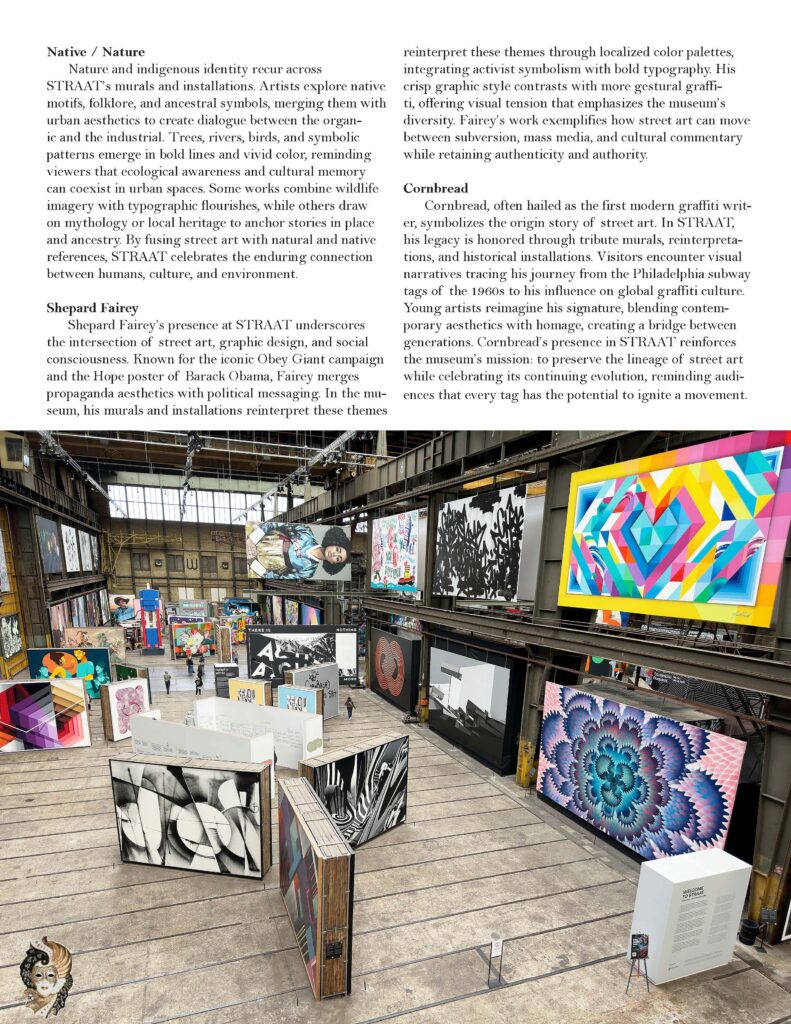
Shepard Fairey’s presence at STRAAT underscores the intersection of street art, graphic design, and social consciousness. Known for the iconic Obey Giant campaign and the Hope poster of Barack Obama, Fairey merges propaganda aesthetics with political messaging. In the museum, his murals and installations reinterpret these themes through localized color palettes, integrating activist symbolism with bold typography. His crisp graphic style contrasts with more gestural graffiti, offering visual tension that emphasizes the museum’s diversity. Fairey’s work exemplifies how street art can move between subversion, mass media, and cultural commentary while retaining authenticity and authority.
Cornbread
Cornbread, often hailed as the first modern graffiti writer, symbolizes the origin story of street art. In STRAAT, his legacy is honored through tribute murals, reinterpretations, and historical installations. Visitors encounter visual narratives tracing his journey from the Philadelphia subway tags of the 1960s to his influence on global graffiti culture. Young artists reimagine his signature, blending contemporary aesthetics with homage, creating a bridge between generations. Cornbread’s presence in STRAAT reinforces the museum’s mission: to preserve the lineage of street art while celebrating its continuing evolution, reminding audiences that every tag has the potential to ignite a movement.
Graffiti / Post-Graffiti / Abstract Graffiti
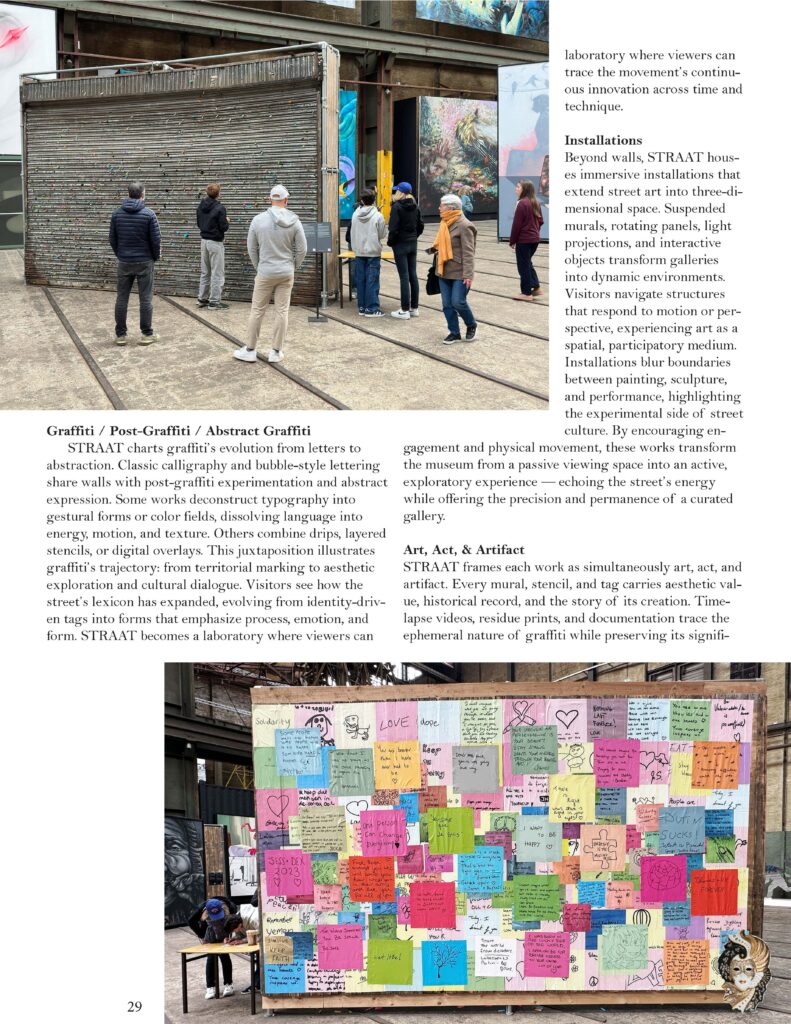
STRAAT charts graffiti’s evolution from letters to abstraction. Classic calligraphy and bubble-style lettering share walls with post-graffiti experimentation and abstract expression. Some works deconstruct typography into gestural forms or color fields, dissolving language into energy, motion, and texture. Others combine drips, layered stencils, or digital overlays. This juxtaposition illustrates graffiti’s trajectory: from territorial marking to aesthetic exploration and cultural dialogue. Visitors see how the street’s lexicon has expanded, evolving from identity-driven tags into forms that emphasize process, emotion, and form. STRAAT becomes a laboratory where viewers can trace the movement’s continuous innovation across time and technique.
Installations
Beyond walls, STRAAT houses immersive installations that extend street art into three-dimensional space. Suspended murals, rotating panels, light projections, and interactive objects transform galleries into dynamic environments. Visitors navigate structures that respond to motion or perspective, experiencing art as a spatial, participatory medium. Installations blur boundaries between painting, sculpture, and performance, highlighting the experimental side of street culture. By encouraging engagement and physical movement, these works transform the museum from a passive viewing space into an active, exploratory experience — echoing the street’s energy while offering the precision and permanence of a curated gallery.
Art, Act, & Artifact
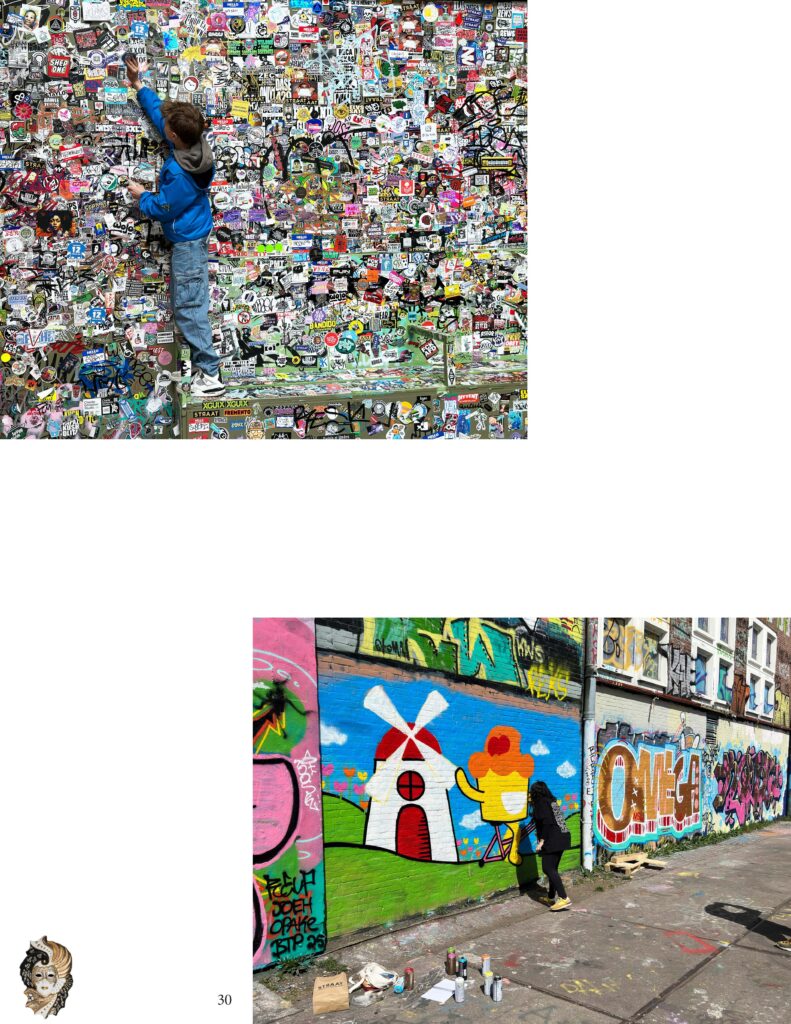
STRAAT frames each work as simultaneously art, act, and artifact. Every mural, stencil, and tag carries aesthetic value, historical record, and the story of its creation. Time-lapse videos, residue prints, and documentation trace the ephemeral nature of graffiti while preserving its significance. Visitors witness both the performative act of street expression and the artifact that remains, creating a dialogue between process and permanence. This framework demonstrates that street art is not only visual—it is experiential and historical, connecting past, present, and future in tangible, layered form.
NDSM Burners
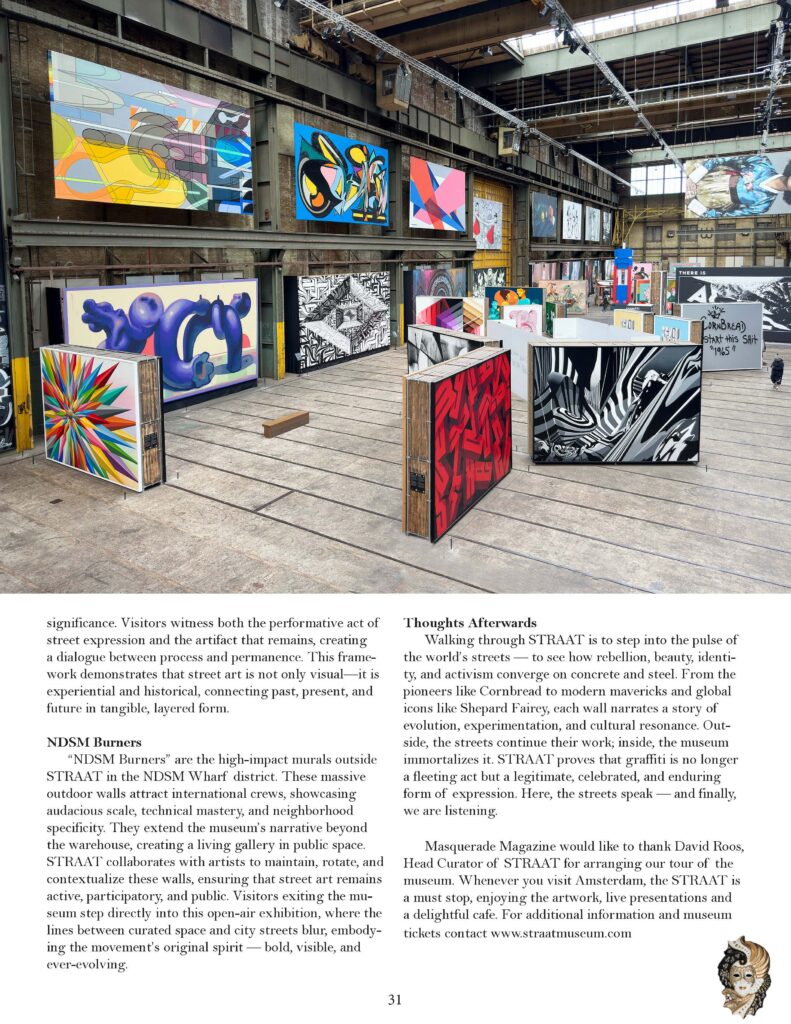
“NDSM Burners” are the high-impact murals outside STRAAT in the NDSM Wharf district. These massive outdoor walls attract international crews, showcasing audacious scale, technical mastery, and neighborhood specificity. They extend the museum’s narrative beyond the warehouse, creating a living gallery in public space. STRAAT collaborates with artists to maintain, rotate, and contextualize these walls, ensuring that street art remains active, participatory, and public. Visitors exiting the museum step directly into this open-air exhibition, where the lines between curated space and city streets blur, embodying the movement’s original spirit — bold, visible, and ever-evolving.
Thoughts Afterwards
Walking through STRAAT is to step into the pulse of the world’s streets — to see how rebellion, beauty, identity, and activism converge on concrete and steel. From the pioneers like Cornbread to modern mavericks and global icons like Shepard Fairey, each wall narrates a story of evolution, experimentation, and cultural resonance. Outside, the streets continue their work; inside, the museum immortalizes it. STRAAT proves that graffiti is no longer a fleeting act but a legitimate, celebrated, and enduring form of expression. Here, the streets speak — and finally, we are listening.
Masquerade Magazine would like to thank David Roos, Head Curator of STRAAT for arranging our tour of the museum. Whenever you visit Amsterdam, the STRAAT is a must stop, enjoying the artwork, live presentations and a delightful cafe. For additional information and museum tickets contact www.straatmuseum.com
