Story and Photography by Terry Check
The Soundtrack of a City
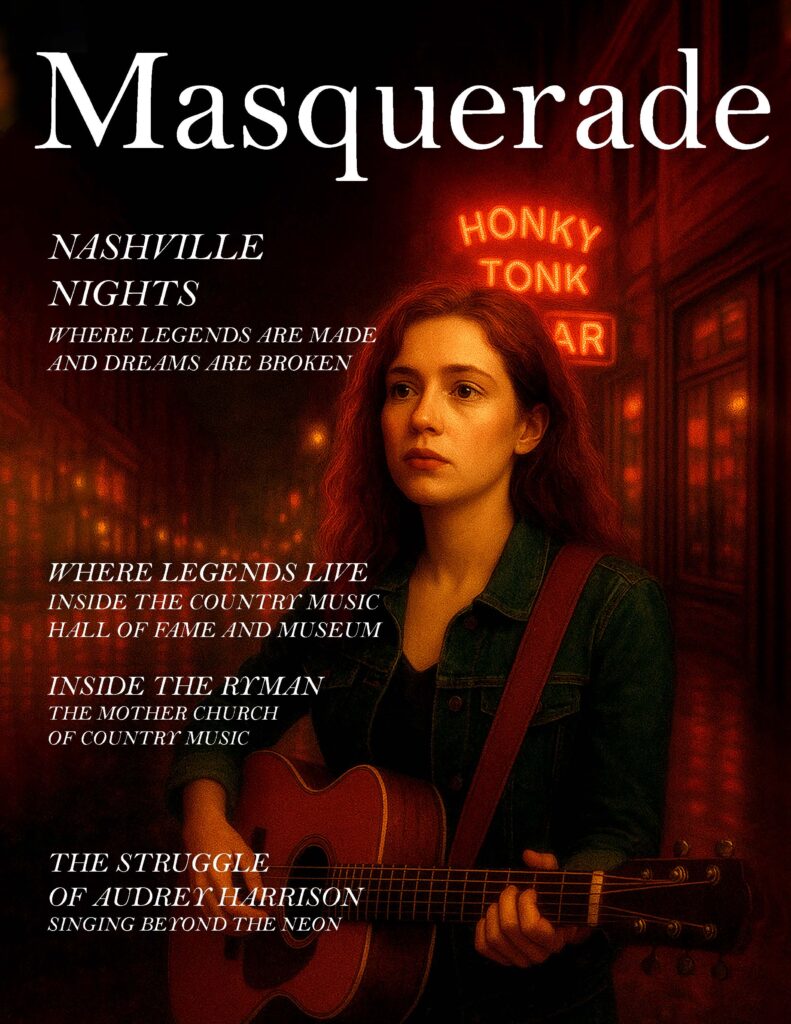
Step out onto Broadway in downtown Nashville on any given night, and the air itself seems to vibrate. Neon lights blaze in every direction, honky-tonks spill out laughter and music, and steel guitars slide above the thump of bass that rattles the sidewalk. Here, in the self-declared “Music City,” nearly every bar promises live music from dawn until the small hours of the morning. A visitor might think they’ve walked into a dream—a place where every corner produces a star-in-the-making, where Nashville’s tradition of breeding legends is alive and well.
But dig a little deeper into the alleys behind Broadway, into the quiet rehearsal rooms off Music Row, or even backstage at the Ryman Auditorium, and the truth reveals itself: for every legend that rises, there are hundreds, perhaps thousands, who never make it beyond the bar stage.
Nashville is a paradox, a city that both nurtures and devours talent.
Music Row: The Engine of a Dream
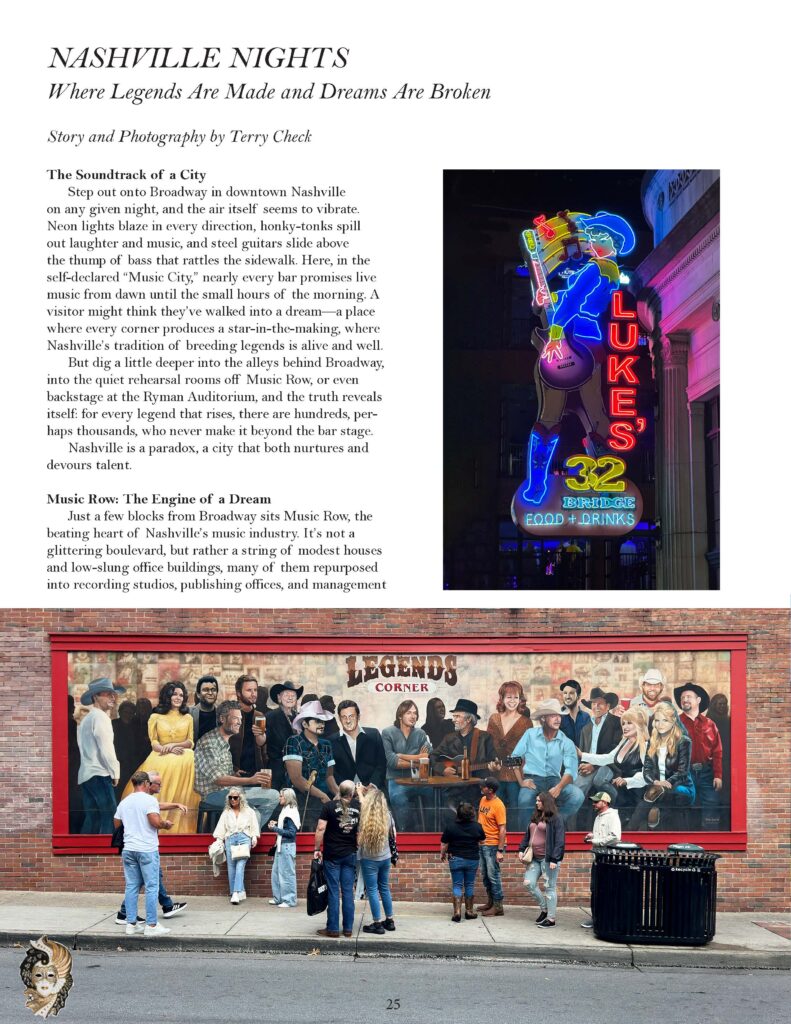
Just a few blocks from Broadway sits Music Row, the beating heart of Nashville’s music industry. It’s not a glittering boulevard, but rather a string of modest houses and low-slung office buildings, many of them repurposed into recording studios, publishing offices, and management companies. The Row has seen giants pass through its doors—Elvis Presley cut songs here, Dolly Parton once walked these sidewalks with a demo tape, and Garth Brooks pitched songs that would become arena anthems.
Music Row is where business meets art. Deals are made in small conference rooms that can launch a career—or quietly shelve one. Young artists line up for meetings with producers, hoping to capture lightning in a bottle. The truth, however, is stark: only a tiny fraction of the hopefuls who pour into Nashville ever land a record deal, and even fewer cross over into stardom.
The Cathedral of Country: The Ryman Auditorium
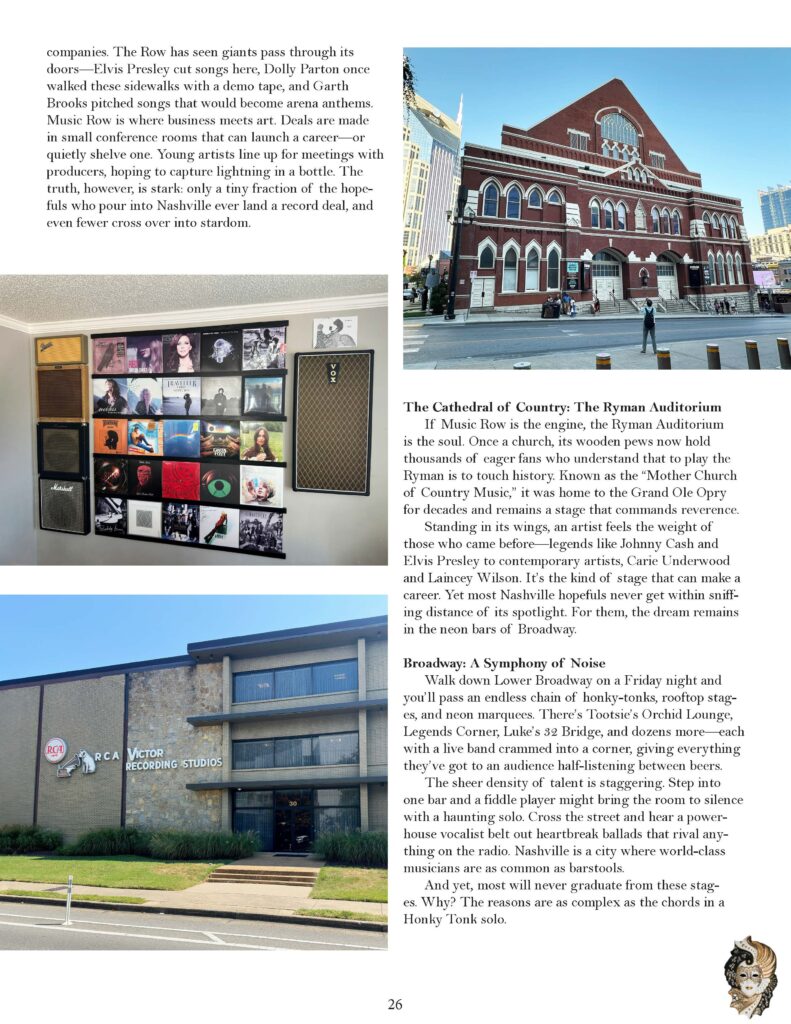
If Music Row is the engine, the Ryman Auditorium is the soul. Once a church, its wooden pews now hold thousands of eager fans who understand that to play the Ryman is to touch history. Known as the “Mother Church of Country Music,” it was home to the Grand Ole Opry for decades and remains a stage that commands reverence.
Standing in its wings, an artist feels the weight of those who came before—legends like Johnny Cash and Elvis Presley to contemporary artists, Carie Underwood and Lancey Wilson. It’s the kind of stage that can make a career. Yet most Nashville hopefuls never get within sniffing distance of its spotlight. For them, the dream remains in the neon bars of Broadway.
Broadway: A Symphony of Noise
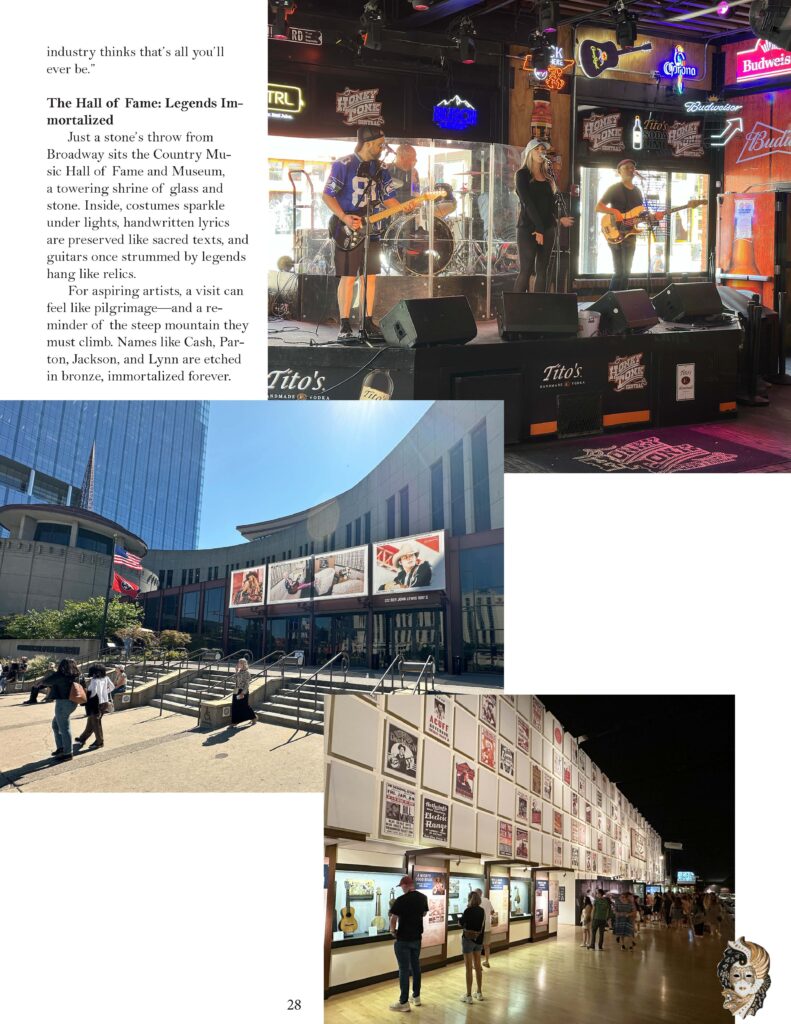
Walk down Lower Broadway on a Friday night and you’ll pass an endless chain of honky-tonks, rooftop stages, and neon marquees. There’s Tootsie’s Orchid Lounge, Legends Corner, Robert’s Western World, and dozens more—each with a live band crammed into a corner, giving everything they’ve got to an audience half-listening between beers.
The sheer density of talent is staggering. Step into one bar and a fiddle player might bring the room to silence with a haunting solo. Cross the street and hear a powerhouse vocalist belt out heartbreak ballads that rival anything on the radio. Nashville is a city where world-class musicians are as common as barstools.
And yet, most will never graduate from these stages. Why? The reasons are as complex as the chords in a Honky Tonk solo.
The Bar Ceiling
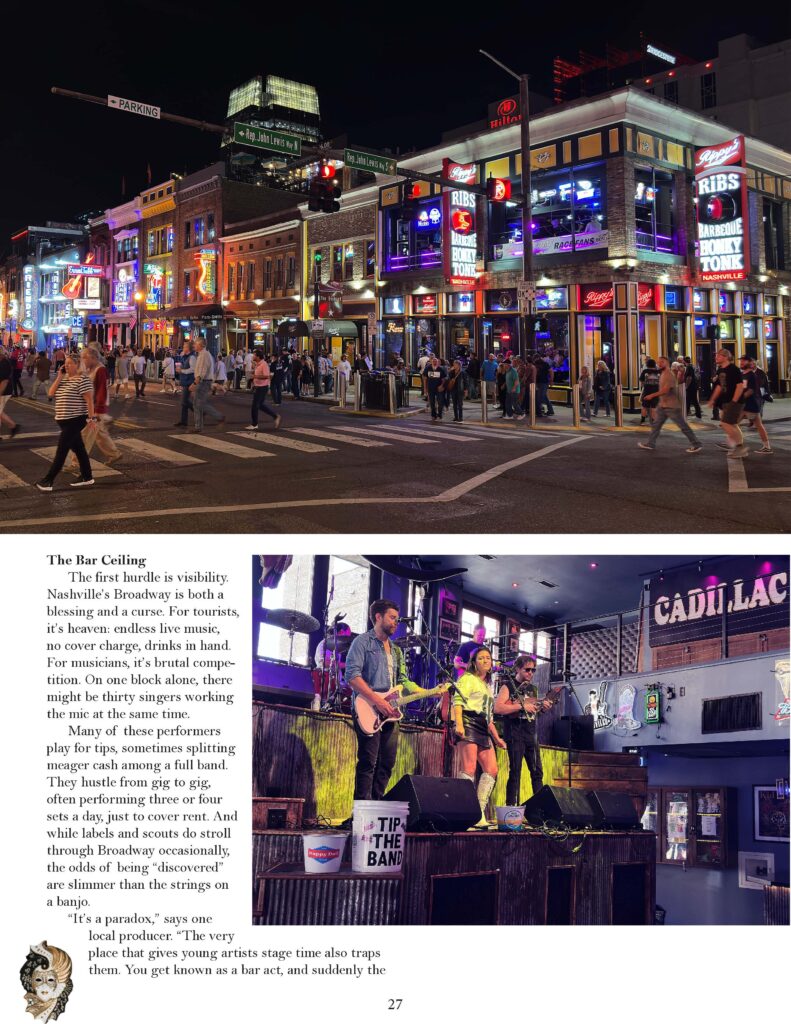
The first hurdle is visibility. Nashville’s Broadway is both a blessing and a curse. For tourists, it’s heaven: endless live music, no cover charge, drinks in hand. For musicians, it’s brutal competition. On one block alone, there might be thirty singers working the mic at the same time.
Many of these performers play for tips, sometimes splitting meager cash among a full band. They hustle from gig to gig, often performing three or four sets a day, just to cover rent. And while labels and scouts do stroll through Broadway occasionally, the odds of being “discovered” are slimmer than the strings on a banjo.
“It’s a paradox,” says one local producer. “The very place that gives young artists stage time also traps them. You get known as a bar act, and suddenly the industry thinks that’s all you’ll ever be.”
The Hall of Fame: Legends Immortalized
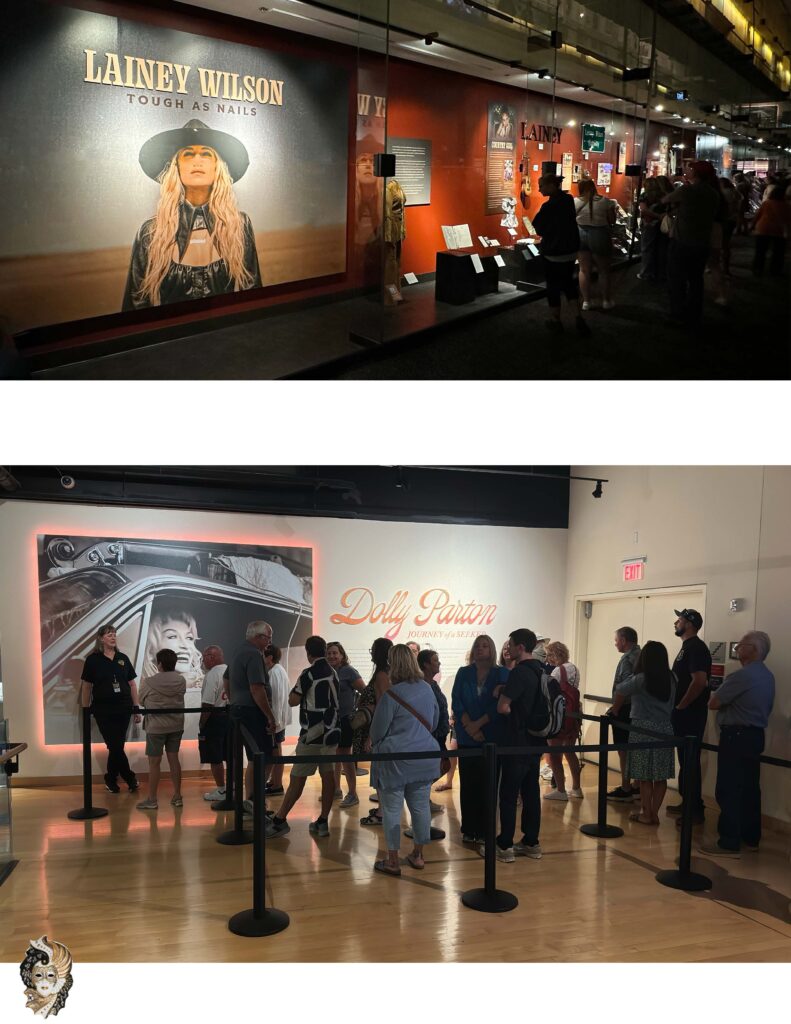
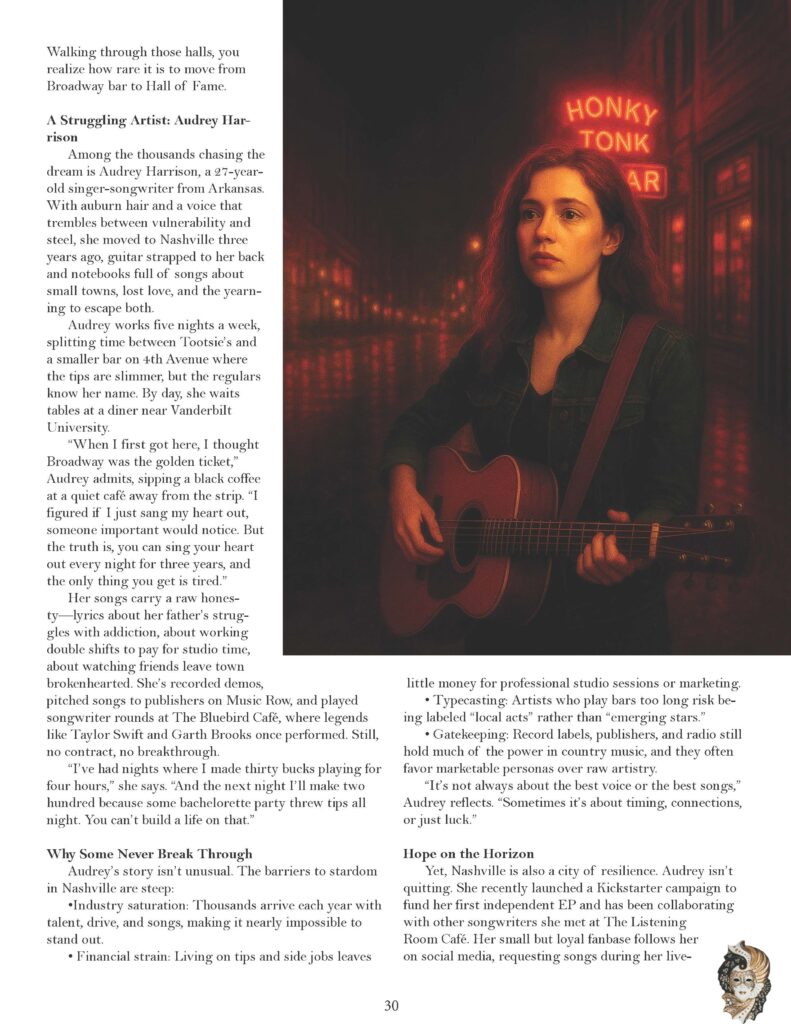
Just a stone’s throw from Broadway sits the Country Music Hall of Fame and Museum, a towering shrine of glass and stone. Inside, costumes sparkle under lights, handwritten lyrics are preserved like sacred texts, and guitars once strummed by legends hang like relics.
For aspiring artists, a visit can feel like pilgrimage—and a reminder of the steep mountain they must climb. Names like Cash, Parton, Nelson, and Lynn are etched in bronze, immortalized forever. Walking through those halls, you realize how rare it is to move from Broadway bar to Hall of Fame.
A Struggling Artist: Audrey Harrison
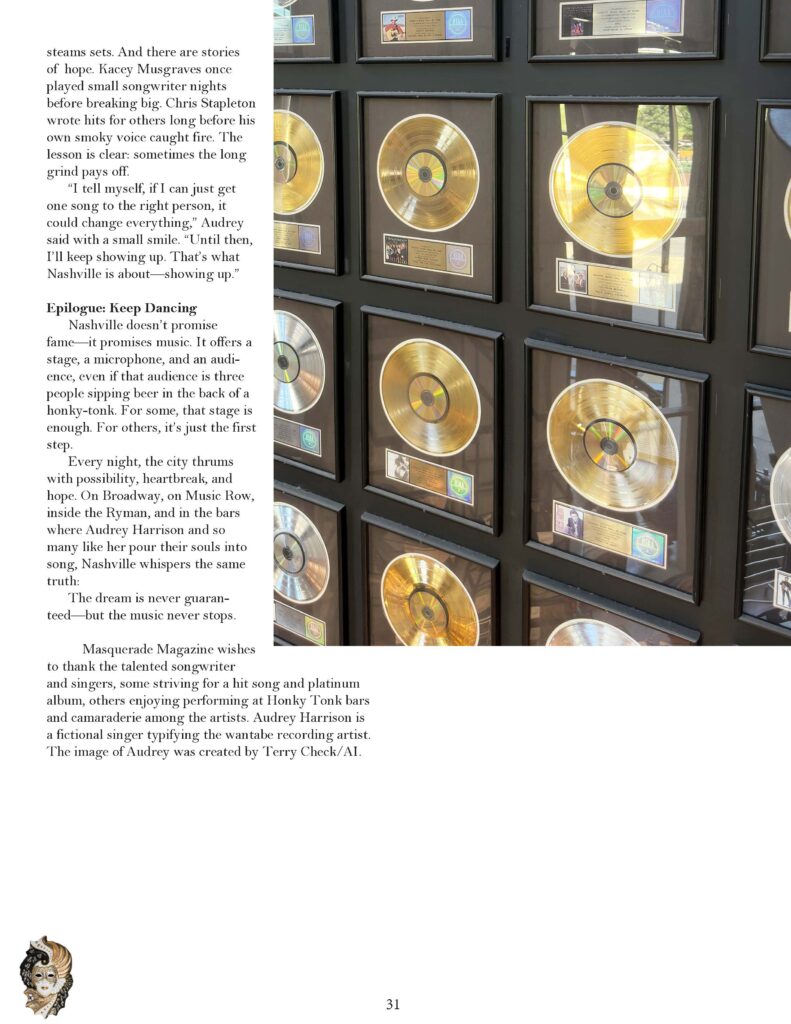
Among the thousands chasing the dream is Audrey Harrison, a 27-year-old singer-songwriter from Arkansas. With auburn hair and a voice that trembles between vulnerability and steel, she moved to Nashville three years ago, guitar strapped to her back and notebooks full of songs about small towns, lost love, and the yearning to escape both.
Audrey works five nights a week, splitting time between Tootsie’s and a smaller bar on 4th Avenue where the tips are slimmer, but the regulars know her name. By day, she waits tables at a diner near Vanderbilt University.
“When I first got here, I thought Broadway was the golden ticket,” Audrey admits, sipping a black coffee at a quiet café away from the strip. “I figured if I just sang my heart out, someone important would notice. But the truth is, you can sing your heart out every night for three years, and the only thing you get is tired.”
Her songs carry a raw honesty—lyrics about her father’s struggles with addiction, about working double shifts to pay for studio time, about watching friends leave town brokenhearted. She’s recorded demos, pitched songs to publishers on Music Row, and played songwriter rounds at The Bluebird Café, where legends like Taylor Swift and Garth Brooks once performed. Still, no contract, no breakthrough.
“I’ve had nights where I made thirty bucks playing for four hours,” she says. “And the next night I’ll make two hundred because some bachelorette party threw tips all night. You can’t build a life on that.”
Why Some Never Break Through
Audrey’s story isn’t unusual. The barriers to stardom in Nashville are steep:
“It’s not always about the best voice or the best songs,” Audrey reflects. “Sometimes it’s about timing, connections, or just luck.”
Hope on the Horizon
Yet, Nashville is also a city of resilience. Audrey isn’t quitting. She recently launched a Kickstarter campaign to fund her first independent EP and has been collaborating with other songwriters she met at The Listening Room Café. Her small but loyal fanbase follows her on social media, requesting songs during her live-stream sets.
And there are stories of hope. Kacey Musgraves once played small songwriter nights before breaking big. Chris Stapleton wrote hits for others long before his own smoky voice caught fire. The lesson is clear: sometimes the long grind pays off.
“I tell myself, if I can just get one song to the right person, it could change everything,” Audrey said with a small smile. “Until then, I’ll keep showing up. That’s what Nashville is about—showing up.”
Epilogue: Keep Dancing
Nashville doesn’t promise fame—it promises music. It offers a stage, a microphone, and an audience, even if that audience is three people sipping beer in the back of a honky-tonk. For some, that stage is enough. For others, it’s just the first step.
Every night, the city thrums with possibility, heartbreak, and hope. On Broadway, on Music Row, inside the Ryman, and in the bars where Audrey Hasrison and so many like her pour their souls into song, Nashville whispers the same truth:
The dream is never guaranteed—but the music never stops.
Masquerade Magazine wishes to thank the talented songwriter and singers, some striving for a hit song and platinum album, others enjoying performing at Honky Tonk bars and camaraderie among the artists. Audrey Harrison is a fictional singer typifying the wantabe recording artist. The image of Audrey was created by Terry Check/AI.
